
Guide / accounting boundaries
"Compatible with QuickBooks" — what the word actually promises
Compatible, integrates, works with: three claims wearing one word. How to decode them, the tests that matter, and BSimple's status stated plainly — no finished QuickBooks claim.
The key facts
- "Compatible" spans three realities: live sync, scheduled export/import, and "exports CSV you could import" — the word promises none of them specifically.
- The tests that decode it: one invoice end to end, payment status both ways, a supplier bill with a partial payment, and the failure behaviour when the connection drops.
- Which QuickBooks matters: Online and Desktop are different platforms with different ecosystems — check which your books actually live in.
- BSimple's status: the established handoff is Xero and MYOB; US accounting integrations are rolling out — no finished QuickBooks claim until general availability.
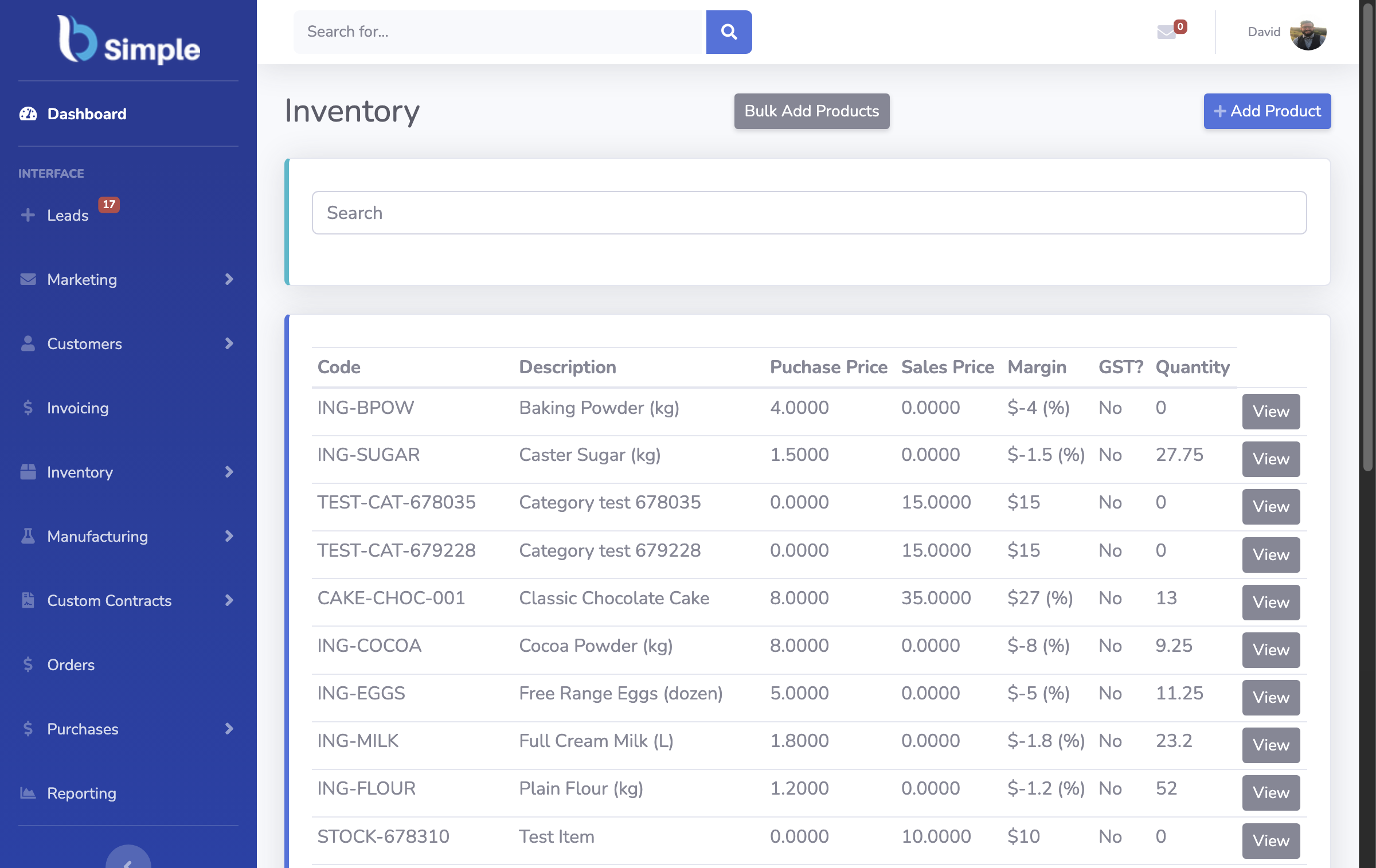
- The full picture: how the inventory record works is the hub page for everything above.
- 01The key facts
- 02Decoding "compatible"
- 03The four tests that decode any claim
- 04BSimple's status, stated plainly
Decoding "compatible"
"Compatible" via live sync. The real thing: approved invoices push to the books, payment status mirrors back, and the operational record stays the quantity master. This removes work; it is also the claim that demands proof.
"Compatible" via export/import. A scheduled CSV bridge — workable at small volumes, and honest if described as such. Its cost is the reconciliation habit: someone compares two systems on a schedule and fixes the gaps. The sync mechanics cover what the live version should deliver.
"Compatible" via file format. The weakest claim — the system can produce a file QuickBooks could theoretically import. Technically true of a spreadsheet; the word "compatible" is doing all the work in that sentence.
The vocabulary lesson generalises: compatibility claims describe transport, not outcomes. The outcomes are the four tests below — the works-with floor and the Online-specific angle frame them in full.
The four tests that decode any claim
- One invoice, end to end. Order to approval to the books, tax treatment intact, nothing retyped — watch it happen, do not accept the slide.
- Payment status, both directions. Paid and voided states travel from the books back to the operational record without a human courier.
- A supplier bill with a partial payment. Reconciliation is where compatibility honestly fails — part-paid, split and joined bills are the stress test.
- Failure behaviour. Connection drops mid-sync: retry with alert, or silent skip? The answer prices the trust you will place in the numbers.
Run all four during evaluation on your own products — the trial logic applies to any vendor making the claim, including the ones who decline the test.

BSimple's status, stated plainly
We build BSimple, so weigh that. Its accounting boundary is deliberate: the operational record — live multi-location quantities, batches, purchasing, order-to-invoice, customer portals — hands reviewed documents to the accounting system. Today that handoff is established with Xero and MYOB: invoice push after approval, payment-status mirroring, GST-inc/ex-GST purchase reconciliation, selective contact import. US accounting integrations are rolling out; until QuickBooks support is generally available, BSimple is not QuickBooks-compatible in the live-sync sense, and we will not dress an export in that word. The current status is one honest question away — ask us — and the trial demonstrates everything except the integration that does not exist yet.
Frequently Asked Questions
Is BSimple compatible with QuickBooks?
Not yet in the live-sync sense — the established handoff is Xero and MYOB, with US accounting integrations rolling out. We will not claim compatibility ahead of general availability; check the current status with us.
What does "compatible" usually mean in vendor marketing?
Anything from live sync to "exports a file". Ask which of the three transport levels applies, then demand the four tests above — the gap between the word and the tests is where reconciliation pain is born.
Is QuickBooks Online different from Desktop for compatibility?
Yes — different platforms, different APIs and ecosystems. A product genuinely synced with one may only export to the other; confirm which your books run and ask the vendor to be specific about that one.
Should quantities sync into QuickBooks?
Preferably no — the operational system owns quantities because it watches real movements; the books carry values. Two quantity masters adjusting each other is the classic drift engine.
If we must have QuickBooks today, what is the honest path?
Choose a tool whose QuickBooks sync passes the four tests — that is a legitimate buying decision. The buying-decision page frames it; if the record itself is the pain, the deliberate-boundary path remains open while US integrations land.
BSimple