Manufacturing Inventory Software with Recipe & Batch Tracking

Everything a small manufacturer needs to connect production to inventory — without the complexity or cost of a full ERP.

  • Recipe management with ingredient lists, quantities, wastage allowances, and version control
  • Production run automation — calculates ingredient requirements, checks stock availability, consumes raw materials, creates finished goods
  • Batch and lot tracking with unique batch codes and barcodes assigned to every production run
  • FIFO batch allocation when fulfilling customer invoices, with manual override available
  • Organic certification and mass balance tracking for certified ingredient workflows
  • Full chain traceability from supplier lot through production batch to customer invoice

Let’s face it — most small manufacturers aren’t running a factory with 200 employees and a seven-figure IT budget. They’re a coffee roaster managing three blends, a food producer making a range of sauces, a craft brewer running seasonal batches, or a cosmetics company blending formulations to order. What they need is something that connects what they make to what they have in stock and what they invoice — without six months of implementation and a consultant on site.

Spreadsheets work until they don’t. The moment you’re managing multiple recipes, multiple production runs in a week, and needing to trace which batch went to which customer, the spreadsheet becomes the problem rather than the solution. BSimple’s manufacturing module is purpose-built for businesses like this — small Australian manufacturers who need recipe consistency, batch traceability, and compliance records, but aren’t ready (and probably never will need) a full MRP or ERP platform.

Recipe Management

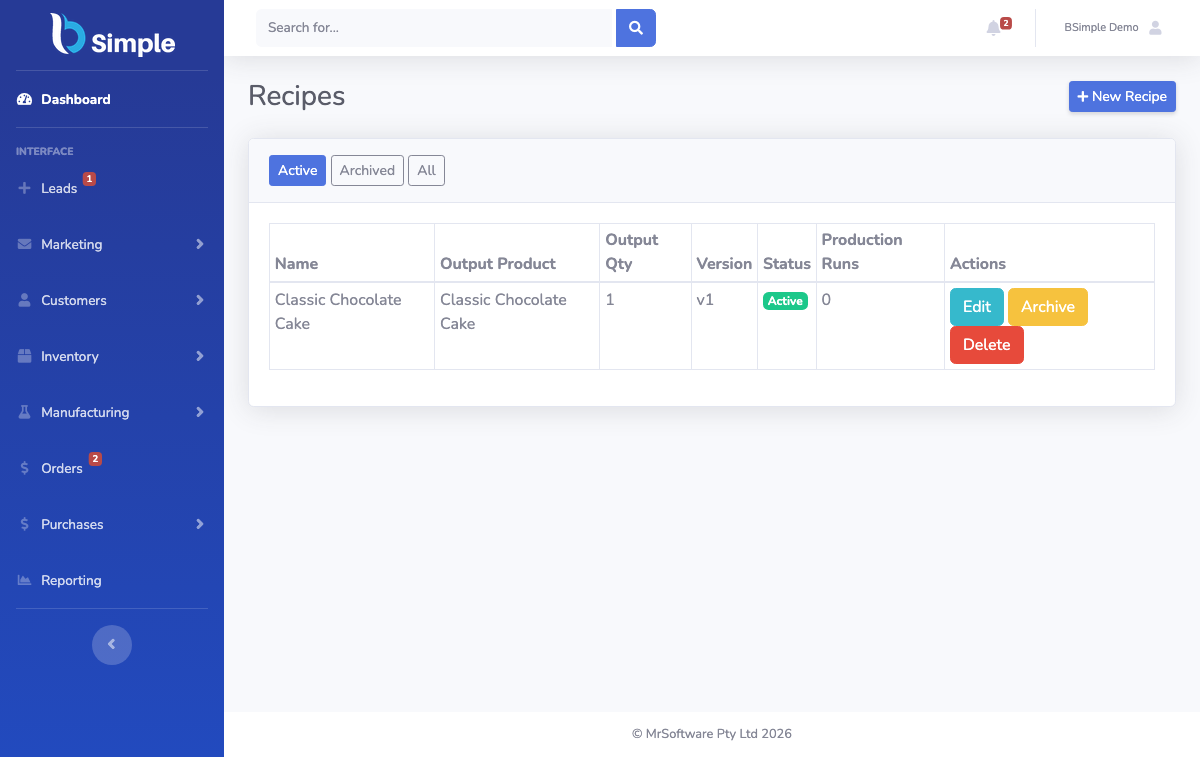
A recipe in BSimple is the foundation of your production process. You define the finished product, list every ingredient with its quantity and unit of measure, set your standard production yield, and add a wastage allowance for any ingredients where there’s normal process loss. Whether you’re making a 20kg batch of hot sauce, roasting a 60kg blend of coffee, or formulating a 200-litre drum of cleaning product, the recipe captures the exact input-to-output relationship for that product.

As your formulations evolve — new ingredient source, adjusted flavour profile, reformulation for certification — you can update recipes and version them. Old versions are archived, not deleted, which matters when you need to demonstrate what was produced six months ago for a compliance audit or customer query. BSimple keeps a clear record of which recipe version was active for each production run.

Recipes in BSimple also handle multi-level bills of materials for products where a sub-assembly or intermediate blend is itself an input to a finished product. If you want to see how recipe management fits into the broader platform, our recipe management software page has more detail.

Production Runs

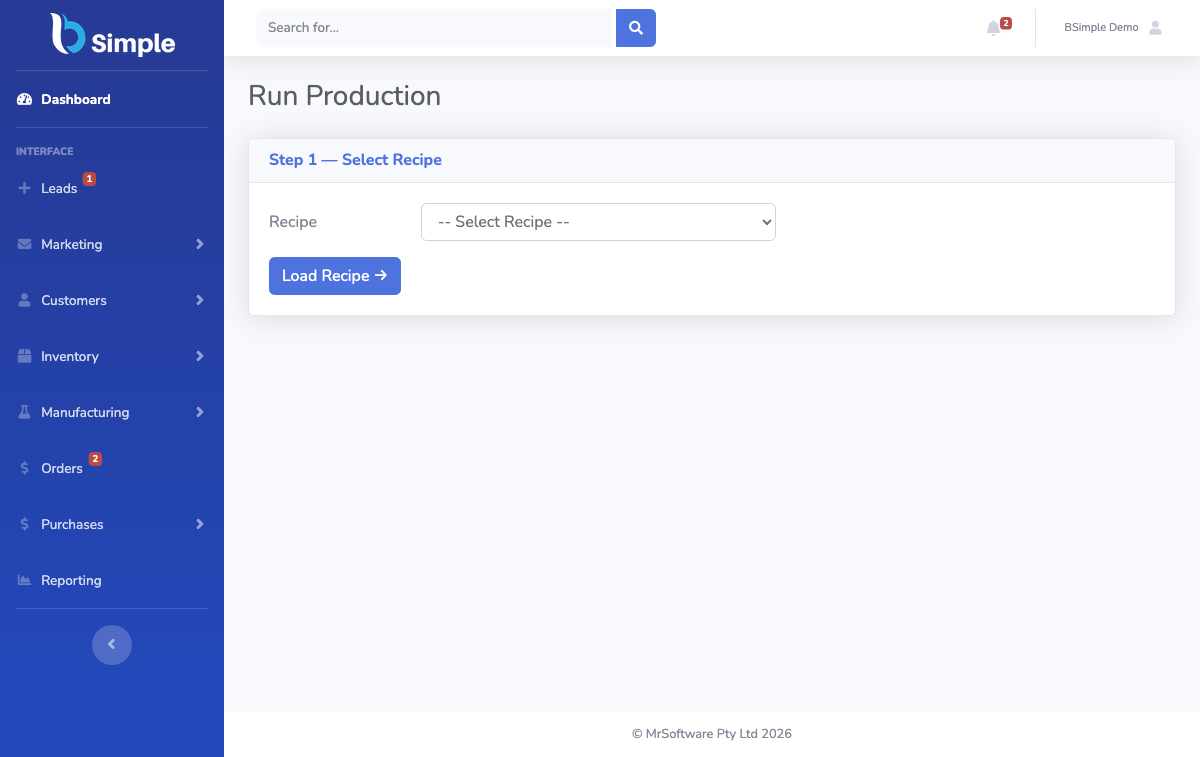
When you’re ready to manufacture, you initiate a production run in BSimple. Tell the system which recipe you’re running and the quantity you plan to produce. BSimple automatically calculates how much of each ingredient is required based on your recipe and your planned yield — including adjusted amounts for your wastage allowances. Before you commit, it checks current stock availability for every ingredient and warns you if anything is short. No more starting a production run and discovering halfway through that you’re out of a key input.

When you confirm the run, BSimple does the accounting: raw material inventory is consumed at the quantities calculated, finished goods inventory is created at the expected yield, and the production record is stored with the recipe version used, the date, and the quantities in and out. If you’re scaling — running a half-batch because you’re low on one ingredient, or doubling up to build safety stock — BSimple handles the proportional calculations for you.

For food manufacturers and producers managing expiry dates, finished goods batches can be assigned a best-before or expiry date at the time of production. That date travels with the batch through storage and into customer invoices. Our batch tracking software page explains how this integrates with the traceability system.

Batch and Lot Tracking

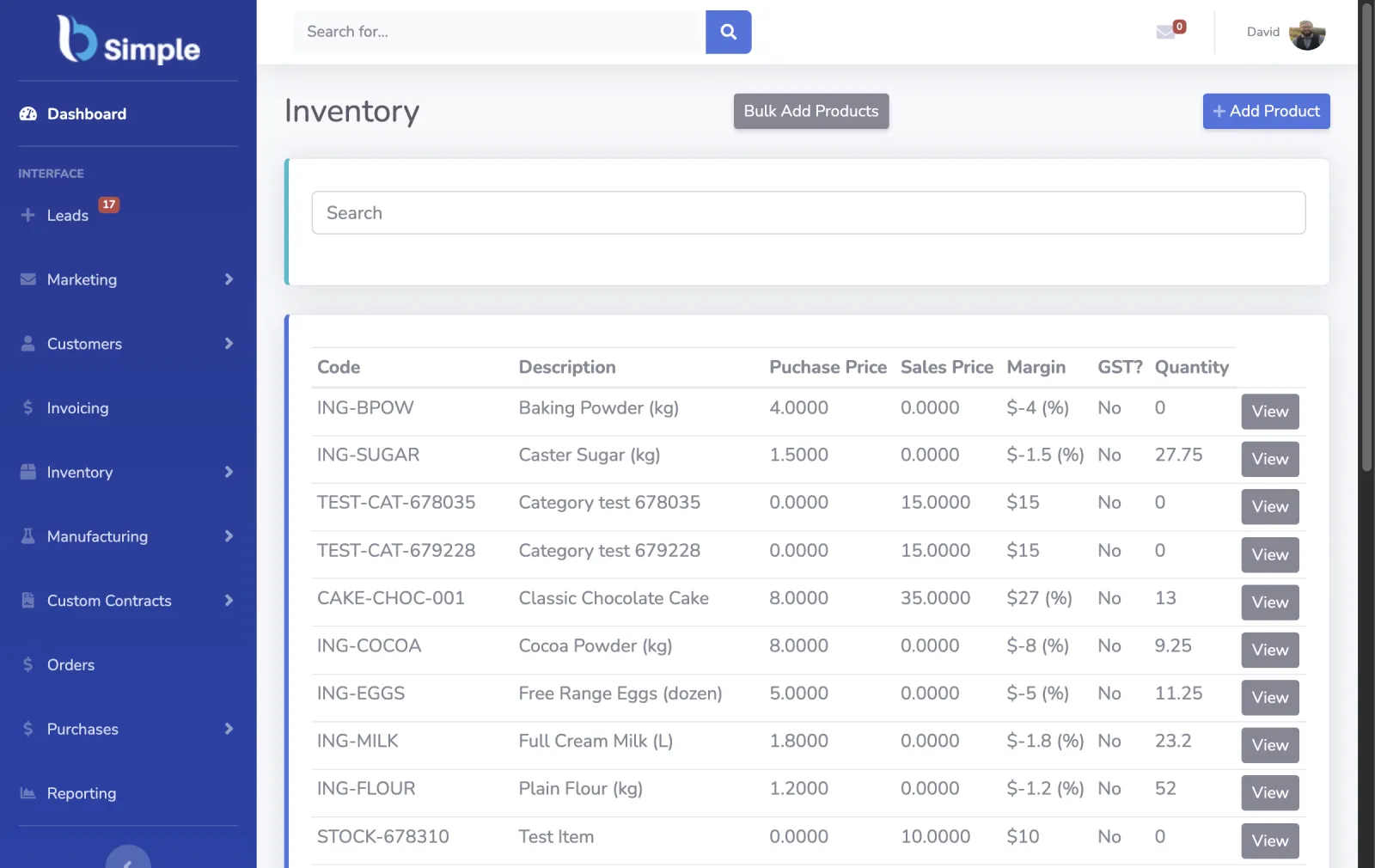
Every production run in BSimple generates a unique batch code and a barcode reference for that batch. From that point forward, BSimple tracks the complete chain: which supplier delivered the raw materials (including the supplier’s own lot or delivery reference), which production run consumed those materials, which finished goods batches were created from that run, and which customer invoices allocated stock from those batches.

That bidirectional traceability is the practical value here. If there’s a food safety issue — contaminated ingredient, quality defect, recall notice from a supplier — you can trace forward in seconds to see exactly which customer orders received affected batches. You can also trace backward from a quality complaint to identify the exact supplier lot and production run involved. What used to take days of manual record searching takes a few clicks.

FIFO batch allocation is the default when BSimple assigns batches to customer invoices — oldest stock ships first, which is standard practice for perishables and date-sensitive products. Manual override is available when you need to allocate a specific batch for a specific reason. At dispatch, your team scans the batch barcode to confirm the right batch is going to the right customer. For more on how barcoding integrates with this workflow, see our barcode inventory management page.

Organic Certification and Mass Balance

For businesses handling certified organic ingredients, eco-labelled formulations, or other compliance-tracked materials, BSimple includes certification tracking at the batch level. When certified stock arrives from a supplier, you mark that inventory batch as certified and record the certification reference. From that point, BSimple keeps certified and non-certified stock separate — they don’t get mixed in storage or in production runs unless you deliberately choose to blend them.

When you process a production run using certified inputs, BSimple tracks the certified inputs consumed versus the certified outputs created, accounting for wastage and process loss. This is the mass balance calculation that certification bodies like ACO require for organic certification audits — inputs in, waste and loss, certified outputs. BSimple can generate mass balance reports covering any date range, showing every certified batch received, every production run that consumed certified stock, and every finished goods batch created from certified inputs.

For coffee roasters with ACO or NASAA certification, food manufacturers with organic or biodynamic certification, and chemical blenders managing ingredient certification claims, this replaces the manual mass balance spreadsheets that tend to get unwieldy as volumes grow. If your business sells into organic or certified channels, explore our coffee roaster inventory management page for an industry-specific walkthrough.

Frequently Asked Questions

Does BSimple have a manufacturing module?

Yes. BSimple includes a manufacturing module that handles recipe management, production runs, and batch tracking. It’s designed for small to medium Australian manufacturers — food producers, beverage companies, coffee roasters, chemical blenders, cosmetics manufacturers, and similar businesses — who need production and inventory connected without the complexity of a full ERP. The module is available as part of the BSimple platform, not as a separate add-on.

Can BSimple handle HACCP traceability requirements?

BSimple’s batch and lot tracking provides the traceability records that underpin HACCP compliance — supplier lot references, production run records, finished goods batch codes, and customer invoice allocation. You can trace any finished goods batch back to its raw material supplier lots and forward to the customers who received it. While BSimple doesn’t generate HACCP plans, it provides the inventory and production traceability records that HACCP audits require.

How does batch tracking work in BSimple?

Every production run creates a unique batch code and barcode. BSimple records which supplier lots provided the raw materials, which ingredients were consumed, and which finished goods batches were created. When stock is allocated to customer orders, BSimple records which batch was assigned to which invoice. This creates a complete chain — supplier lot to production batch to customer invoice — that you can trace in either direction at any time.

Is BSimple suitable for food manufacturing?

Yes. BSimple is used by Australian food manufacturers, bakeries, sauce and condiment producers, coffee roasters, craft brewers, and similar businesses. The manufacturing module handles the specific requirements of food production: recipe management with wastage, production run records, batch tracking with expiry dates, FIFO batch allocation, supplier lot traceability, and organic certification mass balance. It integrates natively with Xero, so production flows directly into your accounts.

Can I track organic certification through BSimple?

Yes. BSimple’s certification tracking lets you mark incoming inventory batches as certified, keep certified and non-certified stock separate, and track certified inputs versus certified outputs through production runs. The system generates mass balance reports showing certified stock received, consumed in production, and produced as finished goods — the format that ACO, NASAA, and similar certification bodies require for compliance audits. It’s designed to replace the manual mass balance spreadsheets that most certified producers rely on.

How is BSimple different from a full ERP for manufacturing?

BSimple is deliberately not an ERP. It doesn’t require months of implementation, a consultant, or enterprise pricing. It handles the core manufacturing workflows that small Australian producers actually need — recipes, production runs, batch tracking, inventory, and Xero integration — without the modules, complexity, and overhead of systems built for much larger businesses. If you’re currently managing production in spreadsheets and invoicing in Xero, BSimple sits cleanly between those two things. Call us on 1300 980 598 to talk through whether it fits your operation.