
Guide / inputs, honestly
Raw material inventory: the free ladder, honestly
Raw materials are promises to the production plan — and the free versions cover the list, not the promises. Here is what free covers, and what the record needs when recipes enter.
The short answer
- The free rung: a spreadsheet of inputs — quantities, lots, expiry, costs — honest while one person maintains it.
- What breaks it: recipes consuming inputs, shortages surfacing mid-run, expiry discipline at volume.
- The paid record adds: bills of materials with shortage checks, traced batches, purchasing raised from the plan.
- BSimple includes recipes, runs and traced batches in every plan — from $180/month (AUD), free to trial.
- Where it fits: this page is one branch of the inventory management guide.
- 01The short answer
- 02What raw material stock demands
- 03Where BSimple fits
What raw material stock demands
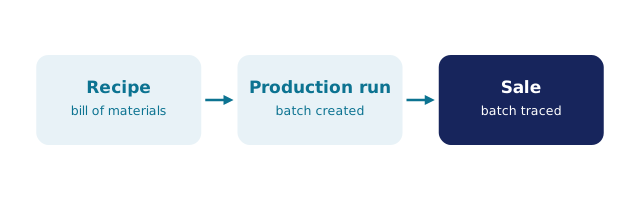
Raw materials are inventory with a downstream commitment: every unit exists to become something else. Three demands follow. Identity: lots and expiry dates on every receipt, because the batch you produce inherits the inputs it used — and audits, recalls and shelf-life questions all run backwards through them. Consumption discipline: the recipe decides what a run takes, and the record should move components down and finished goods up as one transaction — not as two manual journals that drift. Planning truth: shortage checks against live quantities before the run starts, because a missing input discovered mid-run is a production stop, not a data point.
The free spreadsheet covers the list honestly — quantities, lots, expiry, cost, one maintainer. It fails at the downstream commitment: the recipe arithmetic, the concurrency, the traceability chain, the purchasing signal that fires before the store room runs dry.
Where BSimple fits
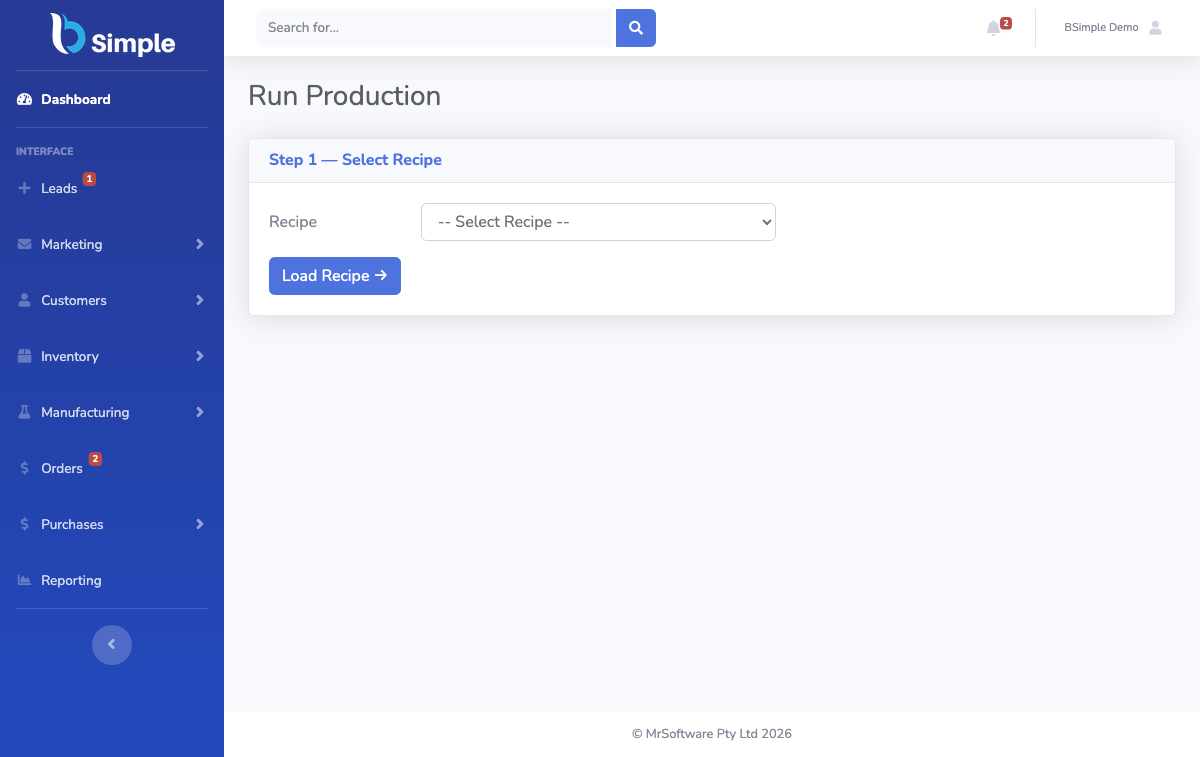
We build BSimple, so weigh that. For makers it holds the inputs on the same record as everything else: raw materials with lots and expiry dates; multi-level bills of materials with versioning; production runs with shortage checks producing traced batches with use-by dates; purchase orders raised from demand — including what the production plan will consume; counts from any phone browser; and the commercial loop — orders, portal, invoicing to Xero or MYOB — on the same record. Mass-balance reporting supports certified operations (ACO, NASAA and OFC are cited by existing customers). Plans start at $180/month (AUD), and the free trial runs one real input lot through to a traced batch sale.
The boundary: BSimple does not claim MRP scheduling or hazardous-materials compliance — the scheduling line is drawn in the manufacturing guide, the hazmat boundary in the chemical page. The BOM mechanics show how the inputs are consumed.
Frequently Asked Questions
Is there free raw material inventory software?
The spreadsheet, genuinely — while one person maintains it and no recipes consume it automatically. Free tiers of tools add polish with caps. The recipe-consumption, shortage-check and traceability layer is the paid product, everywhere in this market.
How does BSimple handle lot and expiry on inputs?
Receipts carry lot numbers and expiry dates; the record shows which lots are active, which expire first; and traceability search runs both directions — from a finished batch back to the raw lots, and from a suspect lot forward to every batch and customer.
Can we plan production against raw material availability?
Yes — shortage checks run at planning time: the proposed run shows what it will consume against live quantities, and missing inputs surface before production starts, becoming purchase orders rather than mid-run stops.
What should we trial with real raw materials?
One input lot end to end: receive it with its lot and expiry, run a recipe that consumes it, sell from the resulting batch, then trace backwards. If the chain reads clean on your own materials, the record fits — start here.

BSimple