
Guide / bills of materials
What a bill of materials does in inventory software
A BOM turns "we make products" into arithmetic the record can do: components out, finished goods in, every batch accounted for. Here is what to expect from software that has one.
The short answer
- A BOM is a recipe with consequences: build one unit of X and these components leave stock — the software performs that arithmetic.
- The capabilities that matter: multi-level bills (packs within batches within ingredients), versioning, shortage checks before the run, batches with identity.
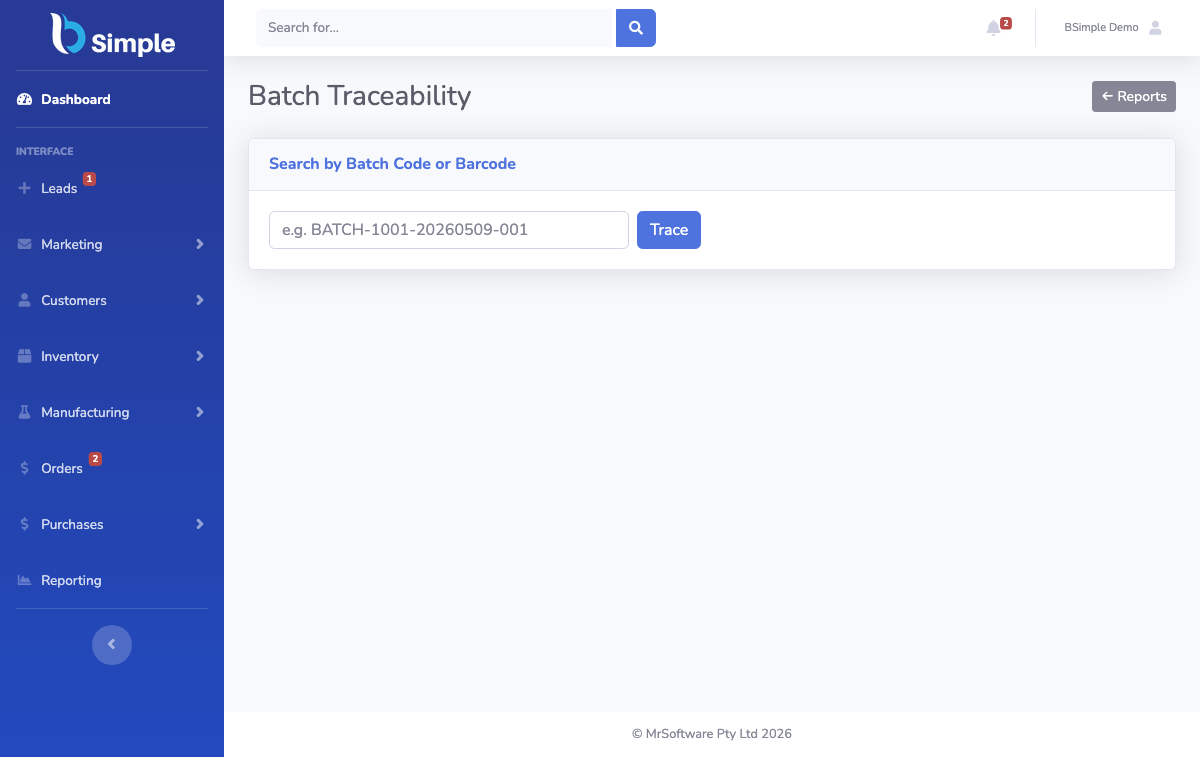
- The test: can a batch be traced from its ingredients to its customers, and back?
- BSimple includes multi-level BOMs, versioning and traced batches in every plan — from $180/month (AUD), no module cost.
- The full picture: how the inventory record works is the hub page for everything above.
- 01The short answer
- 02What the BOM actually does to the record
- 03What BOMs do not cover
- 04Where BSimple fits
What the BOM actually does to the record
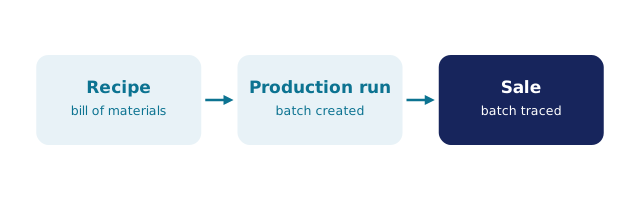
Without a BOM, production is a manual journal: someone subtracts components and adds finished goods, and the two sides drift. With one, a production run is a transaction: the bill defines what a run consumes and produces, the run checks live quantities for shortages before it starts, and completion moves both sides at once — components down, finished goods up, as batches with identity and, where relevant, use-by dates.
The capabilities separate toy from tool. Multi-level bills: a finished carton contains retail packs contain bulk ingredients — each level consumed and produced correctly, not flattened into one layer. Versioning: recipes change, and the change must not rewrite what past batches actually used — each batch carries the version that made it. Shortage checks: the run that fails at hour three because a component was short is a planning failure the software should have caught at planning time. Traceability: every batch knows its inputs and its destinations — searchable in both directions, which is what recalls, audits and customer questions demand.
What BOMs do not cover
A bill of materials is arithmetic, not scheduling. BOM software does not sequence work centres, plan capacity, or optimise labour — that is MRP territory, and the honest vendors say so. BSimple draws that line deliberately: bills, runs, shortage checks and traced batches are the record; scheduling is the ERP conversation that arrives when planning becomes someone's full-time job — the manufacturing growth line covers the boundary, and inventory software versus ERP draws it wider.
Where BSimple fits
We build BSimple, so weigh that. Its recipes are multi-level bills of materials with versioning; production runs carry shortage checks and produce batches with use-by dates; traceability search runs supplier-to-customer and back; and mass-balance reporting supports organic certification — ACO, NASAA and OFC are cited by existing customers. All of it sits on the same record as orders, the customer portal, purchasing and the accounting handoff to Xero or MYOB. Plans start at $180/month (AUD) with recipes included — no separate manufacturing module — and the free trial runs one real bill of materials end to end. Batch tracking software details the traced-batch layer.
Frequently Asked Questions
Does BSimple support multi-level bills of materials?
Yes — sub-recipes nest: finished goods contain intermediate products contain raw ingredients, and a production run consumes and produces at every level correctly. Versions preserve what each past batch actually used, so history survives recipe changes.
Can the software warn us before a run fails?
Yes — shortage checks run at planning time: the proposed run shows what it will consume against live quantities, and missing components surface before production starts. The check is only as good as the record, which is why receiving and counts matter as much as the bill itself.
Do BOMs handle co-products and by-products?
BSimple's production runs produce the outputs the recipe defines — for straightforward co-product needs, define each output in the bill. Complex co-product splitting and yield-optimisation modelling is beyond the scope, and an honest vendor keeps that line visible.
Is the BOM feature an add-on cost?
No — recipes, production runs, batches and traceability are included in every BSimple plan from $180/month (AUD). Software that charges a manufacturing module fee is telling you where its core market is; for BSimple, making what you sell is core, not an upsell.

BSimple