
Guide / manufacturing growth
Inventory software for manufacturing companies
Manufacturers run two stock ledgers at once: components in, finished goods out. Here is what software must hold as the company grows — and where it honestly stops.
The short answer
- The core: multi-level bills of materials with versioning, production runs with shortage checks, batches with use-by dates, two-way traceability.
- The commercial loop on the same record: orders, a customer portal, purchasing from demand, invoicing to Xero or MYOB.
- The growth line: scheduling and capacity planning are the ERP conversation; knowing your stock is the BSimple conversation.
- BSimple includes recipes, runs and batches in every plan — from $180/month (AUD), no module cost.
- Where it fits: the production layer's hub is manufacturing inventory software.
- 01The short answer
- 02The manufacturing stock loop
- 03As the company grows: the honest line
- 04Where BSimple fits
The manufacturing stock loop
A manufacturing company's inventory does two things at once. Components flow in: raw materials and packaging received against supplier purchase orders, held across stores, consumed by production. Finished goods flow out: created by production runs, held as batches with identities, sold against customer orders — often at customer-specific pricing through a portal. The software has to hold both ledgers as one record, because the moment components and finished goods live in separate lists, the company has two truths and a reconciliation job.
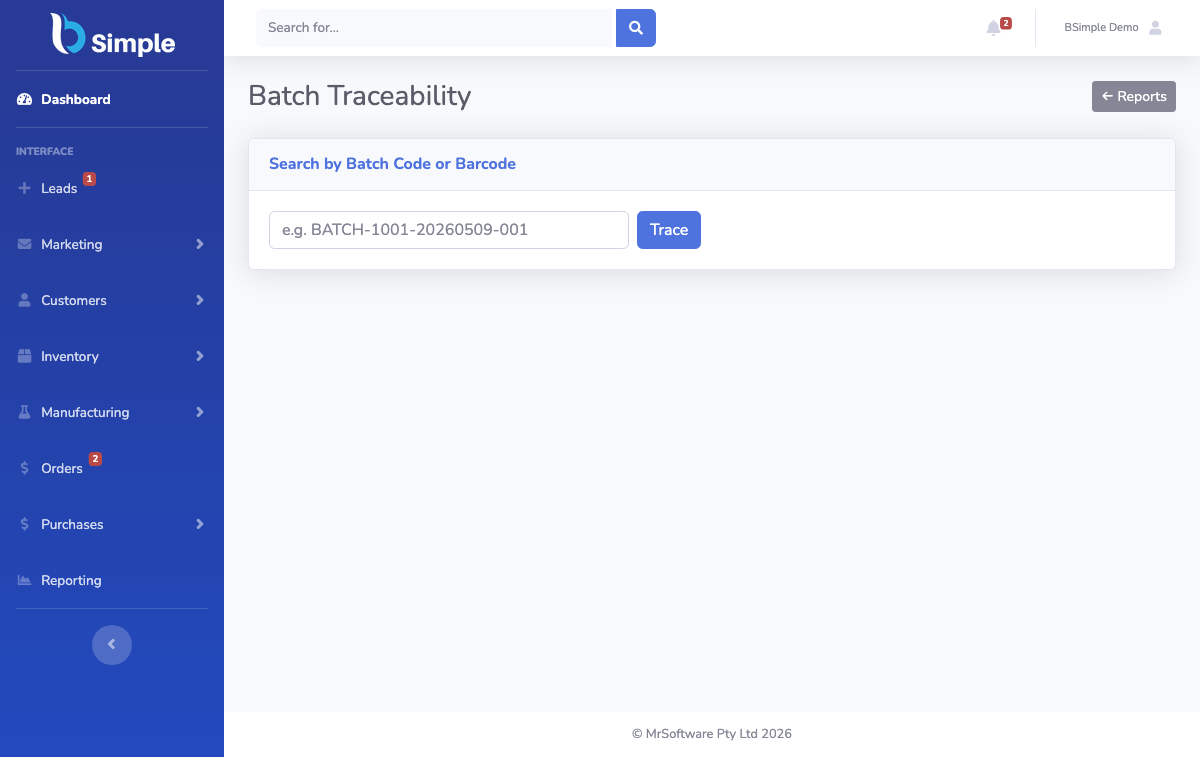
Three capabilities make the loop real. Multi-level bills of materials — a finished pack containing sub-assemblies containing ingredients — with versioning, so recipe changes never rewrite batch history. Production runs with shortage checks — the run shows what it consumes against live quantities before it starts. Traceability — every batch knows its inputs and its customers, searchable in both directions, which is what recalls and audits demand. Mass-balance reporting supports organic certification where it applies — BSimple's is used by businesses certified under ACO, NASAA and OFC.
As the company grows: the honest line
Growth adds people who plan rather than people who make, and that is where the ERP pitch lands: MRP scheduling, capacity planning across work centres, shop-floor data collection. Those are genuine capabilities for genuine scale — and buying them early models a factory that does not exist yet. The honest trigger is administrative: when planning is someone's job, the scheduling layer earns its cost. Before that, the constraint is truth — knowing what is in stock, what a run will consume, what a batch became.
BSimple deliberately covers the truth layer and stops before scheduling: no MRP, no capacity planning, no shop-floor hardware. For manufacturers below the scheduling line, that is the whole job; the small-manufacturer guide covers the early-stage pattern, and inventory software versus ERP draws the growth line in detail.
Where BSimple fits
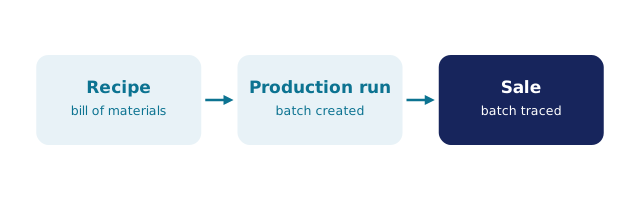
We build BSimple, so weigh that. For manufacturing companies it holds components, recipes, runs, batches and traceability on the same record as the commercial loop — orders with a customer ordering portal, purchasing from demand with supplier variance flags, invoicing handed to Xero or MYOB, stocktakes and counts from any phone browser. Recipes and production carry no separate module cost; plans start at $180/month (AUD), and the free trial runs one real recipe from bill of materials to traced batch sale. Batch tracking software details the traceability layer.
Frequently Asked Questions
Can BSimple run multi-level recipes?
Yes — bills of materials with sub-levels and versioning: finished goods contain sub-assemblies contain ingredients, and each version preserves what its batches actually used. Production runs consume components and create finished-goods batches on the same record orders read from.
Does it support recalls and audits?
Through traceability: batches carry their inputs and outputs, and search runs both directions — from a customer complaint back to the ingredient lot, from a suspect lot forward to every customer. Mass-balance reporting supports organic certification (ACO, NASAA and OFC are cited by existing customers).
We also sell direct and wholesale. Does that fit?
That mixed pattern is BSimple's home ground: counter or online sales (Shopify orders import via webhooks) at shelf pricing, trade customers ordering through their own portal at their own pricing — all writing to the same stock the production runs feed.
When does a manufacturer outgrow BSimple?
At the scheduling line: when capacity planning across work centres and planned orders become someone's full-time job, the ERP-with-MRP conversation is genuinely due. Until then, the true record — what is in stock, what a run consumes, what a batch became — is the part that pays for itself.
BSimple