
Industry / wholesale
The wholesale industry
"Wholesale" is a broad word for a specific pattern: buy in bulk, hold stock, sell repeat orders to trade customers on terms. What that pattern demands from software — and the onboarding work no vendor can skip — stated plainly.
The key facts
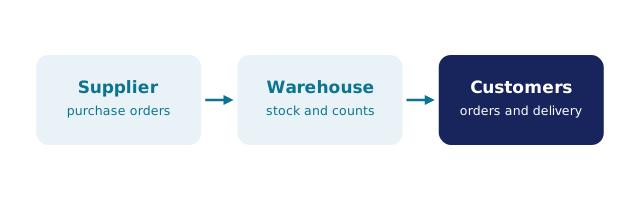
- The pattern: suppliers in, trade customers out — repeat orders, negotiated prices, credit terms, and a margin that lives or dies by the accuracy of the stock record.
- The core problem BSimple solves: the repeat-customer order flow — quick ordering through customer portals, pick and pack, invoiced correctly the first time.
- The cashflow tools: secure customer card storage (EWay, PCI DSS compliant equipment — card details never visible to staff) and scheduled payment collection on due dates.
- The honest onboarding: loading customers, inventory, product images and per-customer order lists is real work — no vendor can skip it, and the trial is where it starts.
- 01The key facts
- 02What wholesale businesses actually need
- 03The repeat-order flow, end to end
- 04Stocktakes and process: the human half
- 05Onboarding: the work no vendor can skip
What wholesale businesses actually need
The vertical is broad — ten SKUs or ten thousand, food, packaging, hardware, components — but the operational shape repeats. Repeat customers ordering the same list at negotiated prices: the biggest saving in most wholesale businesses is making that flow quick, accurate and self-service. Stock truth across locations: what is on hand, allocated, and inbound, live — because a promise made against last week's count is a credit note waiting to happen. Purchasing that reacts to demand: reorder levels raising purchase orders, supplier invoices matched against orders, price variances flagged. Invoices that reach the books without triple-handling the data.
Every one of those is a record-keeping problem before it is a software problem — which is why the inventory record is the foundation the industry's tools sit on, whatever else they add — bakery inventory software is one industry variant.
The repeat-order flow, end to end
The flow BSimple is built around: the customer orders through their private portal — their product list, their pricing, their link — or staff key the order once. Stock is allocated against live quantities, with reservations holding the promise. Pick and pack happens against the same record; discrepancies are corrected before approval, not after the invoice. On approval, the invoice is generated — quantities, pricing, tax codes — stock deducts, and the document lands in Xero or MYOB (US integrations rolling out) with payment status mirroring back.
The customer effectively creates the final invoice: no triple-handling of their order, no adjustments after approval. That is the core loop of wholesale, and the one worth testing hardest in any software evaluation — the cashflow half — scheduled collections against stored cards — extends it for businesses that sell on account.
Stocktakes and process: the human half
Software collects orders, but humans handle the stock — and the miscounts, misplacements and mistakes eventually show up as a record that disagrees with the shelves. That is not the software failing; it is the reason stocktakes exist. BSimple builds them in: walk the warehouse with a tablet, count live into the system, and let the variances become correction movements with reasons — so the record recovers and the pattern of drift becomes visible, rather than the count being a seasonal apology.
The same honesty applies to orders: the software collects them, and a sanity check before approval is process, not paranoia. Wholesale B2B tolerates neither the pure-automation fantasy nor the pure-manual habit; the tools work when the process does.
Onboarding: the work no vendor can skip
The unglamorous truth of moving a wholesale business to any new system is the loading: customer details (BSimple can import selectively from Xero), inventory (CSV export from the current system makes this easier), product images (no hack exists — it is a photo shoot), and the per-customer order lists that make the portals valuable (critical, and worth doing carefully). Anyone promising wholesale onboarding without this work is promising to skip the part that makes the system fit.
The upside after the loading: data entered once, orders flowing without triple handling, and time returned to the parts of the business that earn. We build BSimple, so weigh that — the trial is the full product, the onboarding starts with imports and a handful of test orders, and the wholesale pattern above is exactly what it was built to serve.

Frequently Asked Questions
What software do wholesale businesses need?
The record layer — live inventory across locations, orders with fulfilment states, purchasing from demand — plus the trade specifics: per-customer pricing, portals, credit terms and the accounting handoff. Reporting and extras sit on top of that base.
How does BSimple handle repeat wholesale orders?
Each customer gets a portal with their own products and pricing; reorders take minutes, arrive structured into the same record the warehouse picks from, and approve into invoices that are correct the first time — stock deducting only at approval.
Can customers pay by card on account?
Yes — card details are stored by EWay on PCI DSS compliant equipment (never visible to staff or on screen), and payment collection can be scheduled against due dates, which is how the cashflow half of wholesale terms gets automated.
How long does onboarding take?
Honestly: as long as the data takes. Imports cover customers (from Xero) and inventory (CSV); images and per-customer order lists are manual. The trial starts the process with no commitment — the loading doubles as the evaluation.
What does BSimple cost for a wholesale business?
$180/$250/$399 AUD monthly with every feature in the core plans — no module paywalls. The trial is the full product, and the contact page is where questions about a specific operation get answered.
BSimple