
Guide / small-batch production
Inventory software for small manufacturers
Making what you sell adds a second stock problem: components in, finished goods out, batches between. Here is what software must cover — without ERP cost.
The short answer
- Manufacturing stock runs two directions: components consumed, finished goods created — the software must do both on one record.
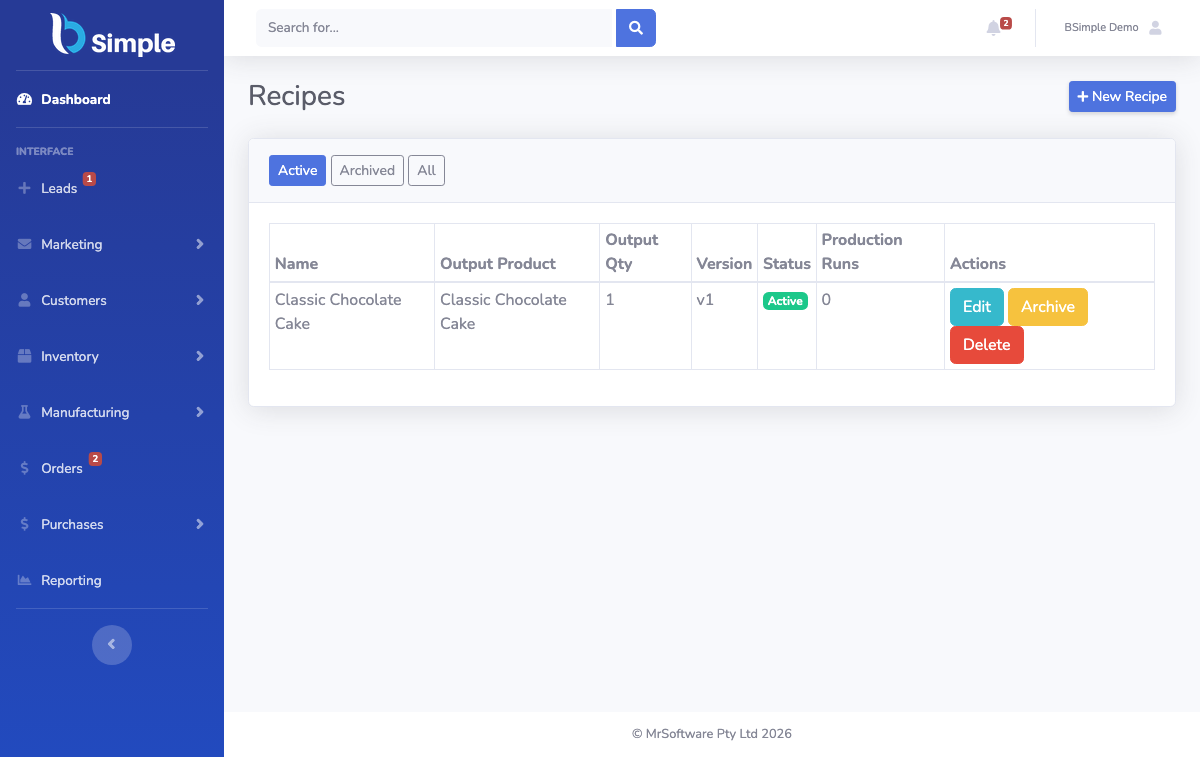
- The needs: multi-level recipes (bills of materials), production runs with shortage checks, batches with use-by dates, traceability.
- Small manufacturers do not need MRP scheduling — they need the record to be true; scheduling software comes later, if ever.
- BSimple includes recipes, runs and batch tracking in every plan — from $180/month (AUD), no module cost.
- The wider guide: the manufacturing inventory guide maps the production record end to end.
- 01The short answer
- 02What manufacturing adds to inventory
- 03What a small manufacturer does not need yet
- 04Where BSimple fits
What manufacturing adds to inventory
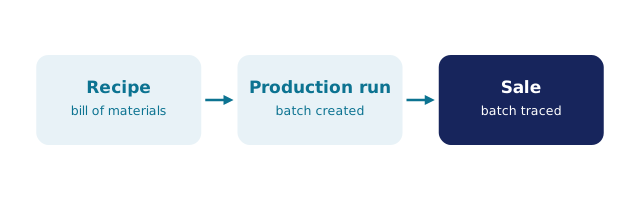
A trader receives and sells the same SKU; a manufacturer receives one set of SKUs and sells a different set, joined by a recipe. The software must hold multi-level bills of materials — a finished pack containing sub-assemblies containing ingredients — with versioning, because recipes change and the change must not rewrite history. Production runs convert components to finished goods with a shortage check before the run starts, not after it fails. Batches give the output identity: which run, which inputs, which use-by date. Traceability closes the loop in both directions — from a customer complaint back to the ingredient lot, from a bad lot forward to every customer who received it.
That set is the difference between an inventory list and manufacturing software. It is also the set auditors ask about: mass-balance reporting supports organic certification — BSimple's mass-balance reporting is used by businesses certified under ACO, NASAA and OFC.
What a small manufacturer does not need yet
The ERP pitch to small manufacturers is MRP scheduling: planned orders, capacity planning, shop-floor terminals. At small scale, scheduling software models a factory that does not exist yet — the owner is the scheduler, and the binding constraint is knowing what is in stock and what a run will consume. The honest sequence: first the true record (recipes, runs, batches), then, when volume justifies people who plan rather than people who make, the scheduling layer — usually as part of a bigger ERP conversation, drawn honestly here.
BSimple deliberately stops before MRP: no production scheduling, no capacity planning, no shop-floor hardware. What it claims is the record — and for most small manufacturers, that record is the thing currently living in a spreadsheet with a recipe tab.
Where BSimple fits
We build BSimple, so weigh that. For small manufacturers it holds the whole loop on one record: ingredients and components with live quantities, recipes with versioning and multi-level bills of materials, production runs with shortage checks creating batches with use-by dates, traceability search in both directions, and the commercial side — orders, a customer ordering portal, purchasing from demand, invoicing to Xero or MYOB — on the same record. Recipes and production carry no separate module cost; plans start at $180/month (AUD), and the free trial runs one real recipe end to end.
For the free end of the market, the manufacturing free-software guide assesses the no-licence options honestly; batch tracking software details the traceability layer.
Frequently Asked Questions
Does BSimple handle bills of materials?
Yes — multi-level bills of materials with recipe versioning: a finished good can contain sub-recipes containing ingredients, and versions preserve what a past batch actually used. Production runs consume components and create finished-goods batches on the same record the orders run against.
Can it check we have enough ingredients before a run?
Yes — shortage checks run before production starts: the run shows what it will consume against live quantities, so a missing component surfaces at planning time. That check is only as good as the record behind it, which is why receiving and counts matter as much as the recipe.
Is BSimple suitable for food manufacturing?
That is one of its home industries: batches carry use-by dates, traceability search runs supplier-to-customer and back, and mass-balance reporting supports organic certification under ACO, NASAA and OFC — cited by existing customers. Allergen and nutrition-labelling work stays with your compliance process.
When do we outgrow BSimple for manufacturing?
When scheduling, not knowing, becomes the constraint: capacity planning across work centres, planned orders, shop-floor data collection. That is ERP-and-MRP territory, and the honest trigger is dedicated planning staff. Until then, the true record — recipes, runs, batches — is the part that pays.

BSimple