
Guide / definitions
Enterprise management system — the meaning, and the weight it implies
An EMS is not "big software" as a compliment: it is an integrated record built for multi-entity, multi-site, compliance-heavy scale. What it means, and whether your business needs the weight.
The key facts
- The meaning: an integrated system holding finance, supply chain, manufacturing, HR and more as one record across an enterprise.
- "Enterprise" is a weight claim: multi-entity structures, deep configuration, implementations measured in quarters — not a quality grade.
- The honest question is never "is it good?" but "is it our weight?" — most businesses never need it; the ERP comparison unpacks the trade.
- BSimple sits below the weight deliberately: the operations record for SMB wholesale/manufacturing, integrating with heavier systems rather than replacing them.
- Where it fits: this page is one branch of the inventory management guide.
- 01The key facts
- 02The meaning, precisely
- 03Who actually needs that weight
- 04Where BSimple sits relative to the meaning
The meaning, precisely
An enterprise management system integrates the organisation's core records into one backbone: finance, supply chain and procurement, manufacturing and inventory, HR, and often sales — sharing one data model so a transaction in one function is immediately visible to the others. ERP is the near-synonym most people know; "EMS" is the same idea stated more broadly. The definitional work is in integrated: the promise is not many modules but one record — a sale in Brisbane changes available stock, receivables and production planning everywhere at once.
The second half of the meaning is the weight it assumes: multi-entity structures, consolidated reporting across jurisdictions, configuration projects measured in quarters, and organisational change management. The layers beneath enterprise systems and the worked examples map what that includes in practice.
Who actually needs that weight
The honest test is structural, not aspirational: multi-entity or multi-country operations needing consolidated records; planning complexity (MRP-scale production scheduling, cross-site supply optimisation) that outgrows operational records; regulatory consolidation demanding one audited backbone. Businesses with those needs know who they are, and for them an EMS is the right answer despite the cost.
Businesses without them — including most wholesalers, manufacturers and distributors under a few hundred people — are better served by an operations record done deeply: live quantities, purchasing discipline, order-to-invoice, with accounting in a real accounting platform. The failure mode is buying the weight and running it shallow: modules half-used, quantities nobody trusts, and an integration bill for the privilege. The who-needs-it signals apply the same honesty to lighter systems.
Where BSimple sits relative to the meaning
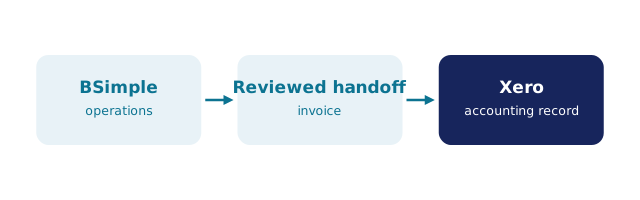
We build BSimple, so weigh that: BSimple is not an enterprise management system, by design. It runs the operations record — live multi-location inventory, multi-level stock and batches, purchasing from demand, order-to-invoice, customer portals, production with recipes and traceability — for wholesale, manufacturing, distribution and trade businesses at SMB weight. Accounting stays with Xero or MYOB (US integrations rolling out); a public REST API keeps the record readable by any larger system a parent group runs. Plans are $180/$250/$399 per month AUD with the trial as the full product. The EMS-definition companion covers the vocabulary from the other side.
Frequently Asked Questions
What does enterprise management system mean?
An integrated system holding an enterprise's core records — finance, supply chain, manufacturing, HR — as one backbone, so every function works from the same data. "Enterprise" signals the weight: multi-entity scale, deep configuration, long implementations.
Is EMS the same as ERP?
Effectively yes in common usage — ERP is the established term for the same integrated-backbone concept. Vendors vary the labels; the definitional test is whether the organisation ends up with one record or several.
Does a 50-person business need an EMS?
Usually no — the structural triggers (multi-entity consolidation, MRP-scale planning, cross-jurisdiction compliance) are absent. A deep operations record plus a proper accounting platform covers most businesses that size, at a fraction of the weight.
Is BSimple an EMS?
No — deliberately lighter: no HR, no MRP, no consolidation. It runs the operations record deeply and integrates upward (via API and standard exports) rather than pretending to the enterprise bundle.
How do we decide our weight class?
Count the structural triggers honestly: entities, jurisdictions, planning complexity. Zero or one? Operations-record territory. Several? Enterprise evaluation — and the trial is how the lighter side of that decision gets measured on your products.

BSimple