
Guide / definitions
Enterprise management software, defined
Enterprise management software is the ERP-class layer built for organisations with administrators, implementation budgets and compliance spanning departments. Here is the definition, the contrast with small-business software — and where BSimple deliberately sits.
The key facts
- The definition in one line: integrated suites that run a large organisation's resources — finance, inventory, manufacturing, HR, planning — on one governed system.
- The tell-tale features: MRP scheduling, multi-entity consolidation, deep customisation, and administrators as a role.
- The costs beneath the licence: implementations in months, configuration discipline, and change management as a permanent function.
- BSimple's position: below that tier on purpose — operations software for stock-carrying SMBs, with the accounting handoff instead of the suite.
- The wider system: inventory management end to end maps the whole record this page sits in.
A definition that actually holds
Enterprise management software — in practice, the ERP class of systems — is defined less by features than by the organisation it assumes. It integrates the resource flows of a whole enterprise: financials, inventory and warehouses, manufacturing and planning, procurement, workforce. It assumes dedicated administration: people whose job is the system's configuration, upgrades and governance. It assumes integration debt exists to be managed — dozens of adjacent systems connected through interfaces. And it prices and implements accordingly: projects measured in months or years, partners and consultants, licences and maintenance negotiated at organisational scale.
The defining features follow from those assumptions: MRP-style production scheduling across capacity constraints; multi-entity consolidation for groups and subsidiaries; customisation deep enough to reshape workflows; audit and compliance machinery spanning departments. A product with none of those demands is not enterprise software, whatever its pricing page implies.
- 01The key facts
- 02A definition that actually holds
- 03The contrast with small-business management software
- 04Where BSimple sits — and the honest test
The contrast with small-business management software
SMB business management software makes the opposite trade: depth in the operations that stock-carrying businesses repeat daily, and no ambition to swallow the rest. The record it holds — quantities across locations, orders, purchasing, invoicing — is the same kind of record an ERP contains, but it is designed to be run by the team that uses it, configured in days, and paid for monthly. Accounting stays in the accounting system rather than inside the suite, connected by a deliberate handoff; HR and payroll stay out entirely. The honest consequence is a ceiling: when the organisation needs enterprise machinery, the SMB tool should lose the deal to an ERP, not stretch to fake it.
Business management software, the SMB category defines that layer fully, inventory software versus ERP draws the line in operational terms, and enterprise inventory software covers the tier's inventory face specifically.
Where BSimple sits — and the honest test
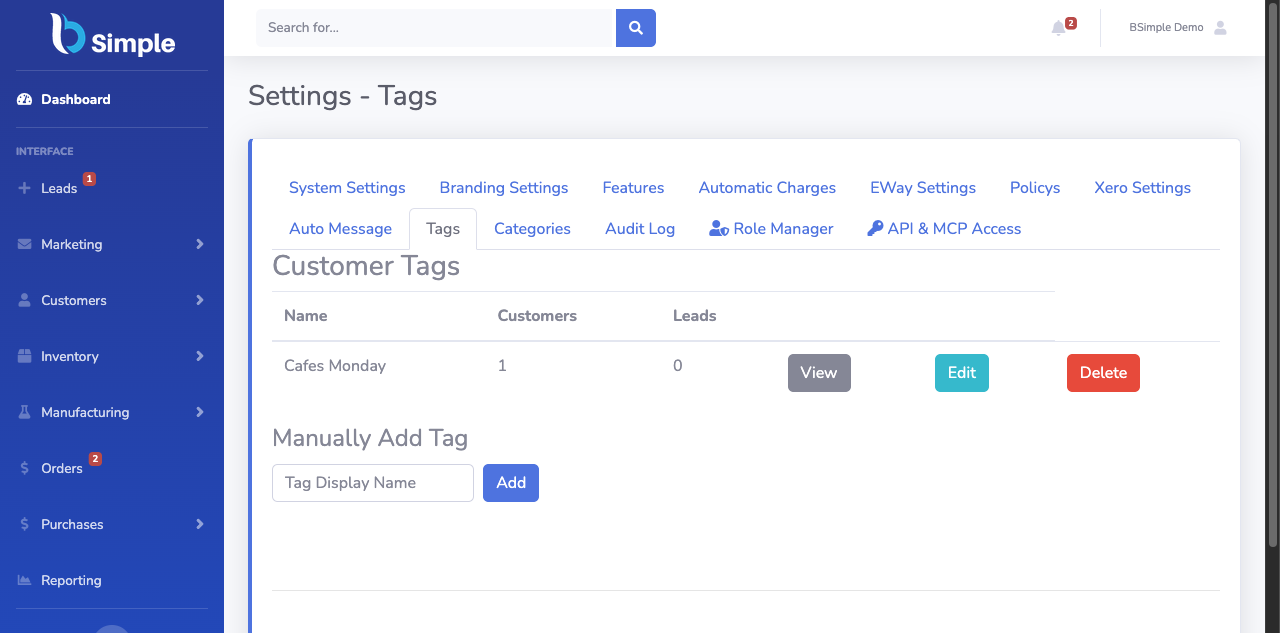
We build BSimple, so weigh that: it sits deliberately below the enterprise tier. It is operations software for wholesale, manufacturing, distribution and trade businesses — one record of inventory, orders, purchasing and invoicing, with multi-level stock, batch and expiry tracking, recipes and production runs, the customer portal, and the accounting handoff to Xero or MYOB (US accounting integrations rolling out). From $180/month AUD, every feature in the core plans, no implementation project between signing and working. It has no MRP scheduling, no multi-entity consolidation, no HR — the enterprise tells, stated rather than blurred.
The test that assigns you a side: name the triggers. If your pain is an untrusted record and daily friction, run the trial on your products — an untrusted record is not solved by a larger system. If your pain is planning and governance across departments, shop the ERP tier seriously; the mid-point case, Odoo is where modular suites begin.
Frequently Asked Questions
What is enterprise management software in simple terms?
The large-organisation tier of business systems — ERP-class suites that run finance, inventory, manufacturing, planning and workforce on one governed platform, implemented as projects and administered as a function.
Is BSimple enterprise management software?
No, deliberately. BSimple is SMB operations software: one deep record of stock, orders, purchasing and invoicing, run by the team that uses it. The enterprise machinery — MRP, consolidation, deep customisation — is outside it by design.
Can a mid-sized business skip straight to enterprise software?
If the triggers are real — scheduling, consolidation, departmental governance — yes, and it is worth doing properly. If the pain is a spreadsheet nobody trusts, an ERP implements that problem at higher cost. Fix the record first.
What is the difference between ERP and business management software?
Scope and overhead. ERP bundles the whole organisation and prices the governance that requires; SMB business management software goes deep on operations and leaves accounting, HR and planning to dedicated tools.
How do we know which side we are on?
Run the trial on your real products. If the record holds your week truthfully, your needs were operational. The gaps you find afterwards — named, written down — are the requirement list for the enterprise aisle.
BSimple