
Guide / tiers without the tier tax
Enterprise software for inventory management
"Enterprise" is a budget line, not a feature — the question is whether your operation needs what the tier actually adds: MRP scheduling, deep customisation, dedicated administrators. Often the honest answer is no.
The key facts
- What the enterprise tier adds: MRP scheduling, deep customisation, multi-entity consolidation, dedicated IT staff and implementation partners.
- What it costs beyond license: implementations measured in months, administrators as headcount, and configuration that outlives the people who built it.
- What mid-market operations software covers: live multi-location stock, purchasing from demand, batch tracking, order-to-invoice, accounting handoff.
- BSimple's position: deliberately not an ERP — built for wholesale, manufacturing and distribution businesses that need the record done properly without the tier tax.
- 01The key facts
- 02What "enterprise" actually buys
- 03The mid-market line, drawn honestly
- 04Where BSimple sits — deliberately
What "enterprise" actually buys
Enterprise inventory software is real software, and the tier earns its name in specific ways: MRP scheduling that plans production across weeks and constraints; multi-entity consolidation where subsidiaries roll into group reporting; customisation depth that reshapes workflows to house process rather than the reverse; and an ecosystem of implementation partners, administrators and audit trails sized for organisations with IT departments. If those words describe your operating reality, shop the tier seriously — it exists because someone needs it.
The failure pattern is buying the tier for prestige or fear: a distributor with two warehouses purchasing MRP scheduling, then running the scheduler in a spreadsheet because the constraint is supplier lead times, not optimisation. The software was never the bottleneck; the record was.
The mid-market line, drawn honestly
Most stock-carrying businesses below the enterprise tier need fewer decisions and more truth: quantities right across locations, purchase orders raised from demand instead of memory, batches and expiry tracked where it matters, orders moving from portal to pick to invoice without re-entry, and the books receiving clean records. That list is what mid-market operations software exists to do, and doing it well is unglamorous, verifiable work — run a real week on your own products and the record either holds or it does not.
The enterprise features above it are real but different in kind: they optimise decisions once the record is already trusted. Buying optimisation for an untrusted record inverts the order of operations.
Where BSimple sits — deliberately
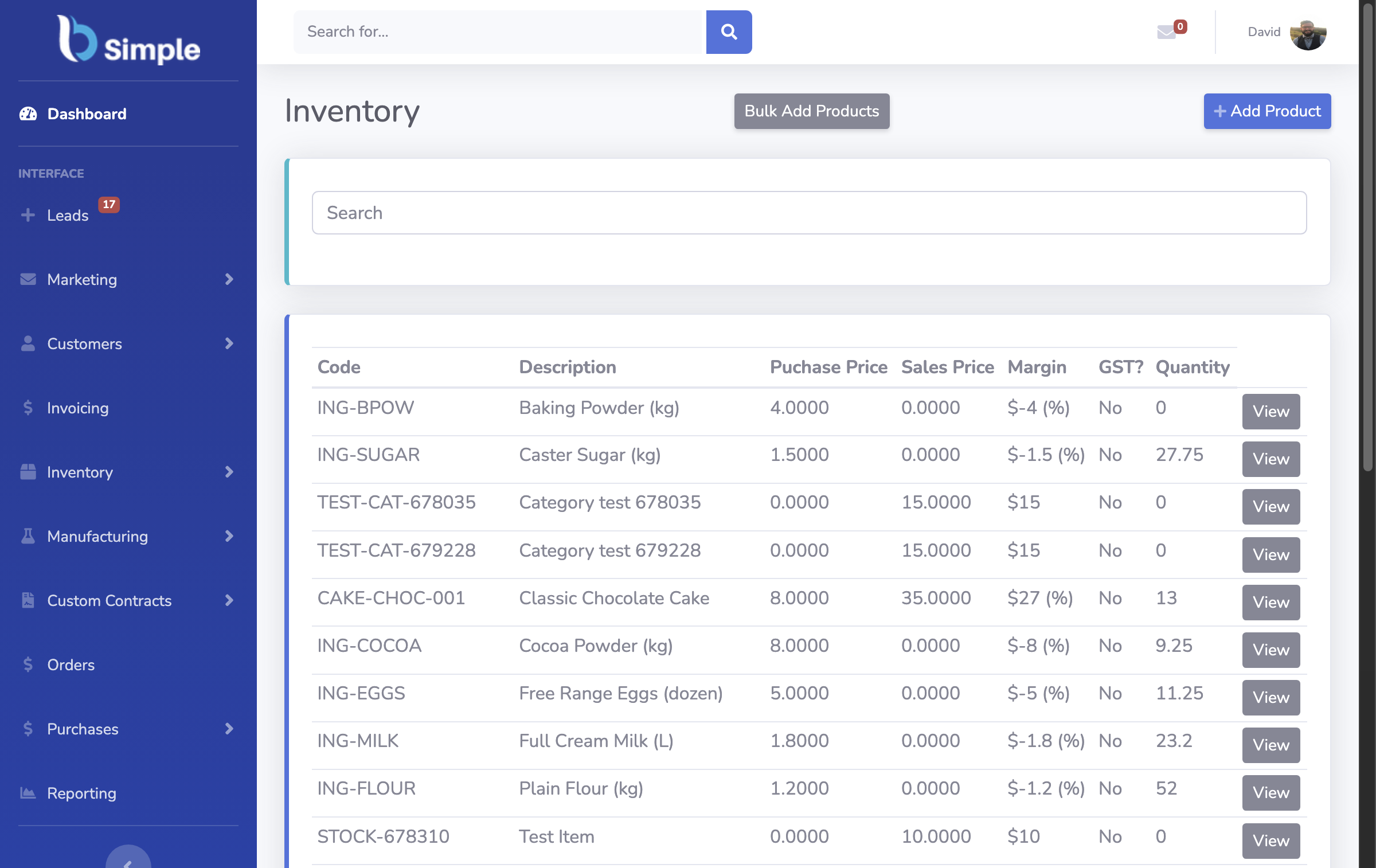
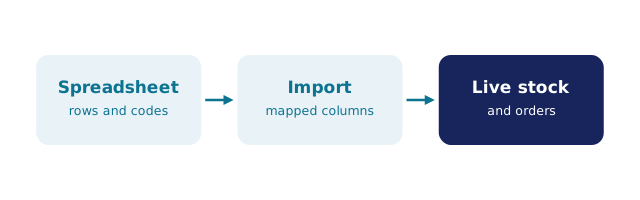
We build BSimple, so weigh that. It is not enterprise software and not an ERP: there is no MRP scheduling, no HR or payroll, no multi-entity consolidation, and we say so plainly rather than selling the tier by implication. It is the operations layer between spreadsheets and ERP — live quantities across locations, multi-level stock, negative-inventory guardrails, reorder levels, stocktakes, batch and lot tracking with expiry, recipes and production runs with mass-balance reporting, a customer ordering portal, invoicing with the accounting handoff to Xero or MYOB (US accounting integrations rolling out). From $180/month AUD, every feature in the core plans, no implementation project to survive first.
If you outgrow that — genuinely outgrow it, with scheduling and consolidation requirements that exist on paper not just in ambition — an ERP list is the right place to shop, and BSimple's REST API keeps the record exportable on the way through. The honest comparison page for that fork is inventory software versus ERP; the inventory management pillar shows what the mid-market record covers in full; the enterprise application management list maps the tier above for teams that land on the ERP side.
Frequently Asked Questions
Is BSimple enterprise software?
No, deliberately. BSimple is built for small-to-medium wholesale, manufacturing and distribution businesses — the operations layer between spreadsheets and ERP. Enterprise features like MRP scheduling and multi-entity consolidation are outside the product, and we would rather say that than imply otherwise.
When does a business actually need the enterprise tier?
When decisions — not records — become the problem: production scheduling across constraints, group consolidation across entities, customisation depth that partners must maintain. If the record itself is still untrusted, the tier solves the wrong problem first.
What do enterprises lose by choosing mid-market tools?
Optimisation and scale machinery: MRP, deep configurability, vendor-managed complexity. What they keep is speed — a record the whole team uses, run without administrators as a headcount line.
Does mid-market mean limited stock capability?
No — the record capabilities are the point: multi-location quantities, multi-level stock, batch and expiry traceability, negative-inventory guardrails, stocktakes. See the inventory management pillar for the full list.
How do we test which tier we need?
Run the trial on your real products and a real week. If the mid-market record holds your operation truthfully, the enterprise tier is buying nothing you can name. If it cannot hold you, the gap you find is exactly the requirement list to take to the enterprise aisle.

BSimple