
Guide / the landscape
Enterprise application management: the list
The categories that make up an enterprise application landscape — what each one manages, which a growing business needs first, and why "managing the list" is mostly about handoffs rather than the apps themselves.
The key facts
- The core categories: ERP, accounting, CRM, supply chain/inventory, warehouse management, HR, e-commerce, and business intelligence — the list behind every "application portfolio" slide.
- The order of adoption for a product business: accounting → inventory/operations → e-commerce → CRM/BI. HR and the heavy suites come with scale.
- Management of the list is about handoffs: the seams between applications create more work than the applications do.
- BSimple's slot: the inventory-and-operations application for wholesale, manufacturing, distribution and trade — deliberately not an ERP, with accounting handed to Xero or MYOB.
- 01The key facts
- 02The categories, and what each manages
- 03Managing the list: the handoff problem
- 04BSimple's slot in the list
The categories, and what each manages
ERP — the whole-of-business bundle: finance, supply chain, production, HR in one suite. The heaviest entry on the list; see what ERP-adjacency really means.
Accounting — the books: invoicing ledger, tax, payments, reconciliation. The first application almost every business adopts, and the system of record for money.
Inventory/operations — stock truth: quantities across locations, movements, purchasing, order fulfilment. The subject of this site's pillar, inventory management.
CRM — customer relationships: contacts, pipeline, communication history. E-commerce — the storefront and its order stream. WMS — warehouse-floor management: bins, pick paths, scanning. HR — people, leave, payroll. BI — dashboards and reporting across the others.
Most lists add niche tenants — marketing automation, support desks, project tracking — but the categories above are the load-bearing ones, and the evaluation question is never "which list is longest"; it is which two or three the business will actually run well.
Managing the list: the handoff problem
Enterprise application management as a discipline is mostly about the seams. Each application is competent inside its own walls; the work multiplies at the borders — the CRM customer who exists under a different name in accounting, the e-commerce order re-keyed into the operations sheet, the warehouse count that never reaches the books. Every manual step at a seam is a place where the record can drift, and every drift becomes a reconciliation meeting.
The mature pattern is fewer, well-connected applications: one record per subject (money, stock, customers), with integrations moving events between them automatically. Webhooks and APIs — order import, payment-status mirroring, contact sync — are what turn a pile of applications into a managed landscape. The definition piece frames the vocabulary, and the broader enterprise-software picture covers how the big vendors position their own portfolios.
BSimple's slot in the list
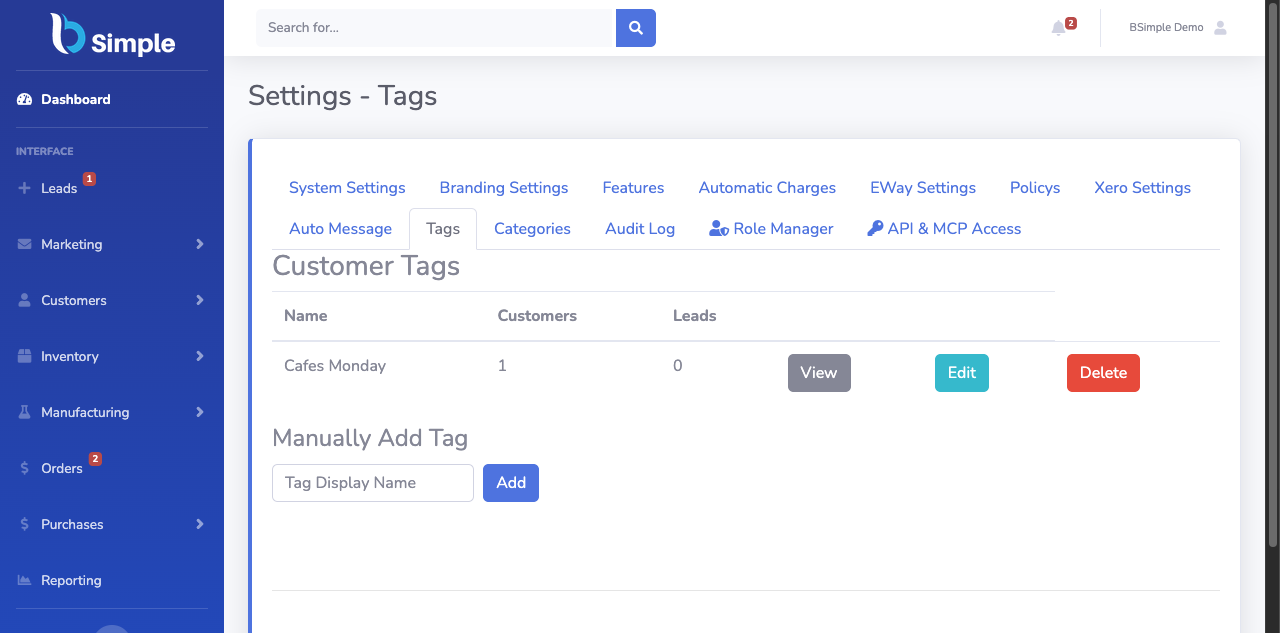
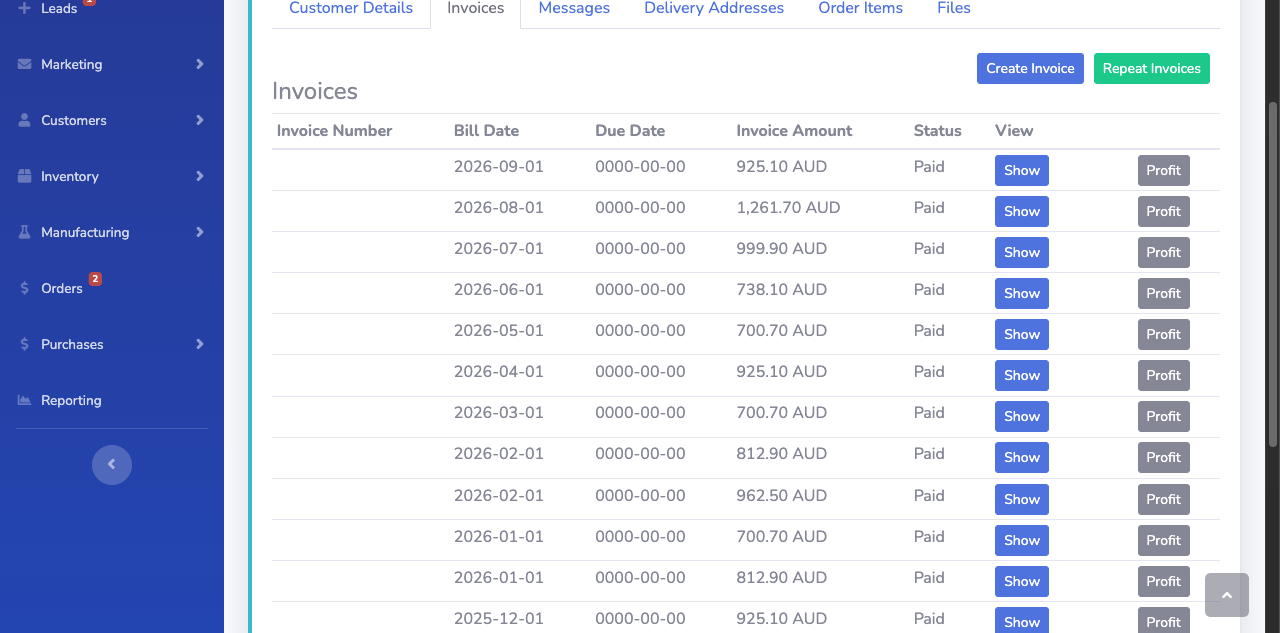
We build BSimple, so weigh that: it occupies the inventory-and-operations slot for wholesale, manufacturing, distribution and trade businesses — live multi-location stock, batches and traceability, purchasing with variance flags, customer ordering portals, invoices handed to the accounting application. It deliberately does not try to be the whole list: no HR or payroll, no CRM, no native storefront (Shopify orders import by webhook instead), and accounting stays in Xero or MYOB (US integrations rolling out). From $180/month AUD, with the trial as the full product.
That restraint is the design principle the list teaches: each application should hold one subject completely rather than several subjects thinly. A business that runs accounting, operations and a storefront well — with the handoffs automated — has a better-managed application landscape than one running six half-integrated suites.
Frequently Asked Questions
What are enterprise applications?
The software categories an organisation runs its business on: ERP, accounting, CRM, supply chain and inventory, warehouse management, HR, e-commerce and business intelligence. "Management" of the list means choosing them, connecting them, and keeping the handoffs between them honest.
Which applications does a small business need first?
Accounting first, inventory/operations second — money and stock are the two subjects that cannot live in spreadsheets for long. E-commerce follows if selling online, CRM when customer relationships outgrow one inbox. The heavy suites wait for scale.
Is ERP the same as the whole list?
An ERP bundles many list categories into one suite — that is its appeal and its cost. A business can also run focused applications per category with automated handoffs. The honest comparison is integration depth against implementation weight, not a default winner.
Where does BSimple sit in the list?
The inventory/operations application: stock, purchasing, orders and fulfilment on one record, connected to the accounting application (Xero/MYOB) and the storefront (Shopify import) — one subject, held completely, from $180/month AUD.
How do I stop my application list from sprawling?
Adopt a new application only when it removes recurring manual work at a seam — and retire what it replaces. The trial is the pattern applied to us: test on your own data whether the operations slot earns its place before adding it.
BSimple