
Guide / platform comparisons
Odoo for business management, honestly
Odoo is the most ambitious open business platform in its price class — modular ERP from CRM to accounting to manufacturing. Whether it is the right business management software for you depends on scope and on who maintains it. Here is the comparison we can make honestly.
The key facts
- Odoo's model: an integrated suite of modular business apps — CRM, sales, inventory, manufacturing, accounting, website — deployable incrementally, open source at its core with paid editions above it.
- Its strength: breadth. One vendor, one database, an app for almost everything, and a large partner ecosystem for implementation.
- Its cost of ownership: modules are configured, integrated and maintained — the platform rewards businesses with someone who owns it.
- BSimple's difference: not modular breadth but one deep operational record for stock businesses — no HR, no website builder, no ERP ambition, from $180/month AUD.
- The full picture: how the inventory record works is the hub page for everything above.
- 01The key facts
- 02What Odoo is, at the model level
- 03Where BSimple differs — deliberately
- 04The evaluation that settles it
What Odoo is, at the model level
Odoo grew from OpenERP into the widest-reaching open business suite: install the apps you want — invoicing, inventory, manufacturing, purchase, CRM, ecommerce, accounting — and they share one database. Community editions are free to self-host; paid plans add hosting, support and features. The appeal is real, especially for businesses that want to consolidate many point tools under one roof and are prepared to configure rather than buy off the shelf. The manufacturing and inventory modules carry genuine depth: multi-level bills of materials, multi-warehouse stock, barcodes.
The model also explains its demands. Modules need configuration to match your processes; versions upgrade annually and customisations must survive them; accounting localisation varies by country and often by partner. Odoo businesses tend to succeed where someone internal or a partner owns the platform as a job — our fuller Odoo comparison walks that boundary in detail.
Where BSimple differs — deliberately
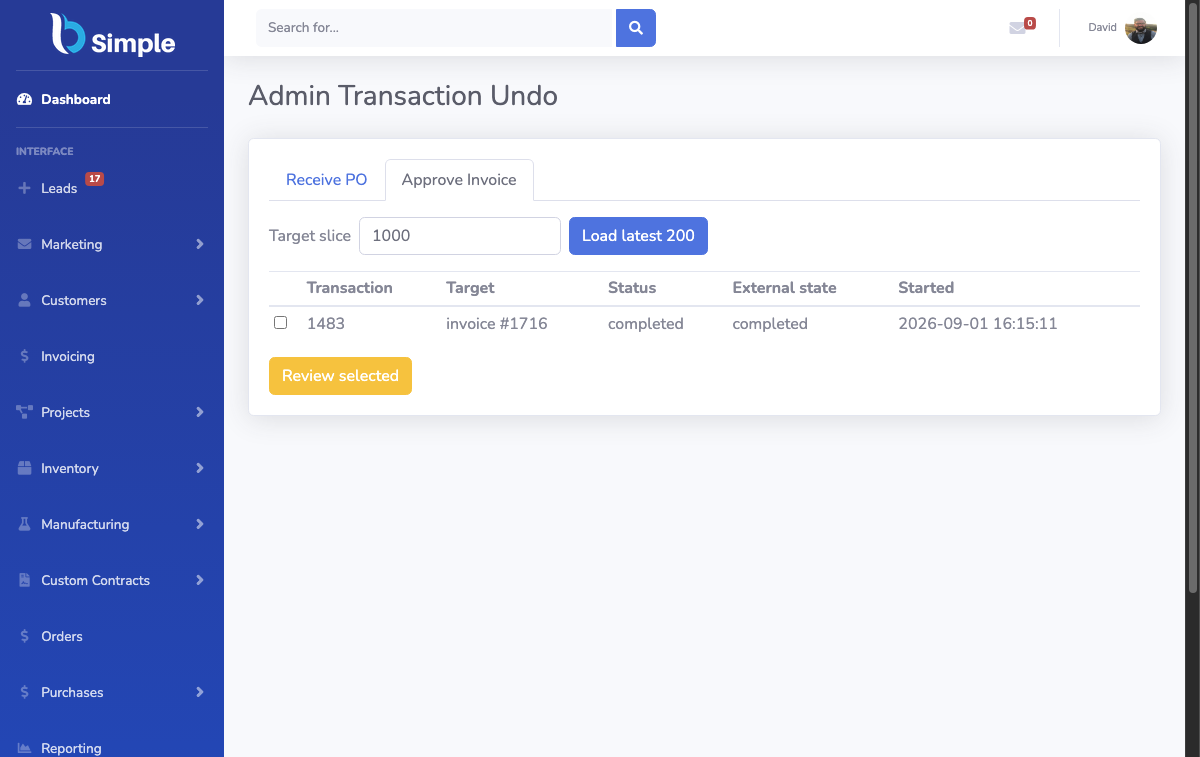
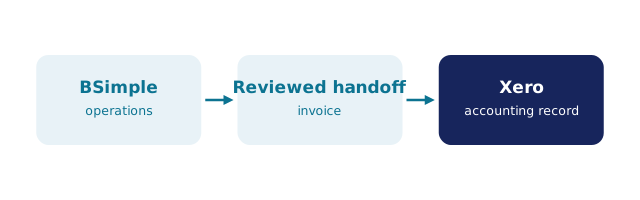
We build BSimple, so weigh that. The honest framing is scope, not quality. BSimple is not a modular suite and does not want to be one: there is no CRM pipeline, no website builder, no HR or payroll, no ERP ambition. What it is, is one deep operational record for wholesale, manufacturing, distribution and trade businesses: live quantities across locations, multi-level stock, negative-inventory guardrails, reorder levels, batch and lot tracking with expiry, recipes and production runs with mass-balance reporting, a customer ordering portal per customer with their own pricing, and invoicing with the accounting handoff to Xero or MYOB (US accounting integrations rolling out).
The practical differences follow from that: BSimple runs in a browser with configuration rather than implementation; version upgrades are ours, not a project; and the accounting boundary is deliberate — the books stay in your accounting system, which Odoo with its accounting app would ask you to move. Business management software, the category explains what the record-first approach covers.
The evaluation that settles it
- Breadth or depth? If you want CRM, website, helpdesk and accounting consolidated, Odoo's model fits and few rivals match it. If you want stock, orders, purchasing and invoicing done deeply with a clean accounting handoff, that is BSimple's whole shape.
- Who owns it? Odoo rewards an owner — internal or partner. BSimple is operated by the team that uses it, with the audit trail behind them.
- Where do the books live? If accounting stays in Xero or MYOB, BSimple's boundary is an advantage. If you want accounting inside the same suite, Odoo's model offers that.
- Test both on your products. Our trial runs a real week on your stock; run Odoo the same way. The comparison that matters is on your data, not on a feature matrix — and business management web applications covers the platform questions either way.
Frequently Asked Questions
Is Odoo good business management software?
It is genuinely capable, particularly for businesses that want a consolidated modular suite and have someone to own configuration and upgrades. The question is not quality but fit: breadth versus a deep operational record, and who maintains the platform.
Is Odoo free?
The community editions are free to self-host, with paid plans for hosting, support and extra features. Free applies to the license, not the total cost of ownership — configuration, upgrades and customisation are real work. BSimple is not free either: plans start at $180/month AUD.
Is BSimple an Odoo alternative?
For stock-carrying wholesale, manufacturing and distribution businesses that want one deep record with a clean accounting handoff — yes, that is the overlap. For businesses wanting a whole suite including CRM, website and accounting in one platform, Odoo is the closer fit.
Which handles manufacturing better?
Odoo's manufacturing module is broader, including MRP-style planning; BSimple covers recipes, production runs with shortage checks, batch creation with use-by dates and mass-balance reporting for certification. If you need MRP scheduling, that is enterprise/ERP territory — the ERP comparison draws that line.
How should we test Odoo against BSimple?
Same test, both systems: your real products, one purchase order, one order through to invoice, one count. Whichever record survives your week truthfully — and whoever will run it day to day — decides it.

BSimple