
Guide / examples
Company management system examples
A company management system is one record carrying the whole operation — stock, purchasing, orders, invoicing. Here is what that looks like for four kinds of company, weights included.
The key facts
- The shared skeleton: one record — inventory, purchasing, orders, the customer portal, invoicing, reporting.
- Four company types: distribution, manufacturing, trade services, retail — same records, different weights.
- The boundary in every example: accounting stays a connected system of record, not a module.
- BSimple: the operations record for small-to-medium companies of these shapes, from $180/month (AUD).
- The full picture: how the inventory record works is the hub page for everything above.
- 01The key facts
- 02Example 1 — a distribution company
- 03Examples 2 and 3 — a manufacturer and a trade services company
- 04Example 4 — a retailer, and the pattern
Example 1 — a distribution company
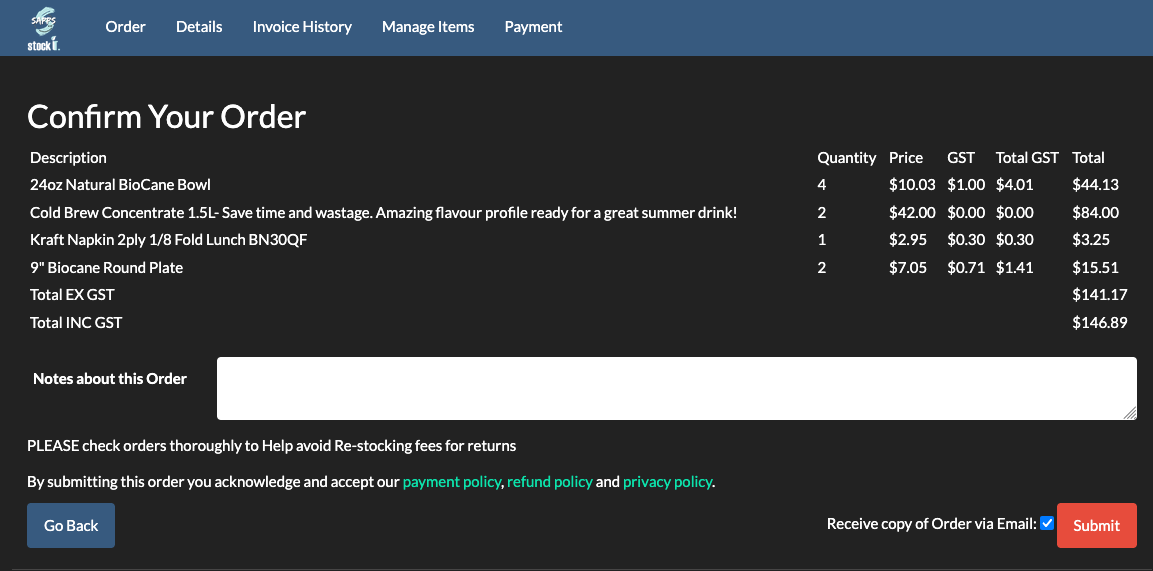
A wholesaler buys by the pallet and sells by the carton to regular trade accounts. The system's heavy records: receiving (deliveries against purchase orders, price variance caught at the dock) and reordering (levels per product raising supplier orders before fast movers run dry). The customer portal carries the wholesale accounts — their own products, their own pricing — and approved invoices push to the accounting system. The wholesale pattern in detail.
Examples 2 and 3 — a manufacturer and a trade services company
A manufacturer weighs consumption: recipes or bills of materials define what a run takes, shortage checks turn missing inputs into purchase orders instead of production stops, and outputs become traced batches — linked back to inputs, forward to customers. Where certification matters, mass-balance reporting rides the same chain. The production example covers the run from recipe to traced sale.
A trade services company — installs, maintenance, fitouts — weighs the job: materials reserved against a project without consuming stock, consumed when the claim or invoice is approved, and the installed equipment keeping its lifetime service history. The job is the record, and the record is what survives the van. The job pattern shows it day to day.
Example 4 — a retailer, and the pattern
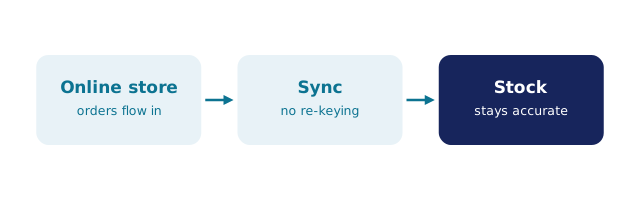
A retailer weighs the counter and the shelf: sales deducted at the register must agree with the storeroom, shrinkage must become a number, and — once an online channel exists — every channel must draw from one truth. The small-retail example covers the store.
The pattern across all four: the same skeleton — one record, movements as transactions, purchasing from demand, invoicing to the books — with the weights moved. Choosing a system is choosing which weights it carries well. What a company management system is defines the skeleton; the diagram version draws it; the worked examples fill in more shapes. We build BSimple, so weigh that: it is the operations record for all four shapes above, from $180/month (AUD), and the trial runs your company's own weight through it.
Frequently Asked Questions
What is an example of a company management system?
A distributor receiving by scan and invoicing its trade accounts from one record; a maker running recipes into traced batches; a trade business carrying jobs from reservation to claim; a retailer keeping the till and the storeroom honest. One record, weighted per company.
What does a company management system include?
The operational core: inventory with live quantities, purchasing from reorder levels, orders and fulfilment, the customer portal, invoicing and reporting — with accounting connected as the system of record rather than absorbed.
Do these examples apply to small companies?
Yes — the skeleton scales; the weights matter more than the size. A five-person distributor needs the same records as a fifty-person one, lighter. The trial sizes it on your own products in an afternoon.
Is BSimple suitable across these company types?
It is built for small-to-medium wholesale, manufacturing, distribution and trade — the four examples above — with retail served where the record matters more than the counter. Plans start at $180/month (AUD), everything in the core plans.
BSimple