
Guide / production
Inventory and production management, on one record
Production is inventory with a plan: inputs consumed, outputs created, batches traced. Software that keeps the two in separate systems guarantees they will disagree — here is what one record does instead.
The key facts
- The pairing that matters: inventory (what you hold) joined to production (what you turn it into) without re-typing.
- BSimple capabilities: multi-level bills of materials, recipe versioning, production runs with shortage checks, batches with use-by dates.
- Traceability both directions: finished batch back to inputs, suspect input forward to every batch and customer.
- Mass-balance reporting supports certified operations — ACO, NASAA and OFC are cited by existing customers.
- No separate production module: recipes and batches are in the core plans, from $180/month (AUD).
- 01The key facts
- 02Why inventory and production belong together
- 03What the production side actually needs
- 04How BSimple runs both sides
Why inventory and production belong together
Production is where inventory arithmetic gets hard: one output consumes many inputs, sometimes in levels (a product into a pack into a case), and every consumption changes what sales can promise. When production lives in a spreadsheet beside the inventory system, the two drift — stock shows inputs that a run already consumed, and finished goods nobody has counted.
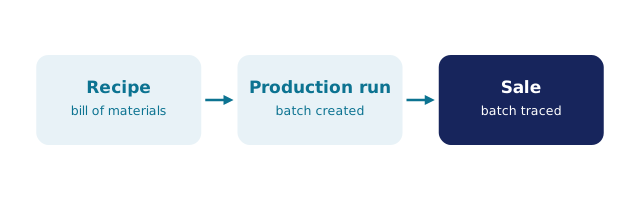
One record closes the drift by making production a set of transactions like any other: a run consumes its inputs and produces its outputs as recorded movements, with the audit trail intact. Purchasing sees the consumption (so shortages become purchase orders, not stops), and sales see the output (so a finished batch is sellable the moment it exists).
What the production side actually needs
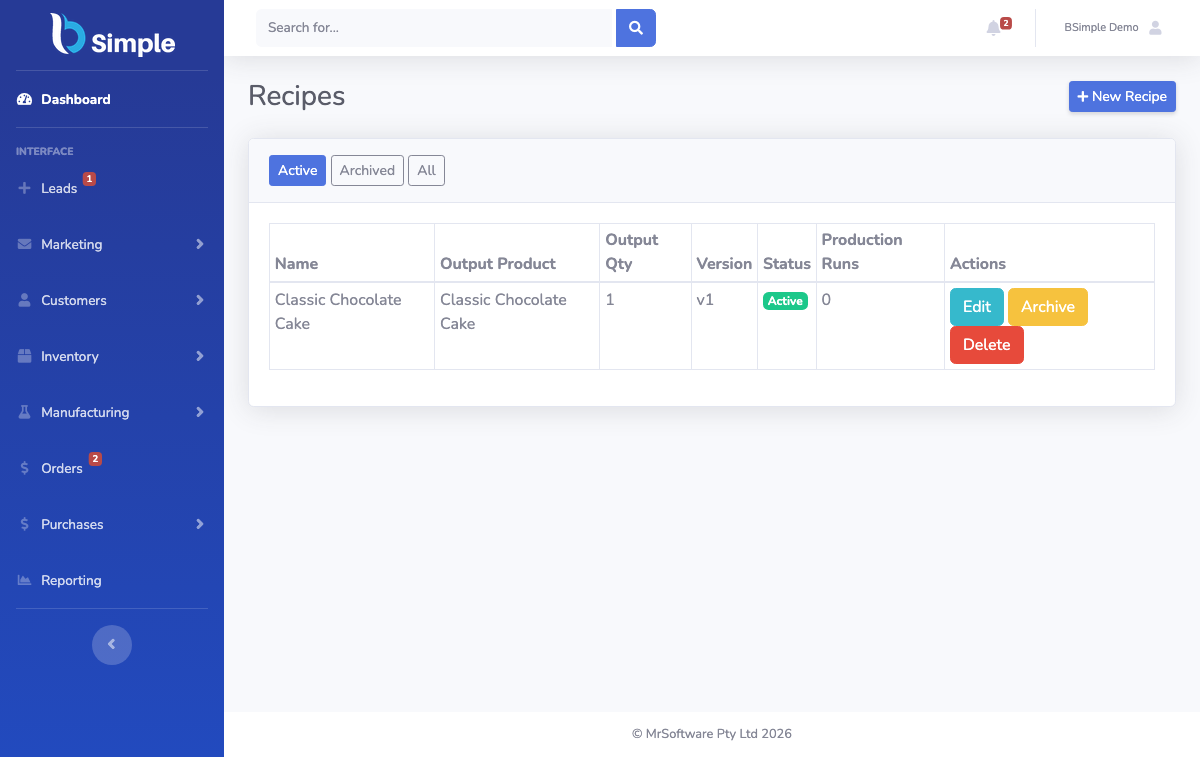
- Multi-level bills of materials — components into sub-assemblies into products, with versions as recipes change.
- Shortage checks before the run — proposed consumption measured against live quantities, so a missing input is a purchase order rather than a mid-run discovery.
- Batch creation with dates — each run produces a traced batch carrying lot numbers and use-by dates from what went into it.
- Two-way traceability — from a sold batch back to its inputs, and from a suspect lot forward to every batch and customer it reached. How batch tracking works covers the mechanics.
- Mass balance for certified operations — the certified share of inputs flowing through to outputs, reportable for audits. ACO, NASAA and OFC certification are cited by existing BSimple customers.
How BSimple runs both sides
We build BSimple, so weigh that. Recipes, production runs, traced batches and mass-balance reporting sit in the core product on the same record as purchasing, orders, the customer portal and invoicing — the manufacturing guide walks the production flow, and the manufacturing comparison evaluates the category. The accounting handoff to Xero or MYOB sits behind it, so a run's output becomes sellable, invoiceable stock without anyone re-keying.
The honest boundary: BSimple does not claim MRP scheduling — no production planning by machine capacity or labour timetable. Runs are planned against availability, not optimised against a schedule; if plant-level MRP is the requirement, that is ERP territory. Plans start at $180/month (AUD), and the trial is the test that matters: run one real recipe from inputs to a traced batch sale and read the chain backwards. For the industry framing, inventory management in manufacturing sets the wider context.
Frequently Asked Questions
What is inventory and production management software?
Software that keeps stock and manufacturing on one record: bills of materials and recipes consume inputs, production runs create traced outputs, and the result is sellable inventory — with purchasing and invoicing attached. Separate systems guarantee drift; one record guarantees agreement.
Does BSimple include recipes and batches without an extra module?
Yes — multi-level BOMs, recipe versioning, production runs with shortage checks, batches with use-by dates and mass-balance reporting are in the core plans. There is no separate manufacturing module price.
Does BSimple do MRP scheduling?
No — production runs are planned against live availability with shortage checks, not optimised against machine or labour schedules. MRP scheduling is ERP territory, and the honest answer is to evaluate an ERP if that is the requirement.
How does production connect to accounting?
Through the same record: consumed inputs and created batches are operational movements; approved invoices for finished batches push to Xero or MYOB with payment status mirrored back. The accounting boundary stays clean while production stays traced.

BSimple