
Guide / manufacturing
Inventory management system for the manufacturing industry
Manufacturing breaks generic inventory tools because stock changes form: inputs become outputs through a recipe, and every batch must be traceable backwards. What a system needs for that, and how BSimple handles recipes, production runs, batches and the purchasing around them.
The key facts
- The manufacturing requirement set: multi-level bills of materials, production runs with shortage checks, batch/lot tracking with expiry, and traceability from finished goods back to inputs.
- BSimple's answers: versioned multi-level recipes, runs that flag missing inputs before committing, batches created with use-by dates, and mass-balance reporting used by existing customers for organic certification (ACO/NASAA/OFC audits).
- No separate manufacturing module — recipes, batches and mass balance are in the core plans, from $180/month AUD.
- The boundary: BSimple runs operations and hands accounting to Xero or MYOB (US integrations rolling out); it does not do MRP production scheduling.
Why manufacturing breaks generic inventory tools
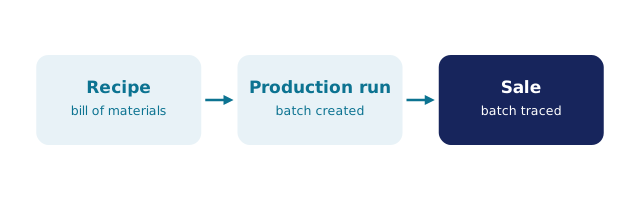
A retailer's stock model is flat: product goes in, product goes out. A manufacturer's stock exists in three states at once — raw materials waiting, work in progress, finished goods — and the interesting events are the conversions between them. A tool that cannot express "these four inputs became twenty units of that output on Tuesday" cannot run a factory floor, no matter how well it counts boxes.
Traceability raises the stakes: in food, beverage and materials businesses, a finished case must trace back to the lots that went into it — for recalls, expiry management, certification audits. Quantity-only tracking cannot answer that, and retro-fitting it onto resale-stock systems usually ends in bolt-on spreadsheets.
- 01The key facts
- 02Why manufacturing breaks generic inventory tools
- 03Recipes and production runs, on the record
- 04Batches, use-by dates and traceability
- 05Purchasing and stock that respect production
- 06Where the boundary sits
Recipes and production runs, on the record
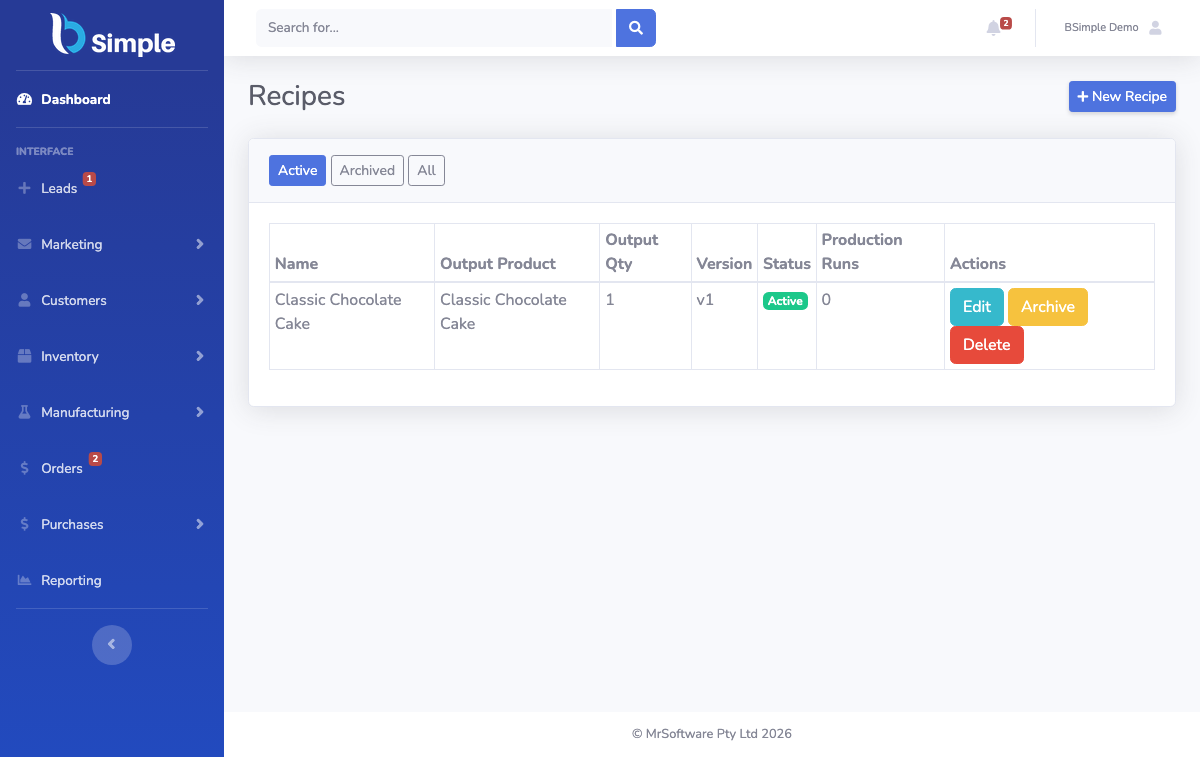
In BSimple, a recipe is a versioned multi-level bill of materials: sub-assemblies inside finished goods, quantities per output, revisions kept as the formula changes. Production runs consume the inputs and create the outputs, with a shortage check before the run commits — the system flags missing inputs against live quantities so a run does not start on hope.
The stock record stays one record through the conversion: inputs leave the raw-material state, outputs enter finished goods with their own batch identity, and live quantities across locations reflect the change immediately. The manufacturing capability page walks this layer in full.
Batches, use-by dates and traceability
Every production run can create batches carrying use-by dates, and batch identity follows the stock wherever it goes — warehouse, transfer, sale. Traceability search runs both directions: from a customer's batch number back to the inputs and the run that made it, or from a suspect input lot forward to every finished batch that consumed it. That is the answer a recall or an auditor needs in minutes, not days.
Mass-balance reporting closes the loop for certification — inputs accounted against outputs across a period, the report organic certifiers such as ACO, NASAA and OFC ask for, and one existing BSimple customers use in those audits. For channels that demand provenance, this is the layer batch-level inventory exists for.
Purchasing and stock that respect production
Around the recipe layer sit the operational pieces production depends on. Purchase orders are raised from demand — reorder levels against live quantities — and supplier invoices are checked against orders, with price variances flagged rather than silently absorbed. Goods receipts update stock on arrival, so the on-order and shelf pictures agree. Negative-inventory guardrails catch the impossible before it happens, and multi-location tracking keeps inputs at the plant and finished goods at the dispatch point honestly separated.
Customer-facing flow runs off the same record: ordering portals give trade buyers their own list and pricing, orders move through pick and pack to an approved invoice, and stock is deducted at the moment the invoice is approved — the trial runs a full test batch through that path on your own products.
Where the boundary sits
BSimple is deliberately not an MRP system: it does not schedule production capacity, sequence jobs or plan labour — businesses needing that depth run an ERP or a dedicated MRP tool. What it does is keep the materials, batches, purchasing and order record accurate underneath whatever scheduling process the business runs, and hand finished invoices to Xero or MYOB.

Frequently Asked Questions
What is the difference between an inventory system and MRP?
An inventory system keeps the record of materials, batches and movements; MRP plans what to produce and when, against capacity and lead times. BSimple is the former — it flags shortages before a production run and keeps purchasing honest, but it does not schedule the factory.
Can it handle multi-level bills of materials?
Yes — recipes support sub-assemblies inside finished goods, versioned so each batch traces to the formula revision that produced it. Runs check input availability before committing.
How does batch traceability work in practice?
Each run creates batches with use-by dates; the batch identity follows the stock through transfers and sales. A traceability search from a batch number returns the inputs, the run and the formula behind it — and from a suspect input forward to every finished batch that used it.
Is mass-balance reporting included or an add-on?
Included in the core plans — no separate manufacturing module. Existing customers use it in organic certification audits with ACO, NASAA and OFC.
What does it cost for a small manufacturer?
Plans run $180/$250/$399 per month AUD with recipes, batches and mass balance in every plan. The trial is the full product, so a real recipe and a test production run can be exercised before any commitment.
BSimple