
Guide / manufacturing inventory
What is the best inventory software for manufacturing?
Manufacturing inventory lives or dies on recipes, batches and traceability. Here is what to demand from any system — and where BSimple fits, MRP scheduling aside.
The facts about manufacturing inventory software
- Manufacturers run three stock layers at once: raw materials, work in progress, finished goods — all three on one record.
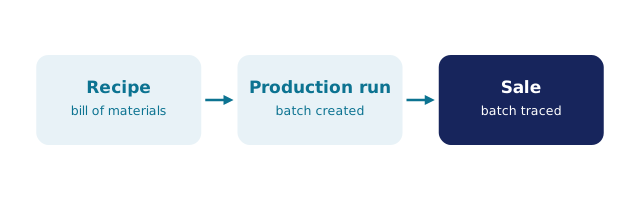
- The recipe (bill of materials) is the engine: production should calculate its own ingredient and component needs, with shortage checks before the run starts.
- Batch traceability is non-negotiable for food, beverage and health products — input lots through to dispatched finished goods.
- BSimple covers this natively: multi-level recipes with versioning, production runs, batch creation with use-by dates, mass-balance reporting for ACO/NASAA/OFC certification.
- The honest boundary: no MRP scheduling. BSimple deliberately stops short of forward-scheduling production plans — from $180/month (AUD) with a free trial.
- Where it fits: the production layer's hub is manufacturing inventory software.
- 01The facts about manufacturing inventory software
- 02What manufacturing actually demands from inventory software
- 03How BSimple handles production — and what it skips
- 04How to compare manufacturing inventory systems
- 05Who should choose BSimple for manufacturing
What manufacturing actually demands from inventory software
A distributor can live on quantities and locations. A manufacturer cannot, because stock transforms: inputs are consumed, outputs are created, and both must land on the same record.
The demands, in order of consequence: multi-level recipes — a product made from components that are themselves made from materials, costed and versioned as they change; production runs with shortage checks — the system calculates what a batch will consume and warns before you start, not after; batch creation with use-by dates — finished goods born with their own identity and expiry; traceability — any finished batch traced back through every input lot, the question recalls and audits ask; and mass-balance reporting where organic certification (ACO, NASAA, OFC) applies.
How BSimple handles production — and what it skips
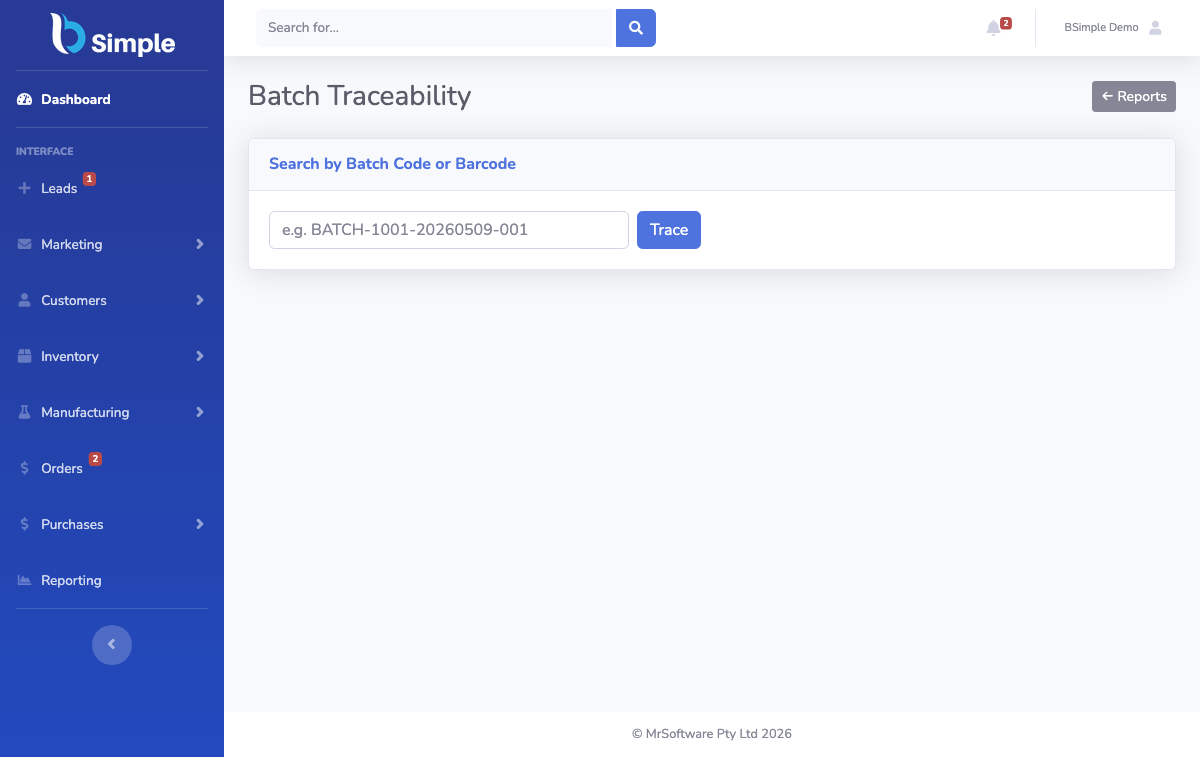
We build BSimple, so weigh that. Recipes are multi-level and versioned: change one and history keeps the old version, so past batches remain explainable. Production runs check component availability with shortage warnings, consume inputs and create batched finished goods with use-by dates on approval. Traceability search follows lots both directions — a customer complaint back to the supplier lot, or a bad ingredient forward to every affected batch. The bakery example shows the workflow in a real kitchen, and the inventory management page shows how production sits beside orders, purchasing and invoicing.
The boundary is deliberate: no MRP scheduling — no forward-loading production plans against forecasts, no capacity planning for machines and shifts. If you run scheduled production planned weeks ahead, an MRP-capable system will serve you better. If production is demand-driven — make what wholesale customers ordered — BSimple covers the loop from portal order to production to delivery to Xero or MYOB invoice.
How to compare manufacturing inventory systems
Demo with one of your own recipes, not the vendor's. Enter a real product with its real components and run a production batch at half quantity, then watch: does it check shortages before you commit; can you trace the finished batch back to input lots in one search; does finished stock carry use-by dates; does the invoice reach Xero or MYOB untouched. Any vendor can claim recipes — this test settles it.
Then price the whole loop: BSimple starts at $180/month (AUD) with recipes, batches and traceability included — no separate manufacturing module fee, where many vendors quietly split the category in two. The Xero-integrated comparison covers the accounting side of the shortlist, and the AI-inventory guide sets fair expectations on demand forecasting before you pay extra for it.
Who should choose BSimple for manufacturing
The fit: Australian and international small-to-medium manufacturers — food and beverage producers, cosmetic and health product makers, light assembly — who need recipes, batches, traceability and certification reporting on the same record as orders, purchasing and invoicing, with accounting handed to Xero or MYOB. The free trial lets you run one real production batch before any money changes hands.
Look past us if: production is scheduled against long-range forecasts (MRP territory), the floor needs machine-level scheduling, or the business has outgrown SMB systems entirely. Honest boundaries save everyone a quarter of integration pain — and if the boundary does not bite, the trial shows the fit with your own recipes in an afternoon.

Frequently Asked Questions
Does BSimple support multi-level bills of materials?
Yes. Recipes can nest — a finished product built from sub-recipes built from raw materials — with versioning, so recipe changes never corrupt past-batch history. Production runs calculate requirements across all levels with shortage checks before you commit.
Can it handle batch tracking with expiry dates?
Yes — finished goods are created in batches with use-by dates, and input lots are recorded on receipt. Traceability search runs both directions: a dispatched batch back through its inputs, or a supplier lot forward to every affected product.
Is mass-balance reporting included for organic certification?
Yes — BSimple's mass-balance reporting supports ACO, NASAA and OFC certification, and existing food-production customers use it for exactly that. Inputs and outputs stay reconciled the way certifiers expect, with no separate spreadsheet.
Does BSimple include MRP or production scheduling?
No — deliberately. BSimple handles demand-driven production: orders and recipes drive runs, and the system checks shortages. Forward-looking MRP scheduling against forecasts and machine capacity is out of scope — vendors who promise it cheaply usually deliver neither.
What does manufacturing inventory software cost?
BSimple starts at $180/month (AUD) with recipes, batches, traceability and certification reporting included in the core plans — no manufacturing module surcharge. Compare that against tools charging per production module before judging features.
BSimple