
Guide / category map
Examples of business management software — sorted by type
A list of brand names teaches nothing; a sorted map of the types does. What each category of business software is actually for, with the example that fits each — and BSimple's slot named honestly.
The key facts
- Five types cover the market: accounting platforms, operations systems, ERP suites, workforce/HR tools, and vertical industry products.
- The sorting question is always the same: which record does the business need to be true — money, stock, people, or the industry's special object?
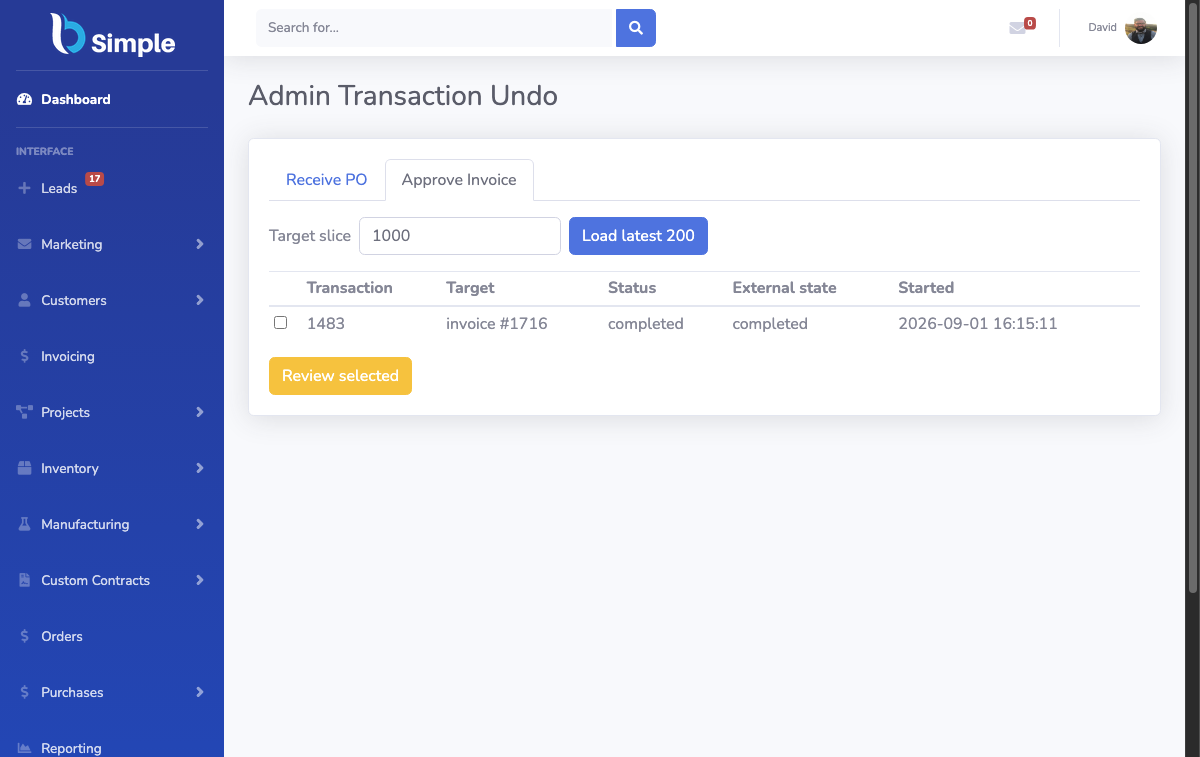
- BSimple is an operations-led example: stock, orders, purchasing, invoicing on one record, with accounting deliberately left to the accounting platform.
- Any example list is a starting point — the trial on your own data outranks every list, ours included.
- 01The key facts
- 02The five types, with what fits each
- 03How to use examples without being used by them
- 04BSimple's example, with its refusals attached
The five types, with what fits each
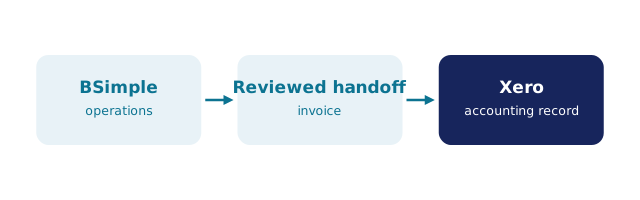
Accounting platforms. The money record: invoices, bank feeds, BAS, payroll integrations. Every business needs one; no business should run operations on one — the Xero boundary explains why the two records separate.
Operations systems. The stock-and-orders record: inventory, purchasing, fulfilment, invoicing against live quantities. BSimple is here — built for wholesale, manufacturing, distribution and trade — as are dedicated inventory and order tools generally. The process examples show what "operations" concretely covers.
ERP suites. The everything record for businesses at scale: MRP, HR, finance, deep configuration. Genuinely right at a size most businesses never reach; the weight comparison covers the trade.
Workforce tools. Rosters, time and attendance, HR compliance — the people record, deliberately separate from the stock record (the workforce boundary explains the division).
Vertical products. Built around an industry's special object — dealer management systems around the vehicle, practice management around the client file. Excellent inside their vertical; brittle outside it.
How to use examples without being used by them
Example lists (this one included) are maps, not recommendations — the seller of the moment funds most of them. Three habits keep you honest: sort by type first — most "which is better?" questions are category confusions in disguise; verify the example's claim on its own site — second-hand feature lists are stale by definition; and finish in a trial on your data, because the product that demos best and the product that fits your floor are correlated only by luck. The longer list of software types extends this map, and the generic examples page works the same terrain from another angle.
One signal separates a useful example page from advertising: whether it names what each product refuses to do. Every real product has boundaries; a list without them is a brochure.
BSimple's example, with its refusals attached
We build BSimple, so weigh that. What it is: Australian operations software — live multi-location inventory, multi-level stock and batches, purchasing from demand, order-to-invoice, customer ordering portals, production with recipes and traceability — on one record, from $180/month AUD. What it refuses to be: an ERP (no MRP, no HR), an accounting platform (Xero and MYOB own the books; US integrations rolling out), a storefront (Shopify syncs in), a POS counter, and free. Where it fits: the business past spreadsheets that does not need an ERP — the trial is the full product, and it is the only test that decides anything.
Frequently Asked Questions
What are some examples of business management software?
By type: accounting platforms, operations systems (BSimple's category), ERP suites, workforce tools, and vertical products. The type matters more than the name — start by identifying which record your business needs to be true.
Is BSimple an ERP?
No — deliberately lighter: no MRP scheduling, no HR, no payroll. It runs the operational record deeply rather than everything shallowly, which is the honest trade at its price point.
Which type should a growing wholesale business pick first?
The operations record — stock truth is the foundation the other layers report on. Accounting is already in place (or should be), workforce comes with headcount, ERP comes with scale; operations comes with the first stockout that surprised you.
Can two types replace each other?
Rarely cleanly. Accounting modules stretch into stock and develop the drift problem; operations systems stretch into books and develop the compliance problem. The boundary between them is a design decision, not a gap.
How do we verify any example on a list like this?
Vendor's own site for current claims, then a trial with your products. The trial exists because even this page's example deserves to be tested rather than trusted.

BSimple