
Guide / books and barcodes
Scanning books into inventory — how it works, honestly
Books arrive with their barcodes already printed: the ISBN. What scanning does, what the cataloguing half needs, and the honest line between business stock and personal collections.
The key facts
- Books are the easy case: the ISBN barcode is already on the cover, so a keyboard-mode scanner or phone camera types it straight in.
- Scanning is input; cataloguing is data: title, author, condition, price must come from somewhere — the ISBN alone is a lookup key, not a record.
- The honest split: second-hand booksellers running stock and invoicing fit an operations record; personal collections fit catalogue apps; BSimple is the former, not the latter.
- The test: scan ten real books end to end — lookup, condition, price, shelf location — before believing any workflow.
- The wider practice: scanning in inventory software is the hub for scanning workflows.
- 01The key facts
- 02How book scanning actually works
- 03Which tool fits which book problem
- 04Testing before committing
How book scanning actually works
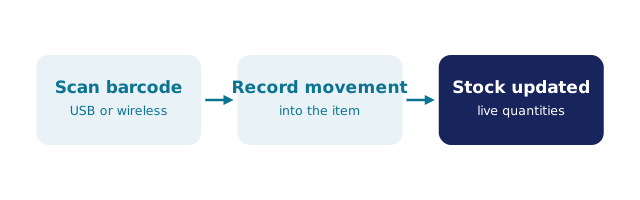
Every book printed since the 1980s carries its ISBN as an EAN barcode. Any mainstream scanner — USB keyboard-mode, Bluetooth, or a phone camera app — types that code into whatever field is focused. The scan is the fast part and the honest part: no mis-keyed ten-digit numbers, and the same code follows the book from acquisition to sale.
The cataloguing half is where tools differ. An ISBN is a lookup key; the record around it — title, author, edition, condition, cost, price, shelf location — must come from somewhere. Business-grade tools let the operator add those fields against the scanned code; some consumer catalogue apps attempt remote lookup from ISBN databases, which is convenient for condition-less collections and wrong for a bookseller whose whole margin is condition and edition nuance. The scanning mechanics and the barcode-and-inventory overview cover the hardware side in depth.
Which tool fits which book problem
Second-hand and independent booksellers are running stock: buy lists, shelf locations, condition grades, sales across counters and online, and invoices. This is a real inventory operation, and it is where BSimple fits — books as products (ISBN as the SKU), quantities per location (shelves, storeroom, stall), a transaction history that answers "did we already sell this copy?", and invoicing that pushes to Xero or MYOB. The boundary, plainly: no marketplace-integration claims — listing synchronisation to book marketplaces is its own tooling; sales that happen there can be recorded, not synced.
Personal collections and libraries need catalogue views — covers, authors, lending — and not reordering, pricing or GST. BSimple is the wrong shape for that by design; dedicated catalogue apps are the honest answer. The general scanner-app question explains why, and the ISBN-flavoured barcode overview rounds out the mechanics.
Testing before committing
Bring ten real, assorted books to any trial — damaged ones, multi-volume sets, one with a torn cover barcode. Scan each, add condition and price, put one on a shelf location, sell it, and run the count. The torn-barcode book matters: manual entry must be a first-class path, because physical books do not respect barcodes. BSimple's trial is the full product for exactly this test, and the barcode-scanning guide covers the day-one habits.
Frequently Asked Questions
Can I use a scanner app to catalog books?
Yes — for collections, catalogue apps with camera scanning do the job. For a bookselling business, the scan must land on a stock record with quantities, conditions and invoicing — which is the operations-record shape BSimple runs.
Does BSimple look up book details from the ISBN?
No — we do not claim ISBN-database lookup. The ISBN becomes the product code; title, author and edition details come in with your import or are added on the record. We would rather state that than imply a catalogue service we do not run.
How do we handle books without barcodes?
Manual entry is a first-class path — SKU by ISBN typed or generated in-house for older stock. A workflow that only works when the barcode survives is not a bookshop workflow.
Can we track condition grades in BSimple?
As product attributes or separate records per condition — the mechanism is the same fields a record carries. Test your grading scheme in the trial before committing; grading is bookselling's core data.
Does BSimple sync listings to book marketplaces?
No marketplace-integration claims, stated plainly — marketplace listing sync is separate tooling. Sales recorded in BSimple keep the stock truth; the listing layer stays where it is.
BSimple