
Guide / worked examples
Warehouse management system in logistics: examples
Three worked examples — a wholesale distributor, an e-commerce fulfilment operation, and a multi-site logistics business — walked through receiving, putaway, picking and dispatch, showing where the WMS earns its keep at each step.
The key facts
- The example set: a wholesale distributor with trade customers, an e-commerce fulfilment operation, and a two-site logistics business — the three shapes most logistics queries match.
- The flow that repeats: receive against the purchase order → putaway to a location → pick against allocated orders → pack and dispatch → invoice pushed to accounting.
- Where the system earns its keep: at the exceptions — partial deliveries, short picks, cancelled reservations — not at the happy path.
- Framing, honestly: these are illustrative walkthroughs of typical operations, not customer stories — no invented company names or numbers.
- 01The key facts
- 02Example 1: the wholesale distributor
- 03Example 2: e-commerce fulfilment
- 04Example 3: the two-site logistics business
- 05The pattern the examples share
Example 1: the wholesale distributor
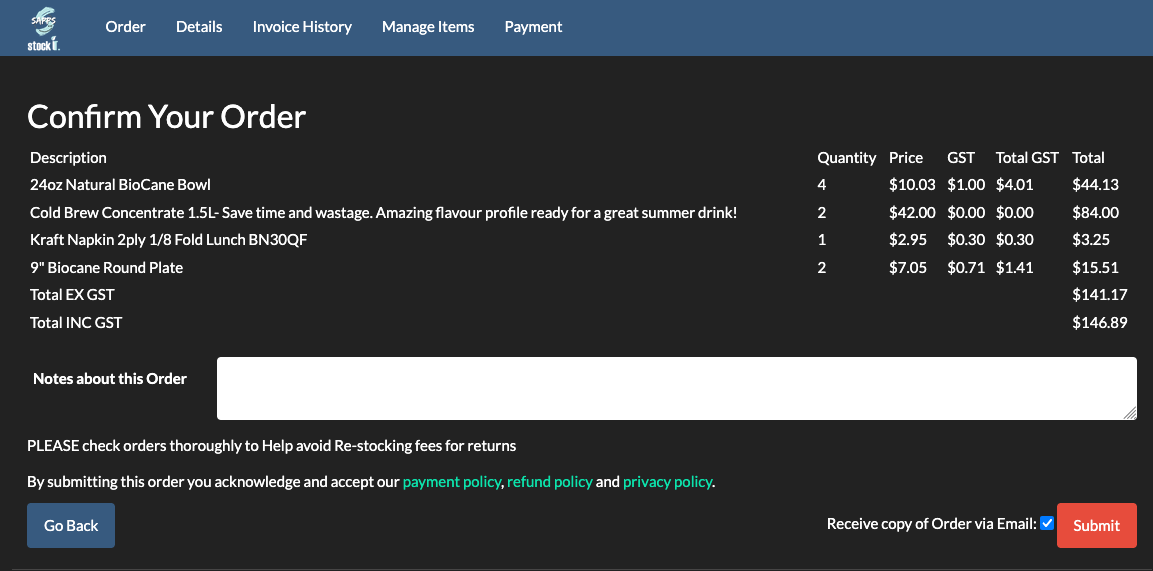
A distributor stocks 1,200 SKUs across a warehouse and holds a second overflow location; customers are trade accounts who reorder weekly. The WMS-shaped week: a container arrives and is received against the purchase order — each line scanned or keyed as it lands, with the receipt writing inbound movements immediately, so the on-order picture and the shelf agree without waiting for the supplier's invoice. Shortages on the container are recorded as partial receipts; the balance stays "expected" rather than vanishing.
During picking, each account's standing orders arrive through their portal with their own pricing. Stock is allocated at order time — reserved, not deducted — so two accounts cannot be promised the same cartons. Pick lists print by zone; a short pick (one line damaged) becomes a designed exception: the line splits, the rest of the order ships, the shortfall drives a purchase order. At dispatch, the delivery slip pairs with the invoice, stock deducts at approval, and the invoice lands in the accounting system — the order-management flow in full.
Example 2: e-commerce fulfilment
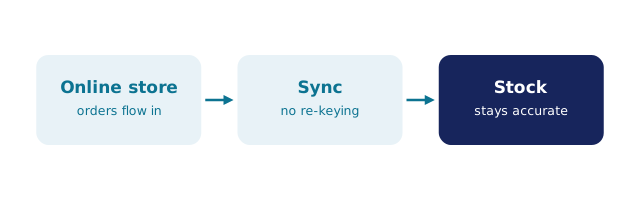
An online seller ships 60–200 parcels a day from one warehouse, orders arriving from a storefront around the clock. The WMS work happens in two seams. Inbound: storefront orders import automatically — by webhook, in BSimple's case — into the same order record the warehouse works from, so no one re-keys overnight orders at 7am. Outbound: orders batch into pick runs, barcodes confirm each pick at the shelf, and the pack station prints the dispatch slip; stock deducts as each order completes, and the storefront-side availability stays honest because the record underneath is honest.
The exceptions define the value here too: the oversold line (the record's guardrail catches it before the label prints), the returned parcel (a return movement with a reason, stock back on the shelf or written off), and the stocktake (cycle counts by zone rather than a shutdown). The wider system examples extend this pattern across more shapes.
Example 3: the two-site logistics business
A logistics operator runs a main warehouse and a cross-dock depot an hour apart, holding stock for several clients. The WMS questions are location questions: which site holds what, how transfers move between sites (an outbound at one, an inbound at the other, nothing lost between), and how client stock stays separated on one record. Receiving follows the same discipline — against the expected transfer, movements written on arrival — and dispatch runs against allocated orders rather than shouted instructions.
The accounting seam closes the loop at both sites: one record, invoices to the accounting system, the accounting boundary respected. This is also the point where barcode capture stops being optional — the scanning layer is what keeps two sites' movements honest when the people moving them never stand in the same room.
The pattern the examples share
Strip the industries and the three examples are the same flow with different volumes: receive against an expected order, putaway to a location, allocate before pick, dispatch against the record, invoice without re-keying — with the exceptions (partials, shorts, cancels, returns) handled as designed paths. Any WMS candidate should be testable against exactly this script on your own products and locations. We build BSimple, so weigh that: it covers this flow for wholesale, distribution and trade operations — the trial is the full product, and the inventory record underneath is what makes every step above trustworthy.

Frequently Asked Questions
What is an example of a warehouse management system in logistics?
The distributor flow above is the canonical one: goods received against purchase orders, putaway to locations, orders allocated then picked by zone, dispatch paired with invoicing. The same skeleton serves e-commerce fulfilment and multi-site logistics — only the volume and the exceptions change.
What is the difference between WMS and inventory software in these examples?
Depth of the physical layer: WMS adds bin-level locations, pick paths and scan-verification inside the warehouse; inventory software holds the stock truth the WMS acts on. Small operations start with the inventory layer and grow into WMS features as volume demands.
Where do most logistics implementations fail?
At the exceptions, not the happy path: partial receipts nobody recorded, short picks handled by shouting, cancelled reservations leaving phantom allocations. Choose the system by testing those paths deliberately, not by watching the demo take a clean order.
How does the WMS connect to accounting?
At the invoice: the checked order pushes to the accounting system with tax codes intact, payment status mirrors back, and the purchase side reconciles against received goods. Count the manual steps in that handoff — it is where logistics software usually leaks hours.
Can I test these flows before buying anything?
Yes — the trial is the full product: run your own receiving, picking and dispatch against it, including the failures. The script above is the test plan; your products are the data.
BSimple