
Guide / invoicing boundary
Inventory management with billing — where the line sits
Billing can mean an invoice produced from the record, or a ledger pretending to be one. The distinction decides whether your books reconcile — and how BSimple draws the line.
The key facts
- "Billing" has two meanings: producing invoices from checked orders (operational — good) and running the ledger (accounting — a different discipline).
- The test: does the invoice come from the checked order, with tax treatment intact, and land in the books without re-entry — or does it live in a second ledger?
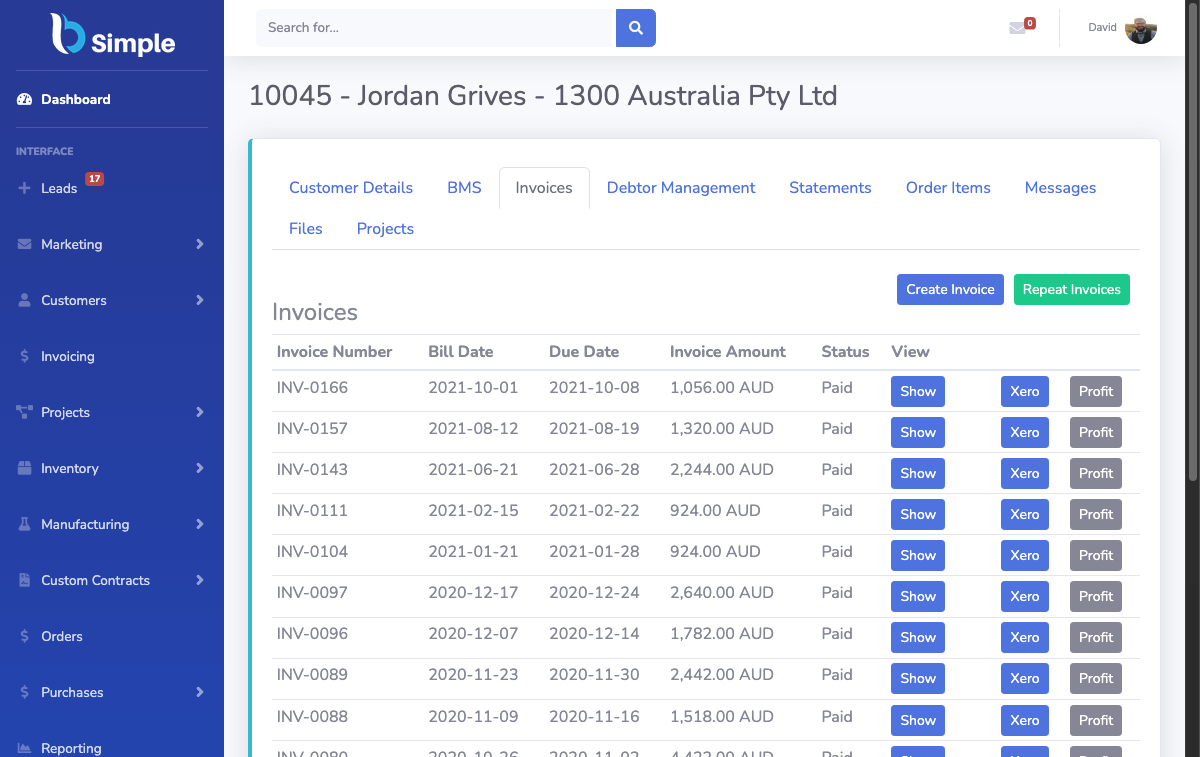
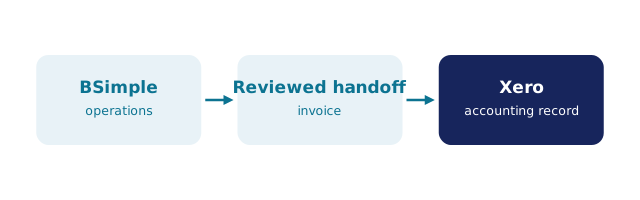
- BSimple's line: invoices are created and approved in BSimple, then push to Xero/MYOB; payment status mirrors back; compliance stays with the accounting system.
- The GST detail: purchase-side reconciliation with GST-inc/ex-GST pages is part of the operational job, not the accountant's cleanup.
- Context: the full inventory system holds the wider system, this page one stop in it.
- 01The key facts
- 02Billing as part of the record — what good looks like
- 03How BSimple draws the line
- 04The questions to ask any inventory-billing product
Billing as part of the record — what good looks like
The operational half of billing is a chain: an order is checked against live stock, picked, packed, and becomes an invoice from that same record — quantities, prices, customer and tax treatment all carried, nothing retyped. Approval is a deliberate step (it is the moment stock deducts and the books learn about the sale), and payment status flows back from the ledger so the record knows what is paid. Every part of that chain eliminates a classic failure: the invoice that disagrees with the delivery docket, the price that disagrees with the quote, the GST that disagrees with anything.
Billing as a ledger — accounts receivable ageing, part payments, credits, tax filings — is the accounting system's discipline. When an inventory product tries to absorb it, the business ends up with two partial ledgers and a reconciliation problem it did not have before. The billing-and-invoice comparison covers the combined-product market, and the accounting boundary explains the split's logic.
How BSimple draws the line
We build BSimple, so weigh that. In BSimple, invoices are created and approved in the operational system — drafted from checked orders, with credit-card payments handled through EWay on PCI DSS compliant equipment (card details are never visible to staff or screens). On approval, the invoice pushes to Xero or MYOB, where tax compliance, BAS and the ledger live; payment status (paid, voided) mirrors back to the operational record. On the purchasing side, supplier invoices reconcile with GST-inc and ex-GST pages, split or joined to match how goods actually arrived. US accounting integrations are rolling out.
The line, in one sentence: BSimple produces the invoice; the accounting system keeps the books. Products that promise both in one usually promise both shallowly — the Katana comparison is one example of the category, and the lab-supply angle shows the record side at work.
The questions to ask any inventory-billing product
- Does the invoice originate from the checked order or get typed twice?
- Is approval a deliberate step with stock deducting there — or does stock move at some ambiguous moment?
- Does tax treatment survive the trip to the books, line by line?
- Does payment status come back, or must someone compare two systems by eye?
- Who reconciles part-paid and voided invoices — the software, or the bookkeeper on Fridays?
Run all five on the trial with one real order; the answers are visible in an afternoon. The invoicing-approval flow shows BSimple's answers in context.
Frequently Asked Questions
Does BSimple include billing?
Invoice creation and approval, yes — produced from checked orders and pushed to the accounting system. The ledger itself stays with Xero or MYOB by design; billing that replaces the books is a different product category.
Why not keep invoicing entirely inside the accounting system?
Because the invoice should come from the checked order, not be retyped into a second screen. Producing it in the operational record keeps quantities, prices and stock deduction consistent — then the books receive a reviewed document instead of cleanup work.
Can customers pay invoices through BSimple?
Card payment options run through EWay on PCI DSS compliant equipment — card details are never visible to staff or screens. The accounting treatment of those payments stays with the books.
How are partial payments handled?
On the accounting side by the ledger (part-payments are bookkeeping), and on the operational side by the payment status that mirrors back. The split is deliberate: each system handles the part of payment it is built for.
Does this work with MYOB as well as Xero?
Yes — both are established handoffs with the same behaviour (invoice push, status mirroring, GST-aware purchase reconciliation), and US accounting integrations are rolling out. The trial runs one invoice across whichever you use.

BSimple