
Guide / Xero integration
Inventory management integrated with Xero — what that means here
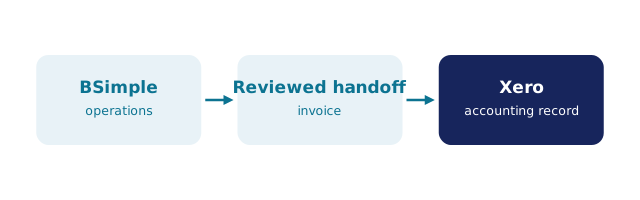
The operational record stays live in BSimple; the books stay in Xero; a reviewed handoff moves invoices, payment status and supplier bills between them. What the integration covers, line by line.
The key facts
- The division of labour: BSimple holds live quantities, orders, purchasing and batch tracking; Xero remains the accounting system of record.
- What crosses: approved invoices push to Xero; payment status (paid, voided) mirrors back; purchase orders reconcile with GST-inc/ex-GST handling; contacts import selectively.
- The point of the boundary: your accountant works in Xero unchanged, while the warehouse works from quantities that update on real movements, not invoice events.
- MYOB is established too, and US accounting integrations are rolling out — the accounting boundary explains why it exists at all.
- 01The key facts
- 02What the BSimple ↔ Xero handoff actually covers
- 03Why the boundary sits where it does
- 04If you are comparing Xero-integrated inventory software
What the BSimple ↔ Xero handoff actually covers
Invoices, after approval. A customer order moves through picking and packing to an approved invoice in BSimple — and it is the approval step that pushes it to Xero. Nothing half-formed reaches the books; stock deducts at approval, not at someone else's month-end.
Payment status, mirrored back. When an invoice is paid (or voided) in Xero, that status appears on the BSimple record. Your team stops calling the bookkeeper to ask whether that big order has cleared — the answer is on the order they are looking at.
Purchase orders, reconciled. Supplier invoices can be split or joined to match how goods actually arrived, with GST-inc and ex-GST pages for reconciliation. The purchase order flow ends with the books matching the shelf, without a spreadsheet bridge.
Contacts, imported selectively. Customers and suppliers come across from Xero — deliberately, so you bring the ones you actually trade with rather than every contact the ledger ever met.
Why the boundary sits where it does
The alternative — running accounting inside the inventory system — asks one product to be excellent at warehouse floors and tax compliance at once, and the compliance half punishes shortcuts. BSimple's position is that Xero and your accountant own compliance, BAS and bank feeds, while BSimple owns the truth about quantities: what is on hand, what is promised, what needs reordering.
In practice this means each system does the whole of its job. Quantities in BSimple update from real movements — a scanned delivery, a packed order, a counted shelf — so Xero's inventory values rest on records that were right when they crossed. That is also why the operations dashboard shows order, invoice and stock values side by side: the numbers agree because they come from the same movements.
If you are comparing Xero-integrated inventory software
Ask every vendor the same four questions: does the invoice cross without re-entry, with tax codes intact; does payment status mirror back; do supplier bills reconcile with part-payments; and who holds the quantity master while the sync runs? Vendors differ on the last one — some sync quantities into Xero, some keep the master in the operational system, and drift between the two is the classic failure.
How BSimple compares for Xero users and the integration-specific shortlist angle cover the comparison honestly, and the free trial lets you connect your own Xero and watch one invoice travel the full path before you decide anything.
Frequently Asked Questions
Does the Xero integration sync stock quantities into Xero?
The design keeps the quantity master in BSimple, where quantities update from real movements, and sends reviewed invoices to Xero. Your accountant can track inventory value in the books without the two systems fighting over who adjusts counts.
What happens when an invoice is voided in Xero?
The voided status mirrors back to the BSimple record, so the operational side sees the same state as the books. No one has to remember to update a second system — there is only one handoff and it runs both ways.
Can we bring our existing Xero contacts across?
Yes, selectively — you choose which customers and suppliers to import rather than taking the whole ledger. From there, customer ordering happens through their own portal, and the invoices those orders produce flow to Xero on approval.
Does BSimple handle GST on the handoff?
Yes — GST-inc and ex-GST reconciliation pages cover the supplier side, and invoices carry their tax treatment across. The tax-code model is extensible beyond GST, which matters if you trade internationally. Compliance filing itself stays in Xero, where it belongs.
We use MYOB, not Xero — same question?
The handoff is established with both Xero and MYOB, and US accounting integrations are rolling out. The division of labour is the same whichever ledger sits on the accounting side.
BSimple