
Guide / purchasing
Supplier management
Supplier management is the underrated half of inventory control: not an address book but the loop of orders, receipts and reconciliations that turns a roster of suppliers into a record of how each one actually performs.
The key facts
- The record, not the address book: each supplier's contact, terms, lead times and the items they supply — held once, used by every purchase order afterwards.
- The loop: raise the order against the supplier, receive goods against it (stock updates on receipt), match the invoice, flag variances.
- The forgotten feature: the price-variance flag — an invoice that does not match the agreed order is held for review instead of silently absorbed into totals.
- The payoff: performance conversations backed by facts — lead times, price drift, shortfall history — and a purchase ledger the accounting system can trust.
The supplier record
Supplier management starts with the record: contact details and payment terms, delivery lead time per supplier, and — most usefully — the items each one supplies. Held properly once, that record works for every purchase order raised afterwards: the reorder knows where to buy and how long the wait is; the receiving knows which delivery is expected; the reconciliation knows which terms apply. Held loosely — in inboxes and memory — and every one of those steps becomes a phone call.
The record earns its keep over time, because every order, receipt and invoice adds to a performance history: who delivers in two days and who promises two and takes five, whose prices drift quietly, whose shortfalls cluster around busy season. The wider inventory record is what turns those footprints into a picture.
- 01The key facts
- 02The supplier record
- 03Purchase orders and the receiving loop
- 04Price-variance flags: the forgotten feature
- 05From record to relationship
Purchase orders and the receiving loop
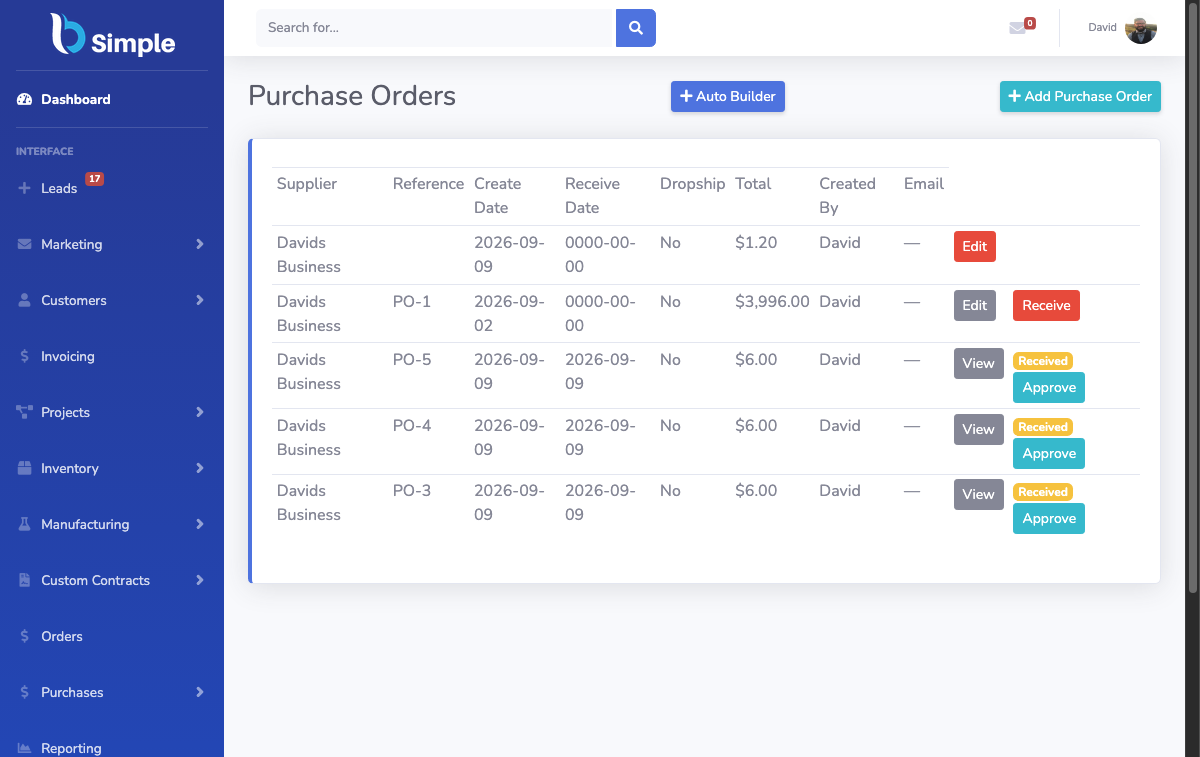
The loop is where supplier management stops being a document and becomes a control. An order is raised against the supplier — from a reorder level, a customer demand, or a deliberate buying decision — and approved deliberately. Goods arrive and are received against that order, with stock updating on receipt rather than whenever someone remembers to type. Partial deliveries split across receipts without losing the thread of what was ordered, what arrived, and what is still owed.
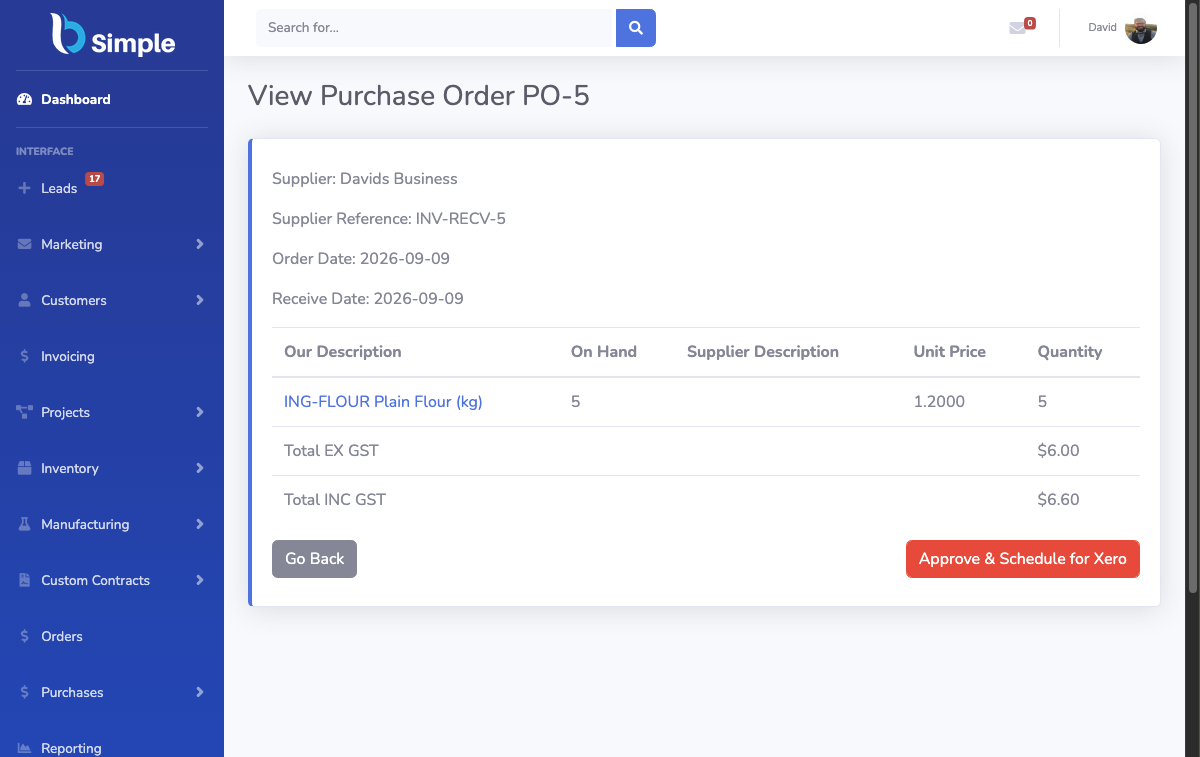
Because the receiving writes the stock record, the warehouse never depends on the invoice arriving first; because the order is on record, the invoice has something to be checked against. That matching — order, receipt, invoice — is the three-way discipline that keeps the purchase ledger clean enough for the accounting system to trust on arrival: the accounting flow receives finished work instead of a reconciliation project.
Price-variance flags: the forgotten feature
The quiet failure of supplier management is the invoice that does not match the order — a few cents up on a volume line, a price that drifted after the quote, a charge nobody remembers agreeing to. Individually invisible; over a year, real margin. A variance flag holds those invoices up at reconciliation instead of letting the difference vanish into totals: the operator sees the agreed price beside the invoiced price and decides — accept, query, or return.
The flag's deeper effect is behavioural: suppliers learn that price changes get noticed, and the drift stops at the source. Combined with GST-inc and ex-GST reconciliation views, it is also what makes tax time boring — the features overview covers where this sits in the wider purchasing toolkit.
From record to relationship
Managed well, the record changes the conversation with suppliers. Renewals become negotiations backed by facts: here is the lead-time history, here is the price drift, here is the shortfall record — not "we feel you've been slower lately". Reordering becomes an automated flow against the suppliers who earned it, and receiving runs at scan speed with barcode capture rather than a clipboard and a guessing exercise.
We build BSimple, so weigh that: supplier management there is part of the purchasing loop, not a separate module — orders, receipts, splits and variance flags in one ledger, with supplier performance implicit in the history. The trial is the full product: raise a real order, receive a partial delivery, and let an invoice arrive with a wrong price to see the flag hold it up — with inventory and procurement on one record as the loop this page sits in.
Frequently Asked Questions
What is supplier management in inventory software?
The record and the loop: each supplier's details, terms, lead times and supplied items, plus the purchasing cycle around them — orders raised and approved, goods received against orders, invoices matched, variances flagged. It turns supplier relationships into data the buying decisions can use.
What is a price-variance flag?
A check at reconciliation that compares the invoiced price with the ordered price and holds the invoice for review when they differ. It catches quiet price drift and billing errors at the moment they appear, protecting margins line by line.
How does receiving goods update inventory?
Goods are received against the purchase order, and the receipt writes inbound stock movements immediately — the shelf, the on-order picture and the record stay aligned without waiting for the supplier's invoice to arrive first.
How does supplier management feed accounting?
Through clean handoffs: matched purchase invoices with tax codes intact flow to the accounting system as finished work, so the books reflect what was actually ordered and received — the accounting boundary stays where it belongs.
How do I evaluate supplier management in a system?
In a trial, run the ugly path: raise an order, receive it partially, let an invoice arrive with a changed price, and see what the system does at each step. The flags and splits you find there are the difference between a record and an address book.
BSimple