
Guide / kitchen inventory
Is there free kitchen inventory management software that works?
For counting stock and building order lists, free tools genuinely work. For a kitchen that also sells — wholesale, batches, invoices — the honest answer changes.
The facts about free kitchen inventory tools
- Free genuinely covers: stock counts, par lists, order sheets and waste notes — on a spreadsheet or a free tier.
- The kitchen twist is the recipe: a kitchen is a mini-manufacturer, and recipes are the first thing free tools drop.
- Yield, waste and use-by dates make food counts harder than retail counts — the record must survive both.
- Selling changes everything: wholesale orders and invoices need a system, not a sheet.
- BSimple is not free — from $180/month (AUD) with a free trial — and suits kitchens that sell, not just cook.
- Context: the full inventory system holds the wider system, this page one stop in it.
- 01The facts about free kitchen inventory tools
- 02What free kitchen tools genuinely do well
- 03The recipe problem: a kitchen is a small manufacturer
- 04How to choose, by what the kitchen does
- 05Where BSimple fits — stated plainly
What free kitchen tools genuinely do well
A shared spreadsheet with a stock list, par levels and a weekly count solves the classic kitchen problem: knowing whether the stores will last until the next delivery. Add a camera phone for spot checks and a standing order sheet for suppliers, and a small kitchen runs honestly on free tools — the Sheets approach and the basic free options cover the setup. For a single kitchen with one person responsible for ordering, that is a legitimate long-term answer, not a compromise.
The gaps appear with the three things food does that stationery does not: it transforms (stock becomes dishes), it expires (use-by dates matter more than quantities), and it varies (yields and waste change what a kilo of onions is worth). Free tools handle counting; they do not handle transformation.
The recipe problem: a kitchen is a small manufacturer
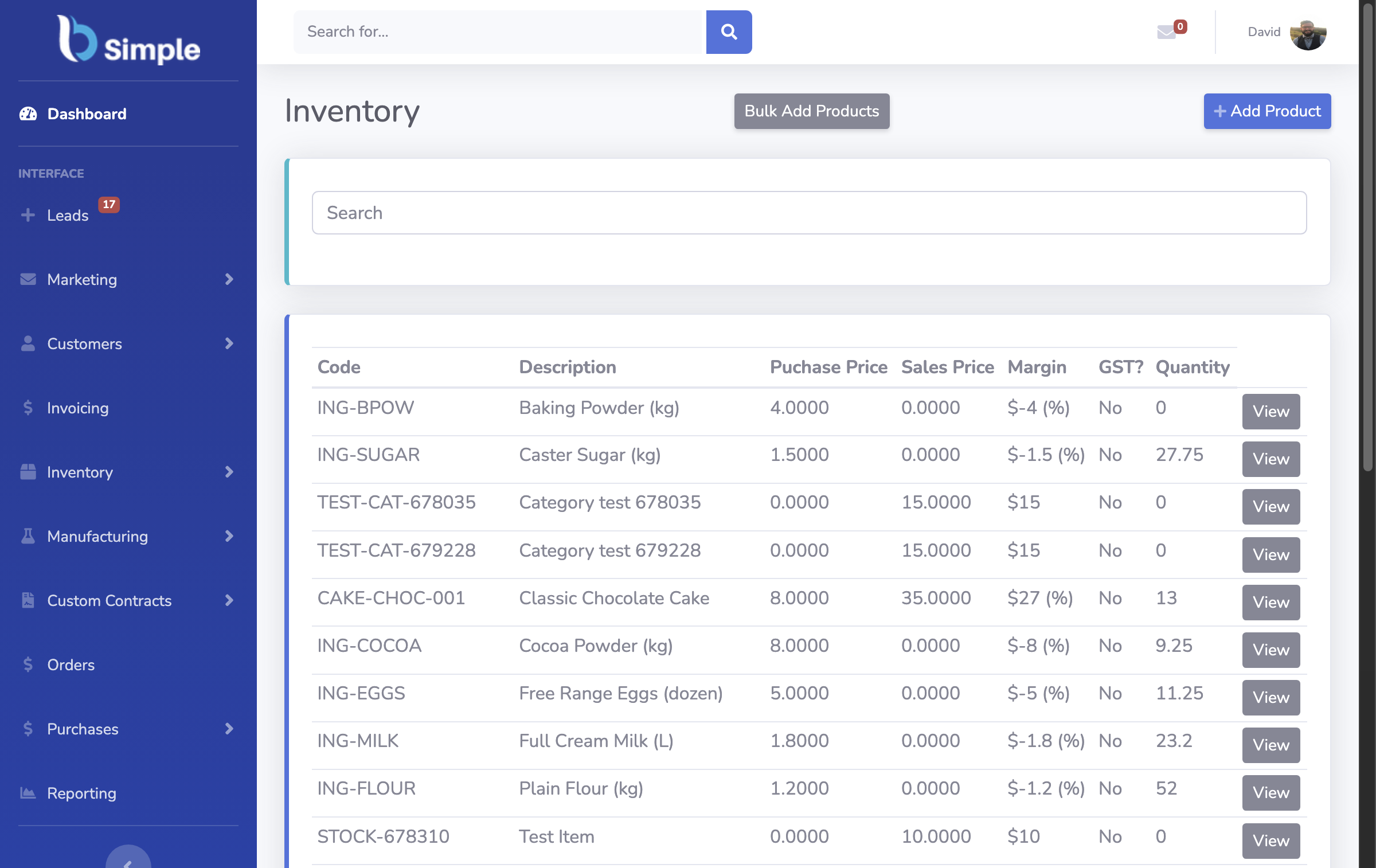
The moment you want to know what a dish actually costs, or what tonight's service will consume, recipes enter the picture — and recipes are a production feature. A kitchen inventory system worth the name converts dishes into ingredient demand: yield-adjusted, waste-aware, priced. That is exactly the layer free tools drop, and it is where the bakery workflow — a kitchen that sells — shows what the production layer looks like when it works.
The other wholesale-era needs follow: purchase orders raised from demand rather than memory, deliveries received against orders, batch and use-by tracking where provenance matters, and invoices that reach Xero or MYOB without a Sunday-night typing session. None of these are app-store features; they are system features, which is why the free tier of the market ends where they begin.
How to choose, by what the kitchen does
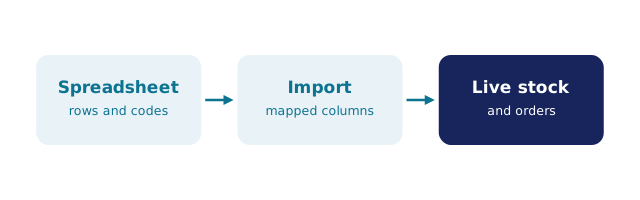
Cooks only (cafe staff meals, small menu): stay free — a sheet, pars and a count discipline. Sells retail with simple stock (bottles, bags, merchandise): a free tier or a light system covers it; the kitchen-specific guide walks the details. Sells wholesale, caters, or produces in batches: you need recipes, batches and the accounting handoff — a system, and the free tools have become the bottleneck rather than the bargain.
Whatever the choice, judge tools by one test: cost a real dish from real stock, including waste, and see whether the numbers survive contact with a week of service. The restaurant-side comparison covers the dining-room variant of the problem.
Where BSimple fits — stated plainly
We build BSimple, so weigh that. It is not free: plans start at $180/month (AUD) with a free trial. The fit is the kitchen that became a business — bakeries, producers, caterers and food manufacturers selling wholesale — where recipes with versions, production runs with shortage checks, batches with use-by dates, traceability for certification, and a customer ordering portal for trade buyers run on the same record as purchasing and invoicing, with the Xero or MYOB handoff.
If the kitchen does not yet sell, the free tools above are the right answer and BSimple would be overhead. If the kitchen sells and the spreadsheets are losing the count, the free trial with a week of your real production is the honest test — and the certification-grade traceability, for what it is worth, comes from food businesses who already run it.

Frequently Asked Questions
What is the best free kitchen inventory software?
A shared spreadsheet with stock counts, par levels and a delivery schedule — free, flexible, and enough for one kitchen with one owner of the record. Free tiers of commercial tools add multi-user access within caps. Neither handles recipes-as-production; that is the system layer.
Can free tools calculate recipe costs?
They can approximate it with careful spreadsheet formulas, but yields, waste and price changes break the maths quickly. Production-grade costing needs a recipes layer — ingredients, versions, batches — which is where free tools end and systems like BSimple begin.
When should a kitchen move to paid inventory software?
When it starts selling what it makes — wholesale orders, invoices, traceability questions from customers or certifiers. The record stops being a count and becomes the backbone of the business, and free tools cannot hold that weight.
Does BSimple handle food traceability?
Yes — batches with use-by dates, lot-level traceability search in both directions, and mass-balance reporting supporting ACO, NASAA and OFC certification. Food producers run this today; it is built into the core plans rather than sold separately.
What does BSimple cost a kitchen business?
Plans start at $180/month (AUD) with recipes, batches, purchasing, the ordering portal and the Xero or MYOB handoff included. Run one week of real production through the free trial — if the numbers it produces would take your spreadsheet a month to get wrong, the fit is proven.
BSimple