
Guide / process management
Business process management solutions — how they are actually packaged
"Solution" is the vaguest word in software. The three shapes BPM is sold in, the process shape that should drive the choice, and BSimple's position as embedded process.
The key facts
- BPM is sold in three shapes: modelling suites (draw any process), rules engines (encode decisions), and embedded processes (the record carries the workflow).
- Match the shape to the process: unusual processes need modelling; unusual decisions need rules; common processes need embedding.
- The honest boundary: BSimple is not a BPM suite — processes like order approval and purchasing are built into the record, not drawn.
- The accounting boundary holds across all three: BSimple hands invoices to Xero and MYOB; US integrations are rolling out.
- Context: the full inventory system holds the wider system, this page one stop in it.
- 01The key facts
- 02The three shapes of BPM solution
- 03Matching the solution shape to your operation
- 04BSimple's position, plainly
The three shapes of BPM solution
Modelling suites let you draw any process — swimlanes, gateways, escalations — and execute it. Their power is generality; their price is that someone must become the company's process author, and the model can drift from what the floor actually does. Right answer when your processes are genuinely unusual or compliance-driven.
Rules engines separate decisions from code — credit limits, approval thresholds, eligibility — so the business can change the rule without a developer. See the rules-engine angle for where that becomes necessary.
Embedded processes skip the canvas: the workflow is built into the record itself. An order is placed, checked, picked, packed, invoiced — not because someone modelled it, but because that is what the product does. The trade is flexibility for reliability: every business gets the same proven process, and nobody has to maintain a diagram that matches reality.
Worked examples and the vendor landscape cover both ends of this spectrum in detail.
Matching the solution shape to your operation
Ask one question per process you care about: is this process common to every business like mine, or specific to mine? Receiving orders, checking stock, approving invoices, counting shelves — common; embed them and the software vendor maintains them. An approval chain that routes by regulatory region, or a claims process with statutory steps — specific; that is modelling-suite territory, and buying an operations product that cannot express it will end in frustration.
The second question is who maintains it: an embedded process is the vendor's problem and improves with their roadmap; a modelled process is yours, forever, including the day its author leaves. Small and mid-size businesses routinely underestimate that second cost — the operations dashboard is only truthful if the processes feeding it actually run as drawn.
BSimple's position, plainly
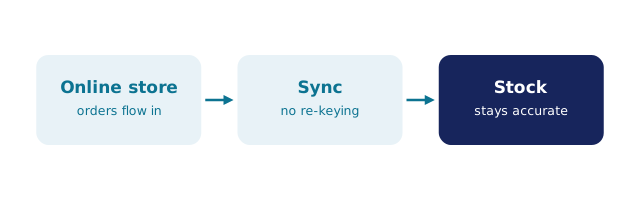
We build BSimple, so weigh that. It is the embedded shape: ordering, purchasing, invoicing, counting and production run as built-in processes on one record — states, rules and trails included — rather than as diagrams you draw first. For wholesale, manufacturing, distribution and trade operations, those are the processes that need managing, which is why embedding beats modelling at this size. The boundary is deliberate: no arbitrary workflow canvas, and accounting stays with the accounting system — Xero and MYOB established, US integrations rolling out.
If a process you need is genuinely bespoke, the honest advice is to weigh a suite; if your processes are the common ones wearing you down, the trial runs them on your products in an afternoon.
Frequently Asked Questions
What is a business process management solution?
Software that makes a process managed rather than remembered: a state showing where each instance sits, a rule governing when it moves forward, and a trail of who did what. It arrives as a modelling suite, a rules engine, or processes embedded in an operations product — the three shapes above.
Is BSimple a BPM suite?
No — no process canvas, no swimlanes. BSimple embeds the core wholesale and manufacturing processes directly in the record. If you need to model processes the software has never heard of, a suite is the right tool; if you need the common ones to simply run, embedding is faster.
Which processes should stay modelled, even at small scale?
Ones with statutory or contractual gates — approvals with compliance consequences, regulated claims, anything an auditor traces step by step. The moment an external body defines the process, modelling it explicitly usually beats hoping an embedded process matches.
How do we tell if our processes are "common enough" to embed?
Describe your process to another business in your industry without naming tools. If they can follow it, it is common — and a product that embeds it will serve you. If they ask three questions, it is specific enough to model.
What does embedded process software cost compared to a suite?
BSimple is $180/$250/$399 per month AUD with the embedded processes included. Suites price higher once licences, modelling effort and ongoing process ownership are counted — but comparing them fairly means pricing your own maintenance time, not just subscriptions.

BSimple