
Guide / who uses what
Which software is used for inventory management?
Depends who is asking: retailers lean POS-connected, wholesalers run operations systems, makers need recipes and batches — and everyone starts in a spreadsheet.
The facts about who uses what
- The honest answer is by role: the software in use mirrors the workflow — selling, moving, making — not a single winner.
- Spreadsheets are the most-used inventory tool on earth, and legitimately so at small scale.
- Retail leans POS-connected; wholesale and distribution lean operations platforms; manufacturers need recipes and batches.
- Accounting handoff to Xero or MYOB is the common thread across every serious answer.
- BSimple is the operations-and-production answer for product businesses — from $180/month (AUD) with a free trial.
- Context: the full inventory system holds the wider system, this page one stop in it.
- 01The facts about who uses what
- 02What different businesses actually run
- 03Why there is no single "most used" answer
- 04The spreadsheet question, answered honestly
- 05Where BSimple sits in the answers
What different businesses actually run
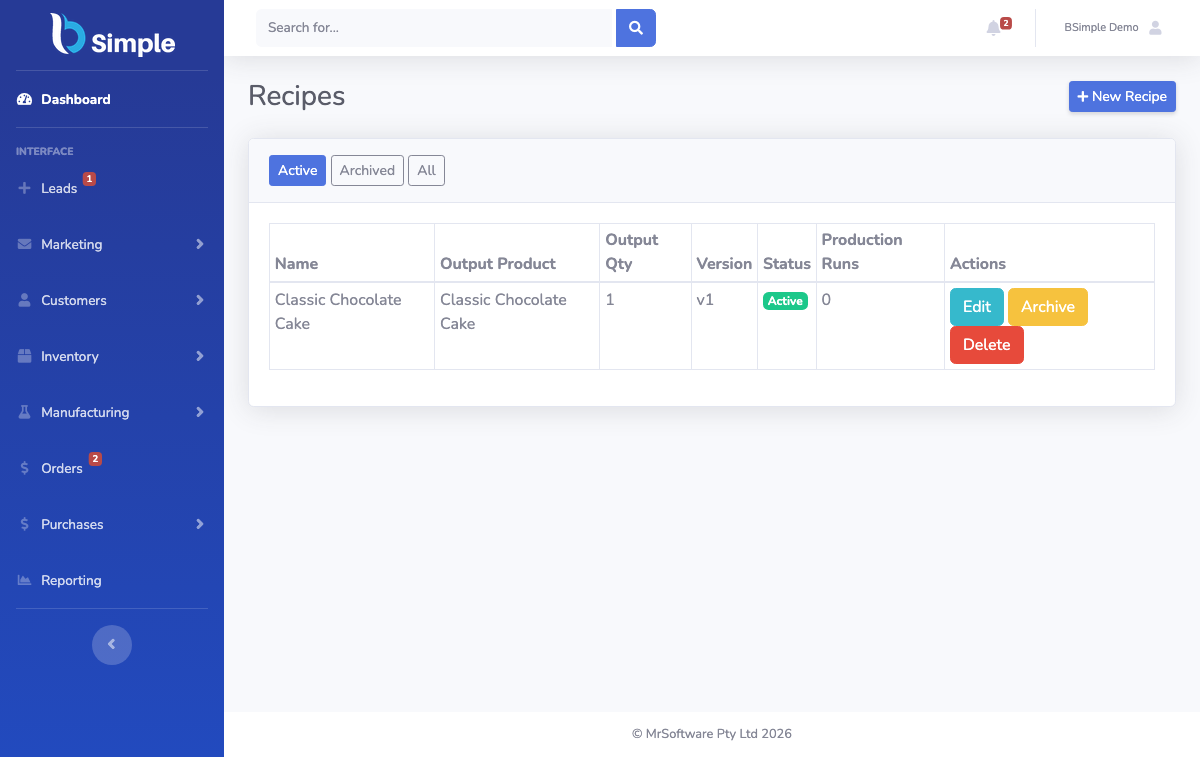
Market sellers and single-store retailers mostly run their point-of-sale system's stock module, sometimes alongside a spreadsheet for backroom counts. It works while there is one channel and one location. Cafes, restaurants and kitchens use food-cost or recipe apps — and when they grow into wholesale (a bakery selling to cafes, say), they outgrow them into operations systems. The bakery example shows that jump.
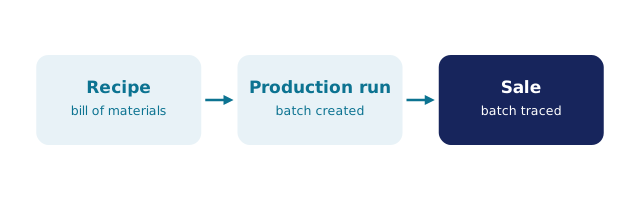
Wholesalers and distributors — the businesses where inventory is the core asset — run operations platforms: one record across stock, orders, purchasing and invoicing. This is BSimple's category; the tell is a customer portal and purchase orders, not just counts. Manufacturers need the production layer on top: recipes or bills of materials, production runs, batches with use-by dates, traceability. And ecommerce sellers run a store plus, once wholesale or second channels appear, a backend that holds one record behind all of them — the ecommerce comparison covers that case.
Why there is no single "most used" answer
The question assumes one software wins everywhere. Inventory software is workflow-shaped: the tool a three-person Etsy shop uses would sink a feed mill, and the system a distributor runs would be absurd at a market stall. What actually correlates across every serious answer is not the brand — it is the capabilities: live quantities, purchase orders raised from demand, counting that reconciles, and an accounting handoff to Xero or MYOB so the books stay true without re-entry.
So the useful version of this question is: "which software is used by businesses like mine?" Answer by role above, then test the shortlist against your own workflow. The systems-types guide explains the categories behind the brand names if you want the vocabulary first.
The spreadsheet question, answered honestly
Any truthful page about "which software is used" has to start here: more businesses track inventory in spreadsheets than in anything else, and at small scale that is the correct choice. The exit signs are consistent — a second person needing the record, stock promised before it is invoiced, counts that stop reconciling — and they arrive at a business size that surprises people, well before "enterprise". The suitability guide turns those signs into a decision you can make in an afternoon.
When the exit arrives, the businesses that move successfully pick by workflow fit and test with their own products — not by review rankings. That is also why BSimple runs a full-featured free trial: the question "which software is used" matters less than "which software works for you", and only your products can answer that.
Where BSimple sits in the answers
We build BSimple, so weigh that. In the landscape above, BSimple is the operations-plus-production answer used by Australian and international wholesale, manufacturing, distribution and trade businesses: inventory, orders, purchasing, invoicing and a customer ordering portal on one record; recipes, batches and traceability where things are made; Shopify orders joining the same flow by webhook; accounting handed to Xero or MYOB. From $180/month (AUD), cloud-based, no module fees.
It is not the answer for everyone — a single-channel retailer is fine at the POS, and a distribution centre needs a WMS. If your business sits between those — stock, orders, customers and possibly production on one record — start the free trial and see why businesses in that position use systems like this one.

Frequently Asked Questions
What is the most commonly used inventory management software?
By user count, the spreadsheet. By businesses that depend on inventory daily, operations platforms sized to the workflow: POS-connected tools in retail, operations systems in wholesale and distribution, production systems in manufacturing. The honest answer follows the workflow, not a leaderboard.
What software do wholesalers use for inventory?
Operations platforms that hold one record across stock, orders, purchasing and invoicing — with a customer ordering portal and accounting handoff. That is BSimple's category: built for businesses whose core asset is stock and whose core workflow is order-to-invoice.
Do manufacturers use the same inventory software as distributors?
Distributors can run on the operational layer alone. Manufacturers need the production layer too — recipes, production runs, batch traceability with expiry. BSimple builds both into the same record; others sell production as a separate module. Ask any vendor exactly where that line sits.
Is Xero integration standard across these systems?
For Australian businesses it should be — Xero (and MYOB) handoff is the feature that saves the most hidden labour. BSimple pushes approved invoices across and mirrors payment status back. If a system exports CSVs for the accountant, it is missing the feature that matters most.
How do we know which one our business should use?
Shortlist by workflow (selling, moving, making), then test with your own products in a trial — receive, sell, count, reconcile. The free trial exists for exactly that, and the system your team runs correctly on day one is the one to choose.
BSimple