
Guide / system types
What are the types of inventory management system?
Periodic or perpetual, standalone or ERP-bound, warehouse-scale or production-deep — the systems differ on where the record lives and how often it updates.
The facts about inventory management systems
- There are four working types: periodic (spreadsheet-counted), perpetual (live record), warehouse management systems, and production-focused systems.
- The dividing line is the moment of truth: when does the record update — at the yearly count, or with every movement?
- Perpetual systems are the default for product businesses past the one-person stage.
- WMS and production systems are specialisations — directed picking, or recipes and batches — layered on the perpetual idea.
- BSimple is a perpetual system with production depth, from $180/month (AUD) with a free trial.
- Context: the full inventory system holds the wider system, this page one stop in it.
Type 1 and 2: periodic versus perpetual
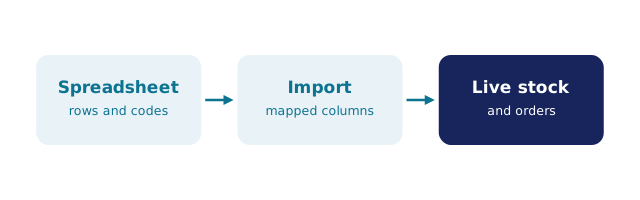
Periodic systems correct the record at counts. A spreadsheet is the classic form: quantities edited after sales and deliveries, trusted fully only at the annual stocktake. Legitimate for one person and modest volume; structurally blind between counts, which is where overselling hides.
Perpetual systems post every movement as it happens — sale, receipt, transfer, adjustment — so the record is current at the moment someone needs it. This is the category most modern software lives in, including BSimple: one record shared by sales, warehouse and accounting, which is why the three never disagree. The design examples page compares these two architectures in detail.
- 01The facts about inventory management systems
- 02Type 1 and 2: periodic versus perpetual
- 03Type 3 and 4: warehouse-scale and production-focused
- 04Choosing a type by your bottleneck
- 05Where BSimple sits among the types
Type 3 and 4: warehouse-scale and production-focused
Warehouse management systems (WMS) specialise the perpetual idea for large operations: bin-level locations, directed put-away, wave picking, labour measurement. They pay for themselves at distribution-centre volume — thousands of orders a day, accuracy scored per picker — and are expensive overkill below it. Most SMBs meeting a WMS in a demo are seeing depth they will never reach.
Production-focused systems specialise in the other direction: stock that transforms. Multi-level recipes and bills of materials, production runs with shortage checks, batch creation with use-by dates, and traceability from input lot to dispatched order. Food, beverage, cosmetic and health manufacturers need this layer; pure distributors rarely do. The bill-of-materials guide covers the recipe side specifically.
ERP suites bundle all of the above with finance and HR — the everything option, priced and timed accordingly, right at enterprise scale.
Choosing a type by your bottleneck
Let the failure in front of you choose. If the record is simply wrong at every count, the step up is periodic-to-perpetual: one live record everything posts to. If the record is fine but the warehouse floor is chaos, that is WMS territory — but check the order volume first, honestly. If you make what you sell and ingredients vanish into products, you need the production layer, and a perpetual system without recipes will disappoint within a month.
Volume and hands still gate everything: the suitability guide turns that into three signals, and the design examples show what each choice looks like built.
Where BSimple sits among the types
We build BSimple, so weigh that. It is a perpetual system — one live record across locations, orders, purchasing and invoicing — with the production specialisation built in: multi-level recipes, production runs, batches with expiry, and traceability search that supports ACO/NASAA/OFC mass-balance reporting. Barcode scanning runs in the browser on any phone, a customer portal handles B2B ordering, and accounting hands off to Xero or MYOB. From $180/month (AUD), Australian-built, with a free trial instead of a sales gauntlet.
The type it deliberately is not: a WMS. No directed slotting, no wave picking, no labour management — at distribution-centre scale a dedicated WMS is the right answer. For everything between the spreadsheet and the distribution centre, the free trial with your own products settles which side of that line you are on.
Frequently Asked Questions
What are the main types of inventory management system?
Four working types: periodic (record corrected at counts, usually a spreadsheet), perpetual (live record updated with every movement), warehouse management systems (perpetual plus directed warehouse work at scale), and production-focused systems (recipes, batches, traceability). ERP suites bundle all of these with finance and HR.
Which type does a small business need?
Usually perpetual, once orders arrive daily or a second person needs the record. Periodic remains legitimate for one person and modest volume. WMS-grade depth is almost never the answer at small scale, whatever the demo suggests.
What is the difference between perpetual and periodic?
When the record updates. Periodic is corrected at counts — true at year end, approximate between. Perpetual posts every movement as it happens, which is what makes overselling preventable rather than discoverable, and stocktakes reconcilable rather than revelatory.
Do manufacturers need a different type of system?
They need the production layer: recipes or bills of materials, production runs that consume inputs and create batched outputs, and traceability for regulated goods. A perpetual system without those will disappoint a manufacturer quickly — it is why BSimple builds them into the core rather than selling them as modules.
Can one system cover retail, wholesale and production?
If it holds one record behind every channel and adds the recipe layer, yes — that is BSimple's design: Shopify orders and B2B portal orders drawing on the same stock, production batches with use-by dates, invoices to Xero or MYOB. Systems that keep channels in separate records cannot honestly make the same claim.
BSimple