
Guide / two meanings
Order management in trading — a different meaning, honestly separated
This search lives in finance: OMS there routes buy and sell orders to exchanges. It is a different product from goods-order management — here is what it means, and why the two should not be confused.
The key facts
- In trading, an OMS routes orders to markets: bid/ask orders, matching, fills, positions, broker/exchange connectivity — software for securities, not goods.
- In operations, an OMS runs customer orders: stock checks, picking, packing, invoicing — the goods meaning, and BSimple's field.
- The overlap is vocabulary only: "orders" and "fills" mean entirely different things; software for one does not do the other.
- The honest boundary: BSimple does not do trading — no market data, no brokerage, no positions. This page separates the meanings so you land in the right category.
- Where it fits: this page is one step of the order management walkthrough.
- 01The key facts
- 02What an OMS means in trading
- 03How it differs from goods-order management
- 04BSimple's position, stated plainly
What an OMS means in trading
In financial markets, an order management system is the software between a trader (or an algorithm) and the market: it places, routes, modifies and cancels buy and sell orders for securities — shares, futures, currencies, crypto — tracks each order's lifecycle (received, routed, partially filled, filled, cancelled), maintains positions and exposures, enforces risk limits, and connects to brokers or exchanges through market protocols. Speed, audit and regulation dominate its design; a fill is a legal event, and the surrounding compliance (best-execution records, audit trails) is the industry's burden and its discipline.
Adjacent terms: the EMS (execution management system) focuses on routing and market access; the trading OMS may bundle it. None of this touches a warehouse. The plain order-in-trading glossary and the order-lifecycle FAQ cover the vocabulary if the finance meaning is the one you wanted.
How it differs from goods-order management
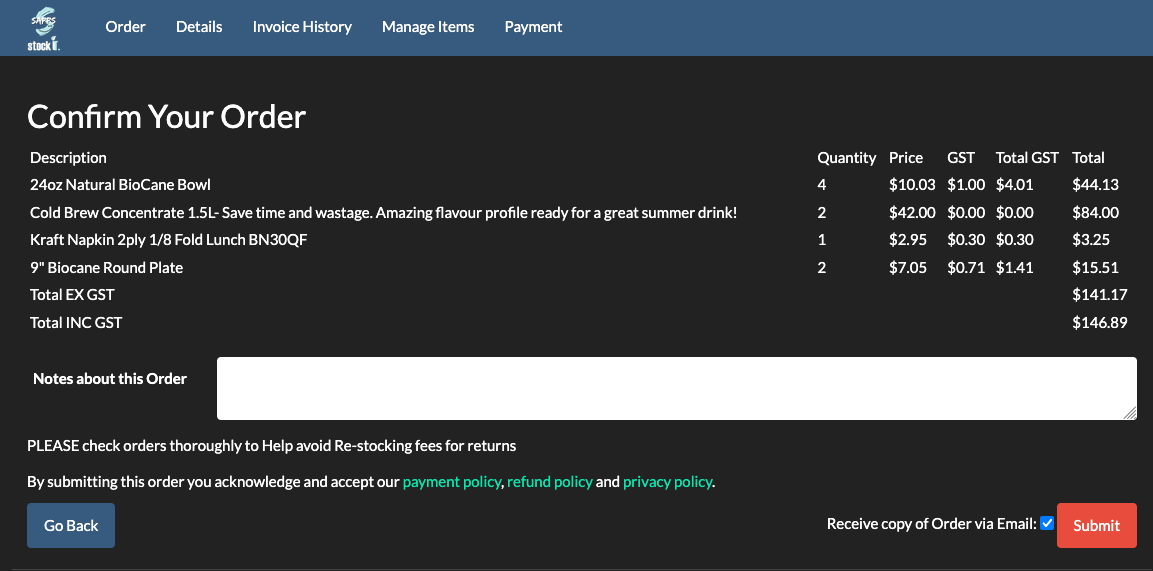
The overlap is the word "order" — the products are opposites. A trading OMS moves money instruments between counterparties at market speed; its "inventory" is positions and cash; its enemy is latency and regulatory breach. A goods OMS — BSimple's meaning — moves physical stock through fulfilment; its inventory is products on shelves; its enemy is overselling and re-keying. A trading OMS has no pick list; a goods OMS has no exchange connectivity. Software marketed under one meaning will not serve the other, however shared the vocabulary looks in a feature matrix.
The tell is the object being ordered: instruments versus items. If your search was really about tracking customer orders for physical goods — wholesale, manufacturing, distribution — you are in goods territory, and the goods-OMS definition is the honest starting point.
BSimple's position, stated plainly
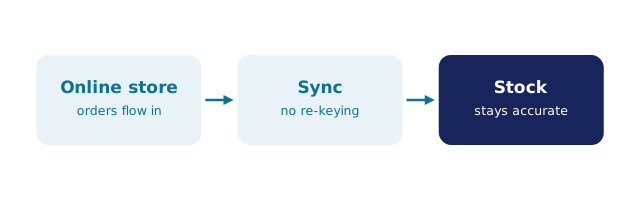
We build BSimple, so weigh that: it is goods-side order management — Australian operations software for wholesale, manufacturing, distribution and trade. Orders arrive from customer portals or synced stores, check against live stock, move through picking and packing, and become invoices pushed to Xero or MYOB (US integrations rolling out). It has no trading capability whatsoever — no market data, no brokerage, no positions — and this page exists partly to say that clearly, because the two meanings of "order management" send enough people to the wrong category already. From $180/$250/$399 per month AUD, with the trial as the full product.
Frequently Asked Questions
What is an order management system in trading?
Software that routes, tracks and records buy/sell orders for financial instruments — placements, fills, positions, risk limits and exchange or broker connectivity. It is finance software for securities, unrelated to goods-order management despite the shared name.
Does BSimple do trading or investments?
No — no market data, no brokerage, no securities of any kind. BSimple manages customer orders for physical goods: stock checks, fulfilment, invoicing. The boundary is stated rather than blurred.
Why do the two products share a name?
Because both manage "orders" — commitments between parties. Finance orders commit trades at market speed; goods orders commit stock through fulfilment. The vocabularies (fills, fills-versus-picks!) diverge immediately; only the search results overlap.
Can a trading firm also use BSimple for its office stock?
If it has physical goods — merchandise, equipment, supplies — the operations record applies as it would to any business. Its trading OMS remains a separate, finance-side system; the two never touch.
My search was about goods orders after all — where next?
The goods-OMS definition and the order life cycle are the starting points, and the trial runs a real order through the whole path in an afternoon.

BSimple