
Guide / order management
The order management life cycle, stage by stage
Every order travels the same road — placed, checked, picked, packed, invoiced, paid. Where each stage breaks in real businesses, and what a system must carry between them.
The key facts
- Six stages: placed → checked against stock → picked → packed → invoiced → paid. Each produces a record the next stage depends on.
- Breaks happen at handoffs: between the phone call and the spreadsheet, between the warehouse and the invoice, between the invoice and the books.
- The life cycle is a state machine: at any moment an order is in exactly one stage, and the system — not a person — should know which.
- BSimple runs this cycle on one record, from the customer portal through pick/pack to an approved invoice that pushes to accounting.
- 01The key facts
- 02Stage by stage, and where each one breaks
- 03Why the life cycle concept matters more than the diagram
- 04Running the cycle on your own products
Stage by stage, and where each one breaks
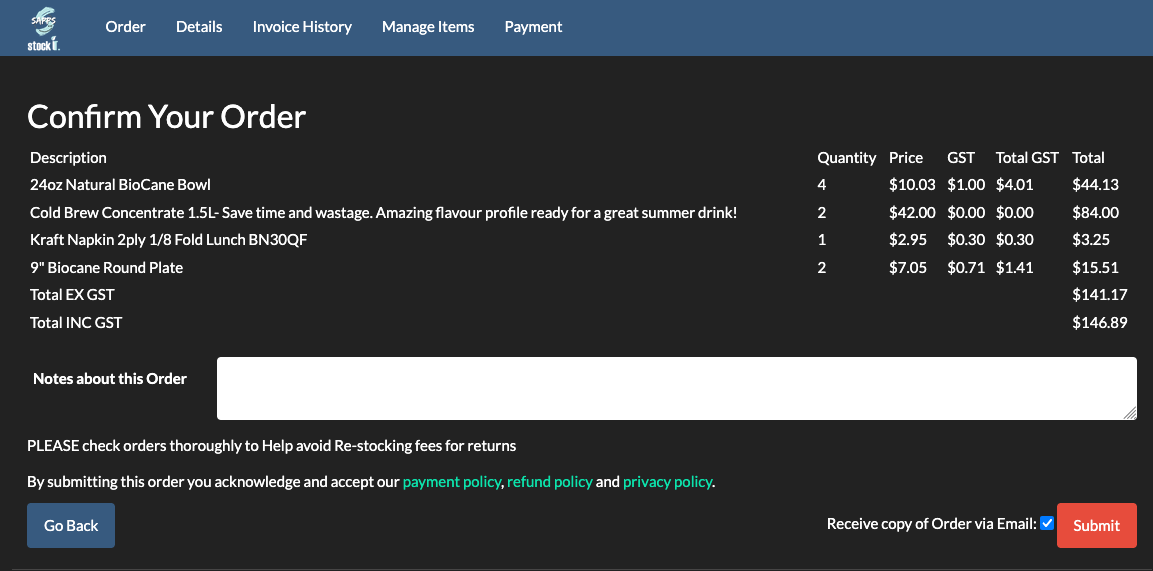
1. Placed. The order enters the system — through a customer ordering portal, a phone call, or a synced store. Breaks here look like half-copied details: a SKU misheard over the phone, a delivery address in a text message, a price from last month's list.
2. Checked. Stock is confirmed against live quantities, including amounts already promised to other customers. This is the stage manual processes fake — a spreadsheet "checked" at 9am is a rumour by 2pm. Selling stock that was already promised is the classic symptom.
3. Picked. The floor gets a list they can work from, in an order that makes sense of the warehouse walk. Breaks: picking from memory, or from a printout that two other people printed too.
4. Packed. Packing slips and dispatch — the last moment to catch a wrong quantity before the customer does.
5. Invoiced. The checked order becomes an invoice without re-entry, approval is a deliberate step, stock deducts, and the invoice flows to accounting with its tax treatment intact.
6. Paid. Payment status mirrors back from the books to the order record. The life cycle ends with the same truth on the operational and accounting sides — not two numbers someone has to reconcile by email.
Why the life cycle concept matters more than the diagram
Drawn on a whiteboard, the six stages look orderly. In software the value is that stages become states: an order is placed, picking, invoiced or paid, and everyone — sales, the floor, the customer — sees the same state instead of asking someone. That is also what makes the wider order-management activities legible: exceptions surface as orders sitting too long in one state, rather than as a phone call three days late.
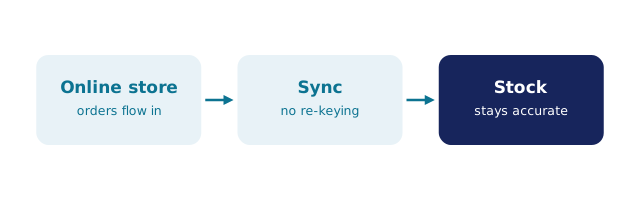
The definition page — what is order management software — covers the system side of this; the life cycle is the process side. Software earns its keep by carrying the order between states without re-keying: the quantity picked becomes the quantity packed becomes the quantity invoiced, or the mismatches become visible immediately rather than at month-end.
Running the cycle on your own products
The fastest audit of your current life cycle is timing it: take a real order today and note the timestamp at each stage change, plus every time someone re-typed or re-checked information that already existed. Most businesses find two or three handoffs that add hours and no value.
BSimple's trial runs the full cycle — portal order to pick list to invoice — in an afternoon, and the order management page walks each step in this order. For the small-business evaluation angle, the shortlist page covers what to compare.
Frequently Asked Questions
What are the stages of the order management life cycle?
Placement, stock check, picking, packing, invoicing and payment. Some businesses split picking and packing, or add delivery confirmation — the count varies, but the dependency chain does not: each stage produces the record the next one consumes.
At which stage do most order errors happen?
At handoffs — re-keying between systems, or copying between paper and screen. That is why the stage boundaries matter in software: an order that moves from placed to invoiced without re-entry has no handoff to fail.
When should stock be deducted in the life cycle?
Where the business can commit honestly. In BSimple, stock deducts at invoice approval — quantities stay sellable while the order is being assembled, and the deduction happens once, deliberately, rather than at several conflicting moments.
How does the customer see the life cycle?
Through their portal: their own products, pricing and order history, with the order's state visible rather than tracked in messages. Status changes are recorded against the order — approved, packed, invoiced, paid.
Is the life cycle different for wholesale vs retail?
The stages are the same; the pressure differs. Wholesale adds per-customer pricing and repeat orders, which makes the placed and checked stages heavier; retail compresses the cycle to seconds at the counter. The record design serves both.
BSimple