
Guide / the order, dissected
Order management activities
"Order management" is six activities wearing one name: capture, validation, fulfilment, invoicing, returns, communication. Businesses that struggle with orders are usually weak at two of them. Here is each activity, and where BSimple runs it.
The key facts
- The six activities: capture, validation, fulfilment, invoicing, returns, communication — each with its own failure mode.
- The connecting rule: every activity works from the same order record, or the six drift apart and reconciliation is born.
- The usual weak pair: validation (orders arrive wrong) and communication (customers chase what nobody can see).
- BSimple's coverage: all six on one record — portal capture, live validation, pick/pack, approved invoicing to Xero/MYOB, returns via the books, status visible to all.
- 01The key facts
- 02Activities 1 to 3 — capture, validation, fulfilment
- 03Activities 4 to 6 — invoicing, returns, communication
Activities 1 to 3 — capture, validation, fulfilment
Capture is where orders enter the record: portal, phone, store import. The design goal is "captured correctly the first time" — the customer's own product list and pricing (in BSimple, via their portal link), not a transcription of someone's handwriting. Validation is the moment wrong orders get caught: does the stock exist live, does the price match the customer's agreement, is the delivery window real? Systems without live validation validate at the dock, which is the most expensive place to learn an order was wrong. Fulfilment turns the validated order into a dispatched one: pick sequence, packing slips, partial shipments handled as a state of the order rather than a note field.
Each activity inherits the previous one's quality. A capture that is wrong is validated against the wrong truth; a validation that is late is fulfilled wrong; a fulfilment without history cannot be communicated — which is the next pair.
Activities 4 to 6 — invoicing, returns, communication
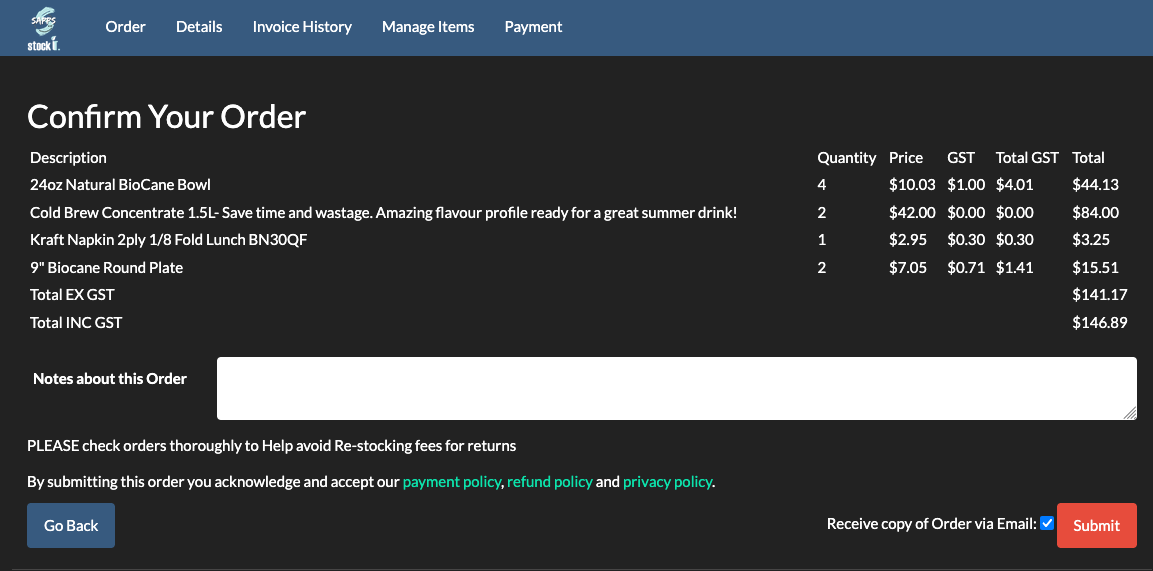
Invoicing is the controlled conversion of a fulfilled order into a financial document: in BSimple, a deliberate approval step — quantities commit, stock deducts, and the invoice pushes to Xero or MYOB with payment status mirroring back. Returns are orders running in reverse: the credit note, the restock decision, and the quantity returning to the record with its reason attached — not a memo. Communication is the activity that hides inside all the others: the customer's status view, the buyer's order history, the "where is my order?" answered from the record rather than from someone's memory of an inbox. In BSimple the customer portal makes it self-service, which is why the phone stops ringing about it.
The connecting rule across all six: one order record. Every activity that works from a copy — a spreadsheet of orders, a folder of pick notes, an inbox of status requests — is where drift begins. What order management software is covers the system-level view, order tracking for small business the visibility layer, and the order management guide the whole path.
Frequently Asked Questions
What are the main order management activities?
Capture, validation, fulfilment, invoicing, returns, and communication. Together they describe everything between "a customer wants to buy" and "the exchange is fully settled and both sides can see it".
Which activity do businesses usually get wrong?
Validation and communication. Orders arrive wrong because capture was a transcription, and customers chase status because nobody can see it — both are record problems, not people problems.
How does BSimple handle returns?
As reverse movements on the record: the credit note connects to the original invoice through the accounting system, and restocked quantities return with their reason attached — history, not guesswork.
Can different staff own different activities?
Yes — permissions match the job: one team captures and validates, the floor fulfils, an approver invoices. Every action lands on the audit trail under the account that made it.
How do we test all six activities quickly?
One order, end to end, on your real products: capture it through the portal, watch validation against live stock, pick and pack it, approve the invoice, return one line, and check what the customer saw at each step. The trial is that afternoon.
BSimple