
Guide / types and examples
Types of inventory management system, with examples
Two axes decide the type: how the record is kept (periodic or perpetual) and how much of the business it carries (stock only, stock plus orders and invoicing, or everything). Here are the types with a concrete example of each.
The key facts
- By record-keeping: periodic (counted at intervals) vs perpetual (updated by every movement).
- By scope: stock-only tools; operations systems adding orders, purchasing, invoicing; ERP suites adding HR, MRP and finance.
- The example that separates them: what happens to the quantity after a sale — nothing until the count, or instant deduction.
- BSimple is a perpetual, operations-first system — inventory, orders, purchasing, invoicing on one record, from $180/month (AUD).
- 01The key facts
- 02Periodic vs perpetual — the first split
- 03By scope — three widths of system
- 04Choosing by your example, not the taxonomy
Periodic vs perpetual — the first split
A periodic system corrects the record by counting. Example: a retailer who counts the store room every Sunday and adjusts the spreadsheet — quantities between counts are estimates, and any error lives there until the next count. Periodic is honest at low volume, and most spreadsheets are periodic systems whether their owners know it or not.
A perpetual system updates the record with every movement: receive a purchase order and stock rises, pick an order and it falls, adjust at a count and the variance posts. Example: a wholesaler whose screen says 42 units, where 42 already includes this morning'"'"'s packed order. Perpetual requires software doing the recording — no spreadsheet stays perpetual for long — and it is the precondition for live availability, overselling guards and meaningful reorder levels.
By scope — three widths of system
Stock-only tools keep quantities and little else. Example: an app for a market stall tracking 50 items by phone. Cheap, simple, and blind to why quantities move.
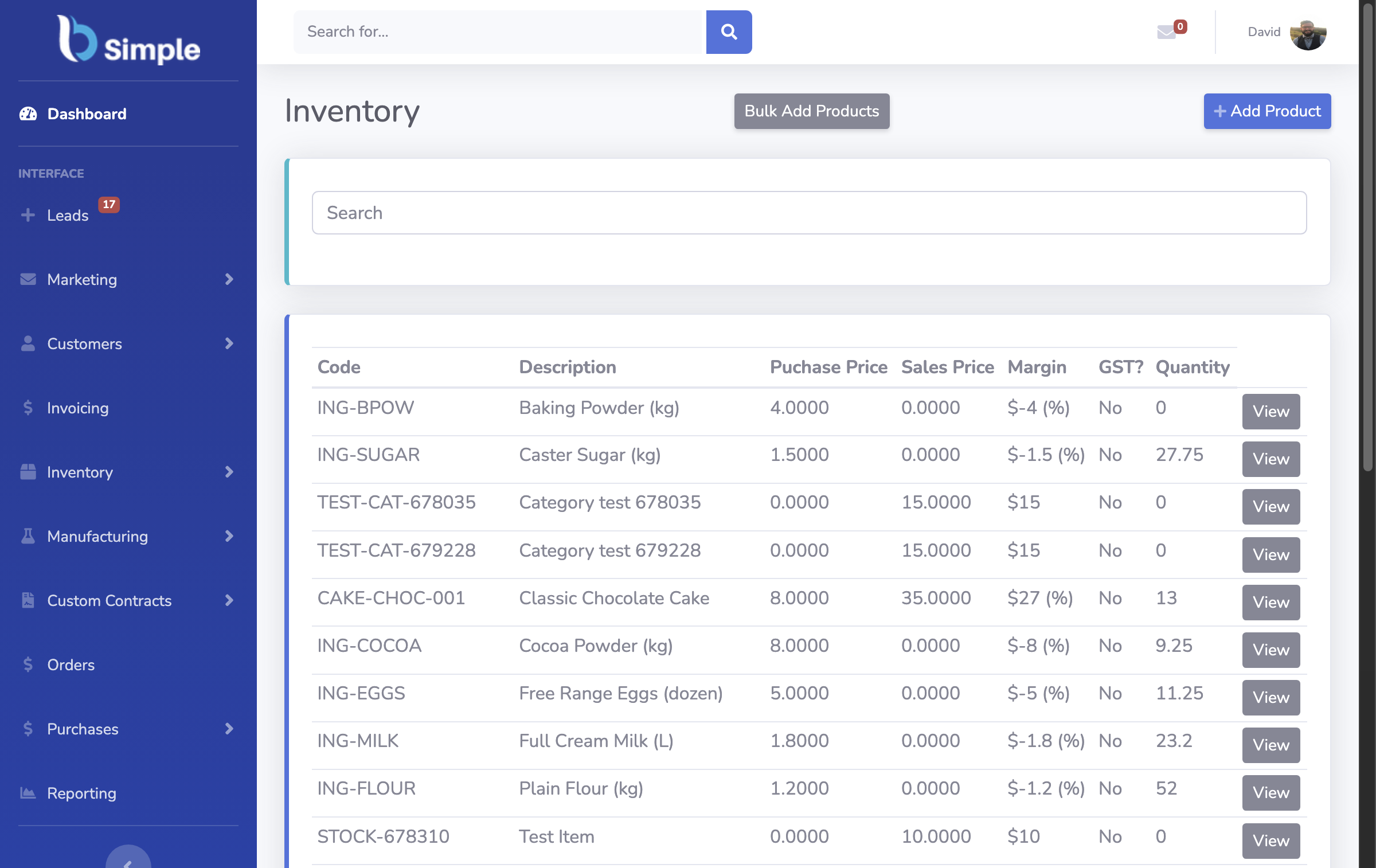
Operations-first systems put inventory on the same record as what consumes it: purchasing, orders, fulfilment, invoicing. Example: a distributor raising a purchase order from reorder levels, receiving it, taking wholesale orders through a portal, picking and invoicing — each step updating the same quantities. BSimple is in this category, built for wholesale, manufacturing, distribution and trade businesses.
ERP suites carry the widest scope — inventory plus MRP scheduling, HR, payroll and finance. Example: a large manufacturer running production planning across plants with dedicated system administrators. Deep and expensive; the right answer only when the extra scope is genuinely the job.
Choosing by your example, not the taxonomy
The types matter because they predict failure. A periodic record fails when decisions need live quantities; a stock-only tool fails when orders must be fulfilled against the record; an operations system fails (by being overkill) for a one-person stall. Match the type to the moment your current record actually breaks: wrong quantities at sale, purchases raised from memory, or invoices that disagree with stock.
For worked versions of these examples, the inventory control system examples page shows the records in different operating contexts, real-life examples show day-to-day running, and small-business examples walk the four records every system keeps. The full picture is in the inventory management guide, and any type can be tested against your own stock in a free trial.
Frequently Asked Questions
What are the main types of inventory management system?
Two classifications. By record-keeping: periodic (corrected by counting) and perpetual (updated by every movement). By scope: stock-only tools, operations-first systems that add purchasing, orders and invoicing, and ERP suites that add everything else. Most real choices are made on the second axis.
Is a spreadsheet a periodic or perpetual system?
Periodic in practice: without software recording movements, the sheet is corrected at counts and estimated in between. It is a legitimate type at small scale — the failure arrives when a decision between counts needs a number that is actually true.
What type of system is BSimple?
Perpetual and operations-first: every receipt, pick, adjustment and count updates live quantities, and the same record carries purchasing, orders, the customer portal and invoicing, with the accounting handoff to Xero or MYOB. It is not an ERP — no MRP scheduling, HR or payroll.
Which type does my business need?
Choose by the first failure you cannot afford: if quantities go wrong between counts, you need perpetual; if orders must be fulfilled against trusted stock, operations-first; if you need MRP and HR inside the system, ERP territory. A trial on your own products tests the answer in an afternoon.
BSimple