
Guide / control, by rule
Inventory control system examples
A control system is not a gadget — it is a rule about quantities, enforced by software. Four examples cover most businesses: perpetual tracking, par-level reordering, cycle counting, and batch control.
The key facts
- Control = a rule plus enforcement: the examples below each pair one rule with the mechanism that keeps it true.
- Example 1, perpetual tracking: every movement recorded as it happens — the foundation the others stand on.
- Example 2, par-level reorder; 3, cycle counting: demand raises purchase orders; counting becomes a routine, not an event.
- Example 4, batch control: lots and expiry traced both directions — the rule that protects food, pharma and certified goods.
- The full picture: how the inventory record works is the hub page for everything above.
- 01The key facts
- 02Example 1 — perpetual tracking: the record moves when stock moves
- 03Examples 2 and 3 — par-level reorder and cycle counting
- 04Example 4 — batch control: the rule with consequences
Example 1 — perpetual tracking: the record moves when stock moves
The foundational control: quantities update at the moment of each movement — a sale deducts, a receipt adds, an adjustment trails its evidence — rather than at a weekly reconciliation. Perpetual control is what makes every other control possible, because the record is current enough to act on. The spreadsheet version fails here first: it records what someone remembered, hours or days late. The software version enforces it structurally: in BSimple, an approved order deducts stock as part of approval, and a goods receipt updates the count as the truck is unloaded. The rule is "the record never waits", and the system is the enforcement.
Examples 2 and 3 — par-level reorder and cycle counting
Par-level reorder is the control that stops both stockouts and cash buried in excess: each product carries a minimum (par) level; when live quantities touch it, the system raises a purchase order from real demand. The rule — "reorder when the level says so, not when someone remembers" — turns replenishment from an art into a trigger, and the supplier lead time becomes the only variable left to manage. Inventory and ordering, working as one loop shows this control wired end to end.
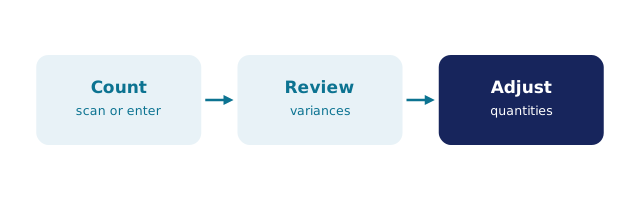
Cycle counting replaces the annual warehouse-shutdown with a rolling routine: count a slice of the catalogue each week, compare against the record, investigate the variances, adjust with evidence. The rule — "the record is checked continuously, so it never drifts far" — makes the annual stocktake a formality instead of a gamble. BSimple carries both EOFY stocktakes and cycle counts, with variances surfaced rather than smoothed over.
Example 4 — batch control: the rule with consequences
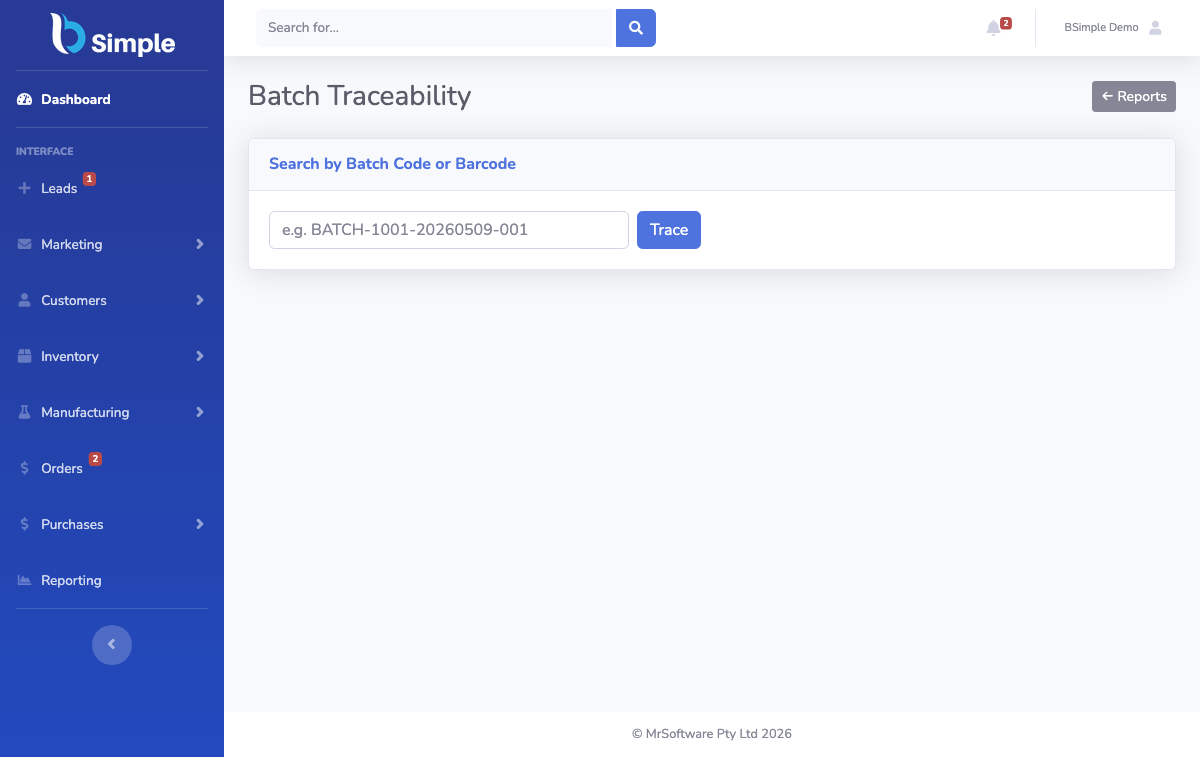
Batch (lot) control gives every receipt an identity: which supplier lot arrived, when it expires, which customers received it. The rules stack: first-expired-first-out for rotation, use-by dates carried onto production batches, and traceability search that answers both directions — "which lots went into this batch?" and "where did this lot go?" For food, beverage, pharmaceutical and certified-goods businesses, this is not an optimisation; it is the difference between a recall notice answered in minutes and a business ended by one it cannot answer. Organic-certified producers using BSimple report mass balance against ACO, NASAA and OFC requirements on the same machinery.
We build BSimple, so weigh that: all four controls above ship in the core plans from $180/month AUD — one record, four rules, enforced by the system rather than by memory. Tracking system examples, the movement-level view and the types of inventory system cover the adjacent ground, and the trial runs your products against all four rules in an afternoon.
Frequently Asked Questions
What is an inventory control system, in one sentence?
A system that enforces rules about quantities — when the record moves, when to reorder, when to count, what carries a lot — instead of leaving them to memory. The four examples above cover most businesses.
Which control should we implement first?
Perpetual tracking — without a current record, the other rules have nothing to enforce against. Par-level reorder usually comes second, because stockouts are the first expensive failure.
Is perpetual tracking the same as real-time?
Nearly — perpetual means every movement is recorded as part of the movement itself, not batched to the end of the day. The distinction matters at the till and the dock, where the batch record is always wrong by exactly the day's trades.
Do we need batch control if we do not sell food?
If anything you sell has a lot, an expiry, a certification or a recall surface — including components and trade goods — yes. Batch control is cheap insurance until the day it is the only defence.
How do we test these controls on our own stock?
Start the trial, set pars on a few products, receive one order, sell a few, count a slice. The four rules either hold on your data or they do not — that is the whole evaluation.

BSimple