
Guide / the record in practice
Inventory tracking system examples
Abstract feature lists hide what a tracking system actually does. Four concrete examples — a distributor, a bakery, a trade installer, an online retailer — each show what gets tracked and the one question the record has to survive.
The key facts
- Example 1, wholesale distribution: the question is "what can we promise today?" — live quantities minus what is already promised.
- Example 2, bakery production: the question is "which batch, and until when?" — lots and expiry, traced both directions.
- Example 3, trade jobs: the question is "what did that job consume?" — reserved stock, consumed on invoice, history per customer.
- The common thread: one record the whole operation works from — the pattern BSimple is built on, shown across all four.
- The full picture: how the inventory record works is the hub page for everything above.
- 01The key facts
- 02Example 1 — the wholesale distributor
- 03Example 2 — the bakery or small manufacturer
- 04Example 3 — the trade installer, and 4 — the online retailer
- 05The pattern the examples share
Example 1 — the wholesale distributor
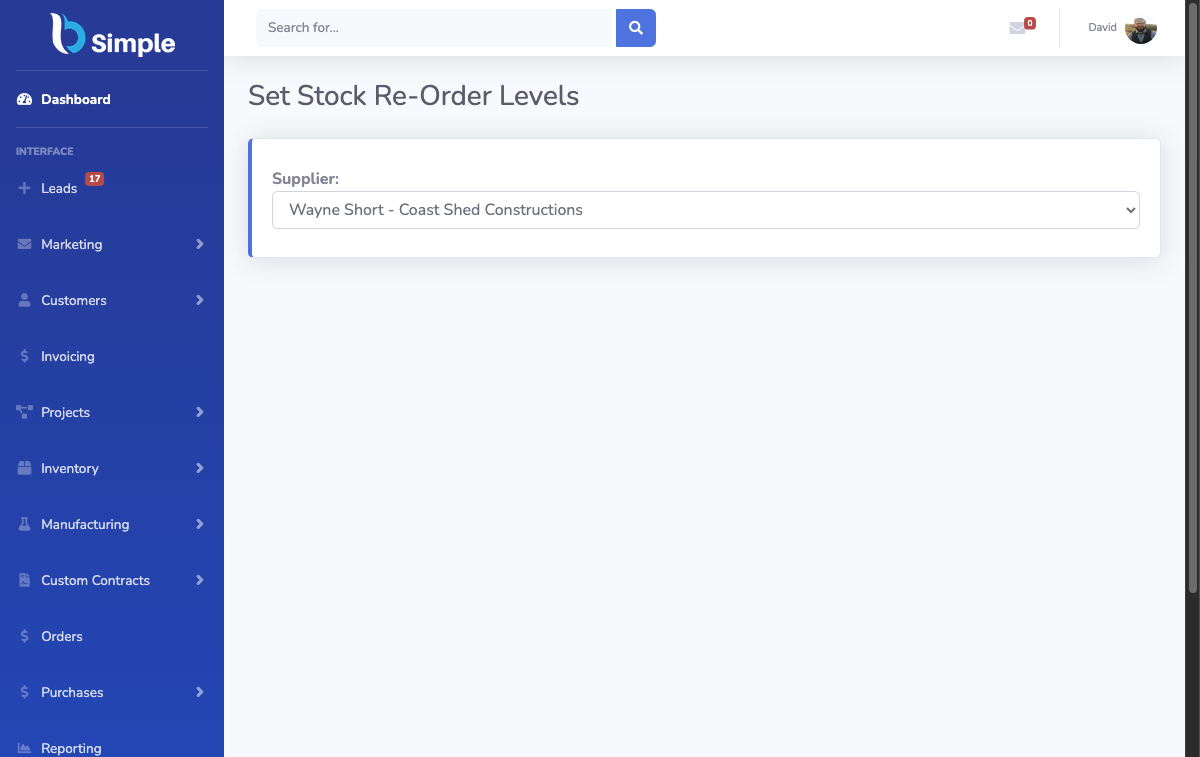
A distributor sells what arrives on pallets and ships in mixed cartons. The tracking question that matters is not "how many did we buy?" but "what can we promise the next customer?" — on-hand quantities minus what is already allocated to open orders. The record has to survive: a purchase order raised because reorder levels dipped; goods receipt updating quantities the moment the truck is unloaded; an order moving through picking and packing to an approved invoice without anyone re-typing it. When the record holds, overselling stops being possible and the office stops reconciling three documents that should have been one.
Example 2 — the bakery or small manufacturer
Production businesses track in two directions at once. Ingredients flow in with lot numbers and use-by dates; batches flow out carrying the trace of everything that went into them. The record has to answer backwards — "which flour lots did this morning's batch consume?" — and forwards, "which customers received that lot?" — because the first recall notice or audit does not accept "probably". Recipes with versioning, production runs with shortage checks, and mass-balance reporting are the machinery; BSimple carries all three, including mass balance used by organic-certified producers reporting against ACO, NASAA and OFC.
Example 3 — the trade installer, and 4 — the online retailer
Trade jobs (air-conditioning, boom gates, fit-outs) break retail assumptions: stock is reserved for a job without being consumed, travels to site, and gets consumed when the invoice is approved — weeks later, tied to one customer's history. The record must keep reservation and consumption as separate, honest steps, plus service and warranty history per job afterwards.
Online retail looks different and is not: the store takes the money, but the record behind it must deduct stock the moment an order imports — Shopify orders arriving by webhook in BSimple's case — so the next channel does not sell the same unit twice. Warehouse system examples by company type covers the storage half of these stories in the same concrete style.
The pattern the examples share
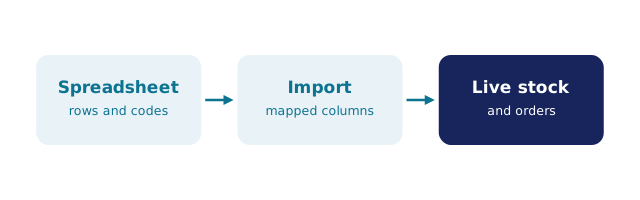
Four businesses, one shape: quantities move for exactly four reasons — received, sold, produced, adjusted — and a tracking system earns its keep by attaching every movement to its evidence (purchase order, order, recipe, stocktake) on one shared record. Everything else labelled "features" is machinery around that spine: reorder levels automate the replenishment, batch tracking answers the traced questions, the audit trail answers who moved what, and the accounting handoff sends the finished record to Xero or MYOB so the books never need re-keying.
We build BSimple, so weigh that: all four examples above run on it out of the box, from $180/month AUD. Real-life inventory examples and the types of inventory system extend the tour — and the free trial is the version of this page where your own business is the example.

Frequently Asked Questions
What is the difference between tracking and counting?
Counting tells you what is there today; tracking keeps every movement attached to its evidence, so the count is still right tomorrow. A system that only counts needs constant recounting — that is the spreadsheet trap.
Do we need different systems for production and distribution?
Not necessarily — the spine is identical, with production adding recipes, runs and batch trace. BSimple carries both on the same record, which is why the bakery example and the distributor example resolve to the same machinery.
What does "reserved" stock mean in the trade example?
Stock held against a job but not yet consumed — the unit exists on the shelf, but it is promised. BSimple's projects reserve without consuming, then consume on invoice approval, so both truths stay visible.
Can tracking handle barcodes without new hardware projects?
Standard scanners that type into a browser work with BSimple out of the box. Barcode tracking in warehouse inventory shows the scan-to-record loop.
How do we try these examples on our own business?
Start the trial, load your real products, and run the loop — receive, sell or produce, count. One afternoon with your own stock answers what a feature list never will.
BSimple