
Comparison / Sage
Sage business management software — an honest comparison
Sage is a real, established software company with accounting and ERP heritage. What that means for a comparison with BSimple — by structural fit, not by second-hand feature tables.
The key facts
- Sage is an established global software company — accounting and payroll heritage (Sage 50 and siblings), expanding upward into business management and ERP for larger organisations.
- This page compares structurally, not by quotes: no pricing, review scores or feature tables — those belong on Sage's own site and change monthly.
- The sorting axes are the usual: accounting gravity, operations depth, business size, and region.
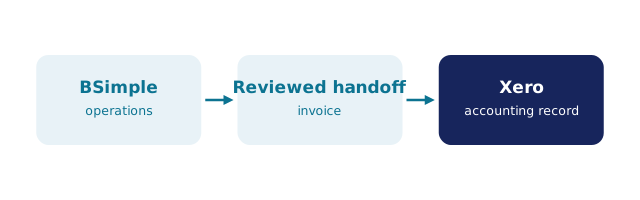
- BSimple's slot, plainly: the operations record for SMB wholesale/manufacturing — Xero and MYOB handoffs (US integrations rolling out) — not an accounting platform and not an ERP.
- Context: the full inventory system holds the wider system, this page one stop in it.
- 01The key facts
- 02What Sage is — without the marketing gloss
- 03The comparison axes that actually decide
- 04BSimple's position, stated plainly
What Sage is — without the marketing gloss
Sage is one of the long-established business software companies, best known for accounting and payroll products used by millions of small and mid-size businesses — Sage 50 and its siblings are household names in several markets, and the company has extended upward into broader business management and ERP territory for larger organisations. That heritage matters for a comparison: Sage's centre of gravity is the books and the back office, with product families spanning from micro-business accounting to enterprise resource planning.
This page will not quote Sage pricing, market share or feature specifics — those are Sage's own disclosures and they change. What compares honestly is structure: which record does each product keep, and which gravity does your business follow?
The comparison axes that actually decide
Accounting gravity. Sage's roots are the ledger; an SMB buying Sage is typically buying the books. BSimple deliberately does not keep books — it hands invoices to Xero or MYOB (US accounting integrations rolling out). If your accounting already lives in Sage, the seam question is decisive: the accounting-boundary logic applies, and a product without a Sage handoff should be weighed honestly rather than waved through.
Operations depth. The stock-and-floor record — live multi-location quantities, boxes of cases, batches with expiry, purchasing from demand, wholesale portals — is BSimple's home ground, the same way the ledger is Sage's. Depth here is what keeps quantities true; breadth elsewhere does not substitute.
Size and weight. Sage spans micro to enterprise across its families, so "Sage" is not one weight class — identify the specific product and compare at your real shape: users, locations, transaction volume. The vendor-evaluation checks apply to both companies equally, and the ERP-weight question matters at the upper end.
BSimple's position, stated plainly
We build BSimple, so weigh that. It is Australian operations software for wholesale, manufacturing, distribution and trade: live multi-location inventory, multi-level stock, batch and expiry tracking, purchasing from demand, order-to-invoice, customer ordering portals, production with recipes and traceability — on one record, from $180/$250/$399 per month AUD, with the trial as the full product. It does not do books, payroll or tax — for any jurisdiction. If your evaluation is accounting-first, Sage's world is the right aisle; if it is operations-first with books already placed (Xero, MYOB, or Sage itself via exports), the inventory-side comparison and the trial are how the decision gets made on your numbers.
Frequently Asked Questions
Is Sage better than BSimple?
They keep different records: Sage's heritage is accounting and back office; BSimple's is the operations record. Better depends on which truth your business is failing to keep — and the five structural checks (record, boundary, accountability, total cost, exit) settle it faster than brand loyalty.
Does BSimple integrate with Sage?
The established accounting handoffs are Xero and MYOB, with US integrations rolling out — Sage is not a claimed integration. If your books are in Sage, weigh that seam honestly; standard exports and the REST API are the honest bridge rather than a promised connector.
Which is cheaper, Sage or BSimple?
We will not quote a competitor's pricing — it changes and misquoting helps nobody. BSimple is $180/$250/$399 per month AUD with core features in every plan. Price both at your real shape, including the accounting subscription each path implies.
Can BSimple run alongside Sage for the operations side?
The record can run and export reviewed data for reconciliation, but there is no claimed deep Sage integration — and honesty about that seam matters more than ambition. Ask us directly about your stack during the trial.
Where does the comparison between us actually end?
With the two records in separate rooms: books (Sage's strength) and operations (ours). Businesses usually need both — the decision is which one to buy deeper, and which one you already have.
BSimple