
Guide / runs as projects
Project management for manufacturing: the run is the project
Manufacturing projects are not Gantt charts — they are recipes, runs, batches and traced outputs. Here is what software must hold, and what it deliberately leaves to schedulers.
The short answer
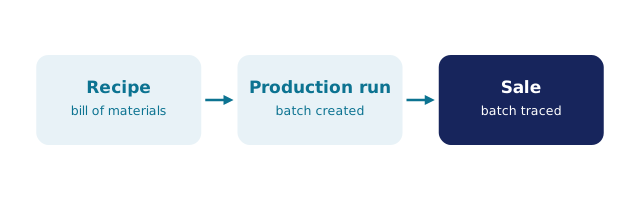
- A manufacturing "project" is a production run: a recipe, components consumed, a batch produced, traced to sales.
- The software needs: multi-level bills of materials, shortage checks before the run, batch identity with use-by dates, two-way traceability.
- The PM-suite pattern — tasks, timelines, Gantt — fits the office and the build site, not the blend room.
- BSimple runs runs-as-projects — from $180/month (AUD) with a free trial — and stops before MRP scheduling.
- The wider guide: the manufacturing inventory guide maps the production record end to end.
- 01The short answer
- 02Why the run is the project
- 03Where BSimple fits
Why the run is the project
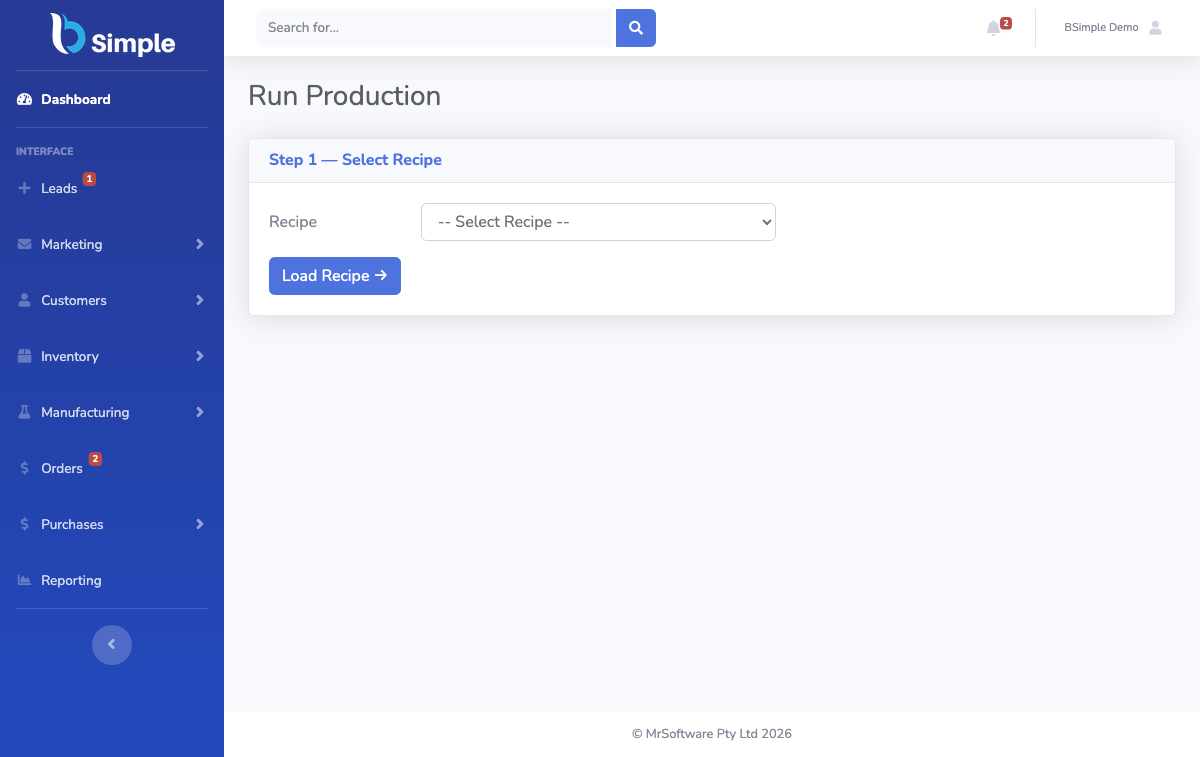
In manufacturing, work is organised by the run: a recipe defines what a batch will consume and produce, the run checks live quantities for shortages before it starts, completion moves components down and finished goods up, and the batch carries its identity — inputs, outputs, use-by dates — for the rest of its life. That structure has its own "project management" built in: scope (the recipe), schedule (the run), deliverables (the batch), traceability (the audit trail). What it does not need is a task board pretending the blend room works in tickets.
What it does need from software: multi-level bills of materials with versioning — packs inside cartons inside ingredients, and history preserved when recipes change; shortage checks at planning time; traced batches searchable from customer to lot and back; and the commercial loop — orders, purchasing, invoicing — on the same record. The BOM guide covers the mechanics, and the manufacturing guide the growth pattern.
Where BSimple fits
We build BSimple, so weigh that. For manufacturers it runs runs-as-projects on one record: recipes with versioning, production runs with shortage checks, batches with use-by dates, traceability search in both directions, mass-balance reporting for certified operations (ACO, NASAA and OFC are cited by existing customers) — and the commercial loop attached: orders, the customer portal, purchasing from demand, invoicing to Xero or MYOB. Recipes and production are included in every plan from $180/month (AUD), with the free trial to run one real recipe end to end.
The boundary, plainly: no Gantt charts, no task boards, and no MRP scheduling — capacity planning across work centres is the ERP conversation that arrives when planning becomes someone's full-time job. The manufacturing growth line draws it, and the project-management split covers the scheduling-versus-record distinction in the construction sibling.
Frequently Asked Questions
Is BSimple project management software?
Not in the Gantt-and-tasks sense. For manufacturing, the production run is the project — and BSimple manages it as a document: recipe, shortage check, run, traced batch. If the need is task boards and timelines for office work, that is PM software's category.
Does BSimple schedule production capacity?
No — no MRP scheduling or capacity planning. The run knows what it needs and what is in stock; sequencing across work centres is the ERP conversation for when planning becomes a full-time job. The growth line page marks it.
How do batches tie back to customer orders?
On the same record: batches are stock with identity, orders allocate from live quantities, and traceability search connects the batch to the customer and the customer's complaint back to the lot. Mass-balance reporting supports certified operations where required.
What should we trial with a real recipe?
One recipe, one run: check the shortage warnings against live quantities, complete the run, sell from the batch, then trace it backwards. If the whole chain reads clean on your own goods, the software fits — the free trial is where it happens.

BSimple