
Guide / the decision
Why your business needs inventory software — or honestly does not
Four failures make the case: the stockout that surprised you, the count that never agrees, the order that got retyped, the shelf full of what nobody buys. If none have happened lately, wait.
The key facts
- The need shows up as four recognisable failures: surprise stockouts, counts that never agree, re-keyed orders, and capital buried in slow movers.
- The software fixes the mechanism, not the discipline — it makes recording movements easy and lying to yourself hard.
- The honest counter-case: one person, slow volume, one location — a disciplined spreadsheet is genuinely enough; no vendor urgency required.
- BSimple's stake: we sell the software ($180/month AUD up), so this page carries the counter-case prominently and asks you to run the trial before believing either side.
- 01The key facts
- 02The four failures that make the case
- 03The honest counter-case — when to wait
- 04If the failures sound familiar: what to do this week
The four failures that make the case
The stockout that surprised you. The spreadsheet said 14; the shelf said 0; the customer is standing there. One surprise is a bad week; a pattern is a record that updates on sales but not on receipts, breakages or theft — recording only the movements someone remembered. Software that records every movement class and flags reorder points makes the surprise structurally harder.
The count that never agrees. Stocktake variance is normal; unexplained variance is a record lying. When adjustments are typed to make totals match rather than traced to causes, the business is pricing, purchasing and promising against fiction. Counts with reviewed variances turn the ritual into a control.
The order that got retyped. Phone call → note → spreadsheet → invoice template → accounting: four transcriptions, each an error opportunity, each costing minutes. Software carries the order from intake to invoice unchanged — and wholesale customers entering their own orders remove even the first transcription.
The shelf full of what nobody buys. Capital buried in slow movers while fast movers stock out is the quietest failure and the most expensive. Reorder discipline plus honest movement history makes overstock visible monthly instead of at the January clean-out.
The honest counter-case — when to wait
If the business is one person, one location, volumes slow enough that typing keeps up, and the count agreed last month — inventory software is a solution looking for your problem, and a disciplined spreadsheet is the right tool. This page carries the counter-case prominently because the industry's habit is manufactured urgency, and because we sell the thing (BSimple, $180/$250/$399 per month AUD) — you deserve to know which parts of this page are marketing-adjacent.
The need arrives between those lines: a second person needing the same truth, a second location, customers ordering themselves, a product line that gains batch obligations. The stage-by-stage path maps when each tool class earns its cost, and the benefit arithmetic turns the four failures above into your own numbers — the only ones worth deciding on.
If the failures sound familiar: what to do this week
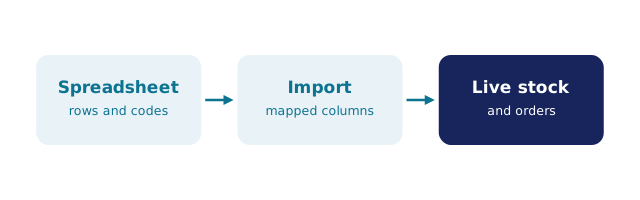
First, run a real count and make the record agree — the baseline matters more than the tool. Then run one week in a trial with your actual products: orders entered, receipts recorded, one reorder flagged. If the failures above shrink measurably in that week, the case is made; if not, you have lost an afternoon and gained a clean baseline. BSimple's trial is the full product for exactly this experiment — and the same experiment works on any vendor's trial, which is rather the point.
Frequently Asked Questions
Why does a business need inventory management software?
To stop the four failures: surprise stockouts, unexplained variances, re-keyed orders and invisible overstock — by recording every movement on one live record and running reorders, checks and counts from it. If none of those failures visit your business, you do not need it yet.
How do we know we have outgrown spreadsheets?
When the count stops agreeing, when a second person needs the truth at once, or when the spreadsheet's maintenance falls behind the operation's pace. The trigger is shared truth, not company size.
Will inventory software fix our stock problems?
It fixes the mechanism — recording, checking, reordering — and makes discipline easier, not optional. A team determined to keep side records will defeat any software; adoption is the multiplier on everything this page claims.
What does it cost if the answer is "not yet"?
Nothing but attention: keep the spreadsheet disciplined (movements, not totals) so the eventual migration is an afternoon. The expensive path is staying too long and migrating from a record nobody trusts.
How do we test the decision cheaply?
One week, one trial, your products, one count. BSimple's trial is free and full-featured; the experiment costs an afternoon and produces your own evidence either way.
BSimple