
Guide / benefits and costs
Inventory software benefits — the honest version
No invented percentages here. What a live inventory record genuinely improves, what it does not fix, and the arithmetic to run on your own numbers before believing anyone's ROI claim.
The key facts
- The genuine benefits are structural: trusted quantities, fewer stockouts, orders without re-keying, counts that reconcile, and decisions made on records instead of memory.
- What software does not fix: bad processes, unlabelled stock, and the discipline of recording movements — it makes good habits easier, not optional.
- No invented ROI figures on this page: the honest benefit case is the one you compute from your own stockouts, re-keying hours and count days.
- BSimple's benefit shape: one record for stock, orders, purchasing and portals — from $180/month AUD, trial free.
- 01The key facts
- 02The benefits that are real, and why they happen
- 03What inventory software does not fix
- 04Run the numbers yourself — the anti-ROI-claim method
The benefits that are real, and why they happen
Trusted quantities. Every movement — sale, receipt, transfer, adjustment — lands on one live record with a history. The benefit is not the software's features; it is the end of the two-lists problem, where the office and the shelf disagree and the shelf is right.
Fewer stockouts that surprise anyone. Reorder levels against live and incoming stock turn "we ran out Tuesday" into a purchase order raised days earlier. The benefit compounds quietly: the stockout that never happens is invisible, which is why this benefit is chronically undercounted.
Orders without re-keying. An order enters once — through a portal, a phone call or a synced store — and travels to picking, packing, invoice and accounting unchanged. Every retyped order you no longer retype is a measurable hour and a measurable error rate.
Counts that reconcile. Stocktakes stop being archaeology: variances are flagged, explained and adjusted with a name attached. Year-end shrinks from a fortnight of guesswork to a week of counting.
Decisions on records. What to buy, what to stop stocking, which customer buys what — answered from the record rather than from whoever was asked.
What inventory software does not fix
It does not fix processes that nobody follows, stock nobody labels, or the decision to record movements "later". A live record makes good habits easier — scanning beats typing, guardrails beat warnings — but a team determined to keep a private spreadsheet will defeat any software. It also does not do your accounting (BSimple hands invoices to Xero or MYOB deliberately), does not forecast demand magically, and does not make an unprofitable product profitable — it makes the unprofitability visible, which some businesses find unwelcome and all of them need.
The honest expectation: software removes a class of errors and a class of labour, and it exposes the truth underneath both. What you do with the truth is still management.
Run the numbers yourself — the anti-ROI-claim method
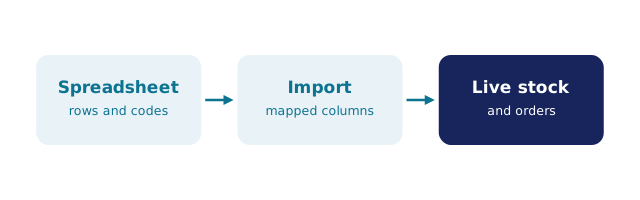
Every vendor's ROI figure (including any you might find about us) deserves the same treatment: replace it with your own arithmetic. Count last year's stockouts that cost a sale, the hours spent re-keying orders and reconciling lists, and the days consumed by stocktake recovery. Price the hours at your team's real cost, price each lost sale once, and compare the total to a year of subscription — BSimple's is $180/$250/$399 per month AUD, and the method works on any vendor. The benefits-by-context page and the wider guide help with the accounting of it all; the arithmetic stays yours.
Then run the trial — one week, your products — and measure the same three numbers again. That comparison is the only benefit case this site will make.
Frequently Asked Questions
What are the main benefits of inventory management software?
Trusted quantities on one live record, fewer stockouts via reorder discipline, orders without re-keying, stocktakes that reconcile, and decisions made from records. Each is structural — the software changes how the numbers are made, not just where they sit.
How much does a business typically save?
We will not quote a percentage — inventing one is the oldest trick in this market. The savings arithmetic above (stockouts, re-keying hours, count days versus subscription) produces your number in an afternoon, and it is the only one worth acting on.
What is the biggest hidden benefit?
The invisible stockout that never happens — reorder discipline has no dramatic moment, so businesses undervalue it. Run-of-the-month it quietly saves the sale you would have lost on a Tuesday; multiply by twelve.
Can inventory software have downsides?
Honest ones: a subscription, an adoption curve, and the exposure of truths the spreadsheet smoothed over — slow movers, real variances, unprofitable lines. Also the risk of buying depth you do not use, which is why the stage-by-stage approach exists.
How do we test the benefits before paying?
The trial is the full product: load your products, run a week of real orders and one count, and measure the three numbers again. A vendor without a full-product trial is asking you to buy the claim.

BSimple