
Guide / templates
Inventory management templates — choose well, structure well
A template is a head start with someone else's assumptions baked in. Where templates live, the structure that works wherever they live, and the traps in the downloads.
The key facts
- Templates live in three places: spreadsheet apps (Excel, Sheets), productivity tools (Notion, Airtable), and vendor starter files — each with trade-offs.
- The structure that works in any of them: products table, append-only movements table, derived quantities — never editable totals.
- The download trap: most templates store editable quantities, which is why they drift from the shelf within weeks.
- The upgrade trigger: shared truth, guardrails or scanning. BSimple ($180/mo AUD up, trial) imports a disciplined template in an afternoon.
- 01The key facts
- 02Where templates live, and what each trades
- 03The structure that works in any template
- 04The upgrade trigger, and the path
Where templates live, and what each trades
Spreadsheets — Excel and Google Sheets. The default home: full control, formulas for derived values, protection for structure. Excel trades sharing (the single-file problem); Sheets trades enforcement (everyone can edit everything). Both are legitimate at one-to-two-person scale.
Productivity tools — Notion, Airtable. Databases with friendlier faces: views, filters, and forms that feel like software. They trade the same discipline problem — records are editable by anyone with access — and gain collaboration polish. Fine for registers and light tracking; the movements discipline still has to be self-imposed.
Vendor starter files. Imports and templates provided by real systems — the bridge option: structure your data the vendor's way now, migrate later in an afternoon. BSimple publishes its import expectations directly (the trial walks them), which is the pattern to demand from any vendor.
The structure that works in any template
Table 1 — Products. SKU, description, supplier, cost, par level. One row per item, deliberately edited.
Table 2 — Movements. Date, SKU, direction, quantity, reason, who. Append-only — the template's whole value lives here.
Derived quantities. On-hand is a formula over movements, never a typed cell. If your template has an editable quantity column, restructure it — that column is where templates drift from reality.
A count ritual. Monthly, with variances investigated and corrections entered as movement rows. The counting discipline is what keeps any template tethered to the shelf.
These four ingredients make a template trustworthy everywhere — which is also exactly how to evaluate a downloaded one: the XLS checklist and the download-safety guide apply the test.
The upgrade trigger, and the path
Templates end where shared live truth begins: a second person needing quantities at the same moment, guardrails on bad entries, scanning at the shelf, reorder automation. Until those arrive, a disciplined template is free and fine — and no honest vendor will rush you past it.
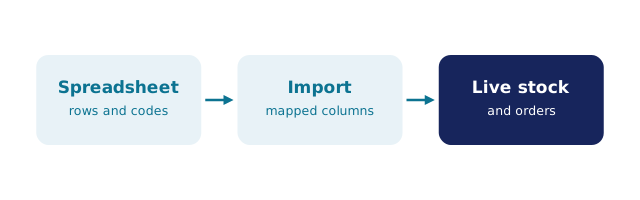
When they arrive, the path is short because the template was disciplined: your tables are a data model. Export, import, one baseline stocktake, movements recorded in the system thereafter. We build BSimple, so weigh that: import is first-class, and the template gains what it could not hold — shared truth, guardrails, portals, invoices to Xero or MYOB (US integrations rolling out) — from $180/$250/$399 per month AUD, with the trial free and full.
Frequently Asked Questions
What is the best inventory management template?
The one structured as movements with derived quantities, wherever it lives — spreadsheet, Notion or vendor file. Structure beats platform: a good template in Sheets outruns a bad one in expensive software.
How do I spot a bad downloadable template?
An editable quantity column is the tell — no history, no audit, drift by design. Check also for protected formulas and clean export tables; the XLS guide walks the two-minute test.
Can Notion or Airtable run inventory properly?
As registers and light tracking, genuinely yes. The limits arrive with enforcement and scale: anyone can edit anything, and movement discipline becomes manual. Past a couple of people, that is the ceiling.
What should a template include for GST and EOFY?
Cost columns and a stock-value report — enough to inform the accountant. Compliance stays with your accounting system; the boundary holds for templates and systems alike.
When do we graduate from a template to software?
At the first unexplained quantity, the second simultaneous user, or the first reorder decision made from memory. The trial imports your template's tables and shows the other side — before any commitment.

BSimple