
Guide / Shopify and the record
The best inventory software for Shopify, honestly
"Best" depends on what your store sits on top of: one warehouse or many, one channel or five, a till or none. Here are the three criteria that actually decide it — and how BSimple's Shopify connection works, stated plainly.
The key facts
- Criterion 1 — the sync: does a store order deduct from one live record immediately, or via a periodic reconciliation?
- Criterion 2 — the rest of the business: purchasing, batches, wholesale buyers and the books — the store is a channel, not the whole company.
- Criterion 3 — the fit test: your products, your week, on a trial. Rankings are written for the median reader; you are not the median.
- BSimple's connection: Shopify orders import by webhook into the standard order flow; invoicing stays between Shopify and your accounting system.
- Where it fits: this page is one branch of the inventory management guide.
- 01The key facts
- 02Criterion 1: the sync decides everything
- 03Criterion 2: the store is a channel, not the company
- 04Criterion 3: the fit test, then the decision
Criterion 1: the sync decides everything
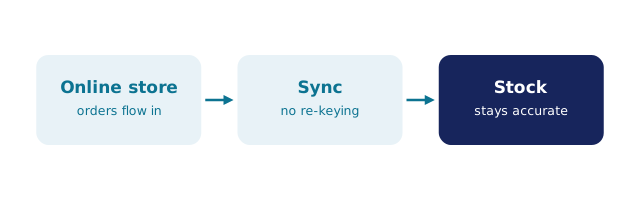
The core question for any Shopify inventory setup: when an order lands, when does the quantity go down, and where? Shopify's own inventory tracks the store; the moment you sell anywhere else — a second store, a marketplace, wholesale, a market stall — you have two records negotiating by sync. The best setups make the store a channel into one record: the order arrives (in BSimple's case by webhook), quantities deduct against the same live record that every other channel draws from, and the next buyer in any channel sees truth. Periodic syncs — app pulls, CSV bridges, nightly reconciliations — all share the same flaw: the window between syncs is where overselling lives.
Ask any candidate tool the timing question precisely: per-order, immediate, from the record? The answer sorts the field faster than any feature matrix. Whether Shopify can manage inventory itself covers the built-in option honestly.
Criterion 2: the store is a channel, not the company
Inventory software chosen only for the store will disappoint the rest of the business. The questions that arrive within months: purchasing against supplier lead times (not just reorder alerts), batch and expiry tracking where products carry lots, wholesale buyers wanting their own pricing and self-serve ordering, stocktakes that keep the counts honest across locations, and the books receiving invoices without re-keying. A tool that only knows the storefront handles none of these; a record that handles all of them makes the store one well-fed channel among others.
We build BSimple, so weigh that: it is not a storefront — Shopify remains your shop — and its Shopify import feeds the same record as phone orders and portal orders from wholesale buyers. Invoicing stays between Shopify and your accounting system (Xero or MYOB), so nothing double-bills, and payment status mirrors back. Plans start at $180/month AUD; the trial connects your store and runs a real order through the whole path.
Criterion 3: the fit test, then the decision
- One channel, light volume: Shopify's built-in inventory plus discipline may genuinely be enough — the free order-management picture covers that stage without upselling you off it.
- Multi-channel or multi-location: one live record stops being optional; overselling across channels is the failure that ends accounts and reputations together.
- You also make or import what you sell: batches, recipes and production push you toward a full record — inventory and ordering together shows the loop.
- Run the trial on your store: connect Shopify, place one real order, watch it through pick, pack, invoice. The best software is whichever record survives your week — the order management guide shows what "survives" means.
Frequently Asked Questions
What is the best inventory management software for Shopify?
The one whose record holds your truth: immediate per-order sync from a live record, coverage for the parts of the business the store does not see, and a fit proven on your own products. Rankings cannot decide that; a trial can.
Does BSimple integrate with Shopify?
Yes — orders import by webhook into the standard order flow: delivery slips, picking and packing, approval, stock deduction, all on one record. Invoicing stays between Shopify and your accounting system.
Do we still need Shopify's inventory if we use BSimple?
The store can display quantities drawn down as orders import; the live record underneath is BSimple. The boundary worth testing in the trial: which system you trust when the two disagree — that one should be the record.
Does BSimple suit digital products or services?
No — BSimple is built for physical stock: quantities, locations, batches, shipments. If nothing ships, a lighter tool serves you better and we would rather say so.
What does BSimple cost?
Starter $180, Professional $250 and Organisation $399 per month (AUD), every feature in the core plans. The trial is the full product, including the Shopify connection.

BSimple