
Guide / orders and online stores
Free ecommerce order management software
Free options exist and some are genuinely useful — but "free" narrows what the tool can do the moment orders carry stock commitments. Here is the honest picture, including ours: BSimple is not free.
The key facts
- What free really means: open-source software you host and maintain, freemium plans capped by order volume, or a store platform's built-in order list.
- Where free works: low daily order counts, one channel, no warehouse team, stock that rarely oversells.
- Where it breaks: live stock across channels, pick/pack for a real warehouse, and an accounting handoff that survives month-end.
- BSimple's position: not free — plans from $180/month AUD, every feature in the core plans, with a full-product free trial rather than a free tier.
- The wider flow: how order management works maps the full path this page is part of.
What "free" actually gets you
Three things hide behind the phrase. Open-source order tools are genuinely free to license, but you own the hosting, updates, and every integration — a real cost in hours if nobody technical is on the team. Freemium plans are free until an order cap or a missing feature, and the features behind the paywall are usually the ones that matter: multi-channel stock sync, pick lists, accounting export. Store-platform order management — the orders list inside Shopify or WooCommerce — is free because you already pay for the store, and it covers order capture well while knowing almost nothing about what happens after checkout: picking, packing, partial fulfilment, stock commitments.
None of these is a scam. The mistake is matching a growing operation to a tool built for the day it started.
- 01The key facts
- 02What "free" actually gets you
- 03Where free order management breaks
- 04How BSimple handles ecommerce orders
- 05Choosing between free and paid, without the marketing
Where free order management breaks
The failures arrive in a predictable order. First, stock truth: orders land in the store while the spreadsheet holds the real quantities, and overselling starts at the worst time — a promotion, a season peak. Second, fulfilment: the orders list cannot tell your picker what to grab or produce a packing slip, so someone re-types it. Third, the books: every order needs manual entry into accounting, which is where errors and month-end surprises come from. Fourth, customers: no order status they can check themselves, so they email you instead.
What order management software is breaks the full job into those steps — capture, stock check, fulfilment, invoicing, status. A free tool can cover the first step well. The cost appears at step two.
How BSimple handles ecommerce orders
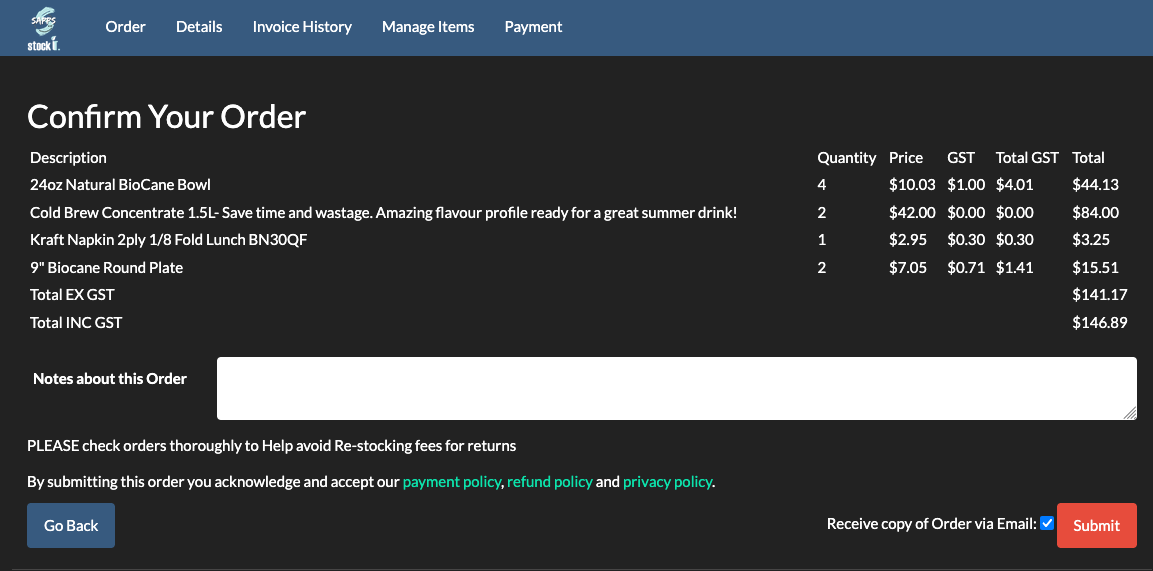
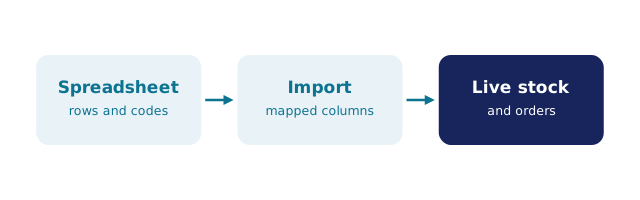
BSimple is not an ecommerce platform and does not run a storefront — it manages what happens after the sale. Online store orders import into the same order flow BSimple uses for every channel: Shopify connects by webhook, and imported orders get delivery slips, picking and packing, approval, and stock deduction on the same record as phone and portal orders. Invoicing stays between your store and your accounting system (Xero or MYOB), so nothing double-bills.
Alongside that, BSimple's customer ordering portal gives wholesale buyers their own product list and pricing through a unique link — the B2B counterpart to the storefront.
If you are evaluating the free route seriously, our honest look at free ecommerce order management options and free-to-use inventory software cover the tools people actually try, and when each is enough.
Choosing between free and paid, without the marketing
Ask one question: what does an order cost to handle, end to end? Free software with ten minutes of re-keying and reconciliation per order is more expensive than paid software with none, at even modest daily volumes. Free wins when volumes are low and one person can hold the whole operation in their head — and there is no shame in staying there until the numbers say otherwise.
The switch point is usually visible in advance: a second sales channel, a second person touching orders, or the first oversell that cost a customer. If you are near one of those, start the trial, connect your store, and measure the per-order cost yourself — the trial is the full product, so the comparison is honest on both sides.
Frequently Asked Questions
Is there genuinely free ecommerce order management software?
Yes — open-source tools you host yourself, freemium tiers capped by volume, and your store platform's built-in order list. Each covers order capture well; live stock control, warehouse fulfilment and the accounting handoff are where free versions stop.
Does BSimple have a free plan?
No. Plans start at $180/month AUD (Starter $180, Professional $250, Organisation $399) with every feature in the core plans — no module paywall. There is a free trial of the full product, because order management is only worth judging against your real orders.
How does BSimple work with Shopify?
Shopify orders import by webhook into the standard order flow — delivery slips, pick/pack, approval, stock deduction — on the same record as every other channel. Invoicing stays between Shopify and your accounting system, so there is no double entry and no double billing.
When should we move off a free tool?
At the first oversell, the second sales channel, or the second person touching orders — whichever arrives first. Those are the symptoms of the stock and fulfilment gaps free tiers do not cover, and they compound once customers are affected.
BSimple