
Guide / Shopify and inventory
Can Shopify manage inventory? Yes — up to a line
Shopify tracks stock for a storefront well enough. It is not built to run purchasing, multi-level stock, B2B ordering or the path from order to invoice — so the question is what you add, and when.
The key facts
- Yes, for a store: Shopify tracks quantities per location, blocks overselling and flags low stock.
- It is a storefront record, not an operations record: no purchase orders from demand, no multi-level stock, no B2B pricing per customer.
- Invoicing is not its job: Shopify handles store payments, not the invoice-and-accounting workflow wholesale runs on.
- BSimple imports Shopify orders by webhook into the same record as everything else — delivery slips, pick and pack, approval, stock deduction.
- Invoicing stays between Shopify and your accounting system; BSimple runs the operations around it.
- 01The key facts
- 02What Shopify manages natively
- 03Where the line sits for wholesale and makers
- 04How BSimple works with Shopify — and where the boundary is
What Shopify manages natively
Shopify's inventory system does the retail basics competently: quantities per product per location, automatic reduction when a store order is placed, low-stock thresholds, and inventory adjustments. For a business whose entire operation is that store, this is often enough — the store is the record.
The gaps appear as soon as the business is more than the store. Stock that exists before it reaches the shelf (made, assembled, or bought in cartons), customers who order off-store, suppliers who need purchase orders, and an accountant who needs invoices pushed to Xero or MYOB — none of these are store problems, and Shopify does not pretend to solve them.
Where the line sits for wholesale and makers
Four concrete things push a business past Shopify's inventory:
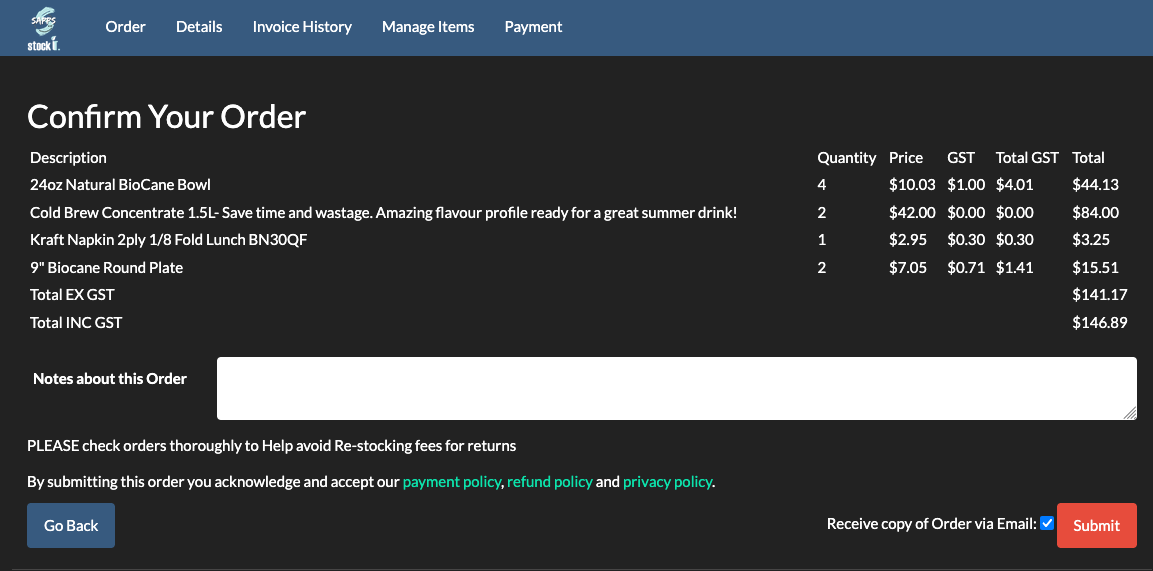
- Purchasing. Reorder levels that raise purchase orders, supplier price variance, goods receipts updating stock — Shopify tracks; it does not buy.
- Multi-level stock. Boxes into sleeves into units, or recipes into batches — one-level records cannot represent them (the BOM mechanics show what that takes).
- B2B ordering. Per-customer product lists and pricing, repeat orders, order status — a storefront checkout is not a wholesale channel.
- The accounting handoff. Invoices approved and pushed with payment status mirrored back, GST handled — the boundary where the Xero integration lives.
If none of those apply today, Shopify alone is a reasonable answer — adding a system before you need it is its own cost.
How BSimple works with Shopify — and where the boundary is
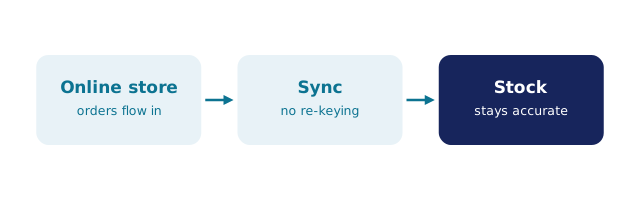
BSimple does not replace your Shopify store, and it has no storefront of its own. What it does is import Shopify orders by webhook into the same record as the rest of the business: the order appears with the others, gets delivery slips and pick/pack treatment, passes approval, and deducts stock — sitting alongside wholesale portal orders rather than in a separate retail silo. Invoicing for store sales stays between Shopify and your accounting setup; operations runs through BSimple.
That makes the combination honest about roles: Shopify for selling, BSimple for the inventory record and fulfilment, accounting for the books. The ecommerce inventory guide covers this division of labour, and the Shopify-focused comparison evaluates the options for the inventory layer specifically. You can test the order-import path with your own store during the free trial.
Frequently Asked Questions
Can Shopify manage inventory by itself?
For a single-store retail operation, yes — quantities, low-stock flags and overselling protection work as advertised. It becomes insufficient when purchasing, multi-level stock, B2B ordering or an accounting handoff enters the operation.
Does BSimple replace my Shopify store?
No. Your store stays exactly as it is. BSimple imports the orders it generates by webhook and runs the operational record around them — stock, fulfilment, purchasing — while invoicing for store sales stays between Shopify and your accounting system.
How do Shopify orders get into BSimple?
Automatically. A webhook fires when the store order is placed, and the order arrives into BSimple's normal order flow — delivery slips, picking and packing, approval, stock deduction — the same path a phone or portal order takes.
What about invoicing for Shopify sales?
That stays between Shopify and your accounting platform — we do not interpose ourselves in store invoicing. Where BSimple invoices directly is for the orders it manages: wholesale, trade and portal orders approved and pushed to Xero or MYOB with payment status mirrored back.

BSimple