
Guide / barcode, honestly
Barcode inventory software free: the honest ladder
Scanning is cheap — the phone in your pocket already does it. What costs money is the record behind the scan: live quantities, real transactions, and the accounting handoff. Here is where free stops.
The key facts
- The scanner is not the cost: a phone camera reads standard barcodes; free scanning apps exist and work.
- The record is the cost: a scan only helps if it posts a real transaction to the same ledger your orders and invoices use.
- Free tiers cap the wrong half: users, history and integrations — not scanning itself.
- BSimple is not free: plans from $180/month (AUD) with scanning native to the inventory record, free to trial.
- 01The key facts
- 02What "free barcode inventory" actually means
- 03What scanning needs from the record
- 04Where BSimple fits
What "free barcode inventory" actually means
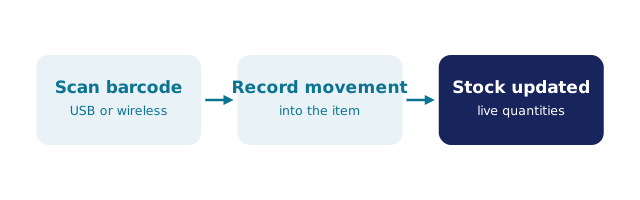
There are two products being priced, and they separate cleanly. The first is scanning: any modern phone reads Code 128, EAN and QR codes from the browser, and free scanning apps will beep happily all day. The second is the inventory record: what the scan does next. In a spreadsheet-with-scanner setup, the scan types a part number into a cell — saving keystrokes, not creating truth. In a real system, the scan posts a movement: stock up on receipt, down on issue, adjusted at count, against live quantities with an audit trail.
Free tiers of cloud inventory tools usually include basic scanning and cap the record instead — extra users, order volume, history, integrations. That is the honest shape of "free": you get the beep, you rent the truth. How barcode inventory works explains the record side, and the scanning guide covers the hardware and workflow.
What scanning needs from the record
- Same-ledger transactions. The scan must move the stock the orders and invoices see — not a parallel list that gets reconciled by hand.
- Live quantities. A scan that confirms availability against yesterday's count is a faster way to be wrong.
- Labels that match reality. Product codes plus human-readable text; shelf labels are the cheap start if unit labels are not practical.
- Counts built on scans. A stocktake walked with a phone posts variances as auditable adjustments — the stocktake-with-scanner workflow is where scanning pays back first.
If a free tool covers the beep but not these, the gap is the part that stops stock errors — which was the point of scanning.
Where BSimple fits
We build BSimple, so weigh that. Scanning is native to the inventory record, not a module: receive, adjust, count and pick by scan from any phone browser, flowing into the same ledger as purchasing, orders and invoicing — with the accounting handoff to Xero or MYOB behind it. Plans start at $180/month (AUD); hardware is yours to choose, and most teams start with the phones they own. The free trial is the honest test: label five products, receive them by scan, count them, pick one — an afternoon on your own stock.
If you are earlier in the decision, the barcode scanner software comparison and the free-options guide map the market honestly.
Frequently Asked Questions
Is there free barcode inventory management software?
Free scanning, definitely — your phone. Free tiers of inventory tools include basic scanning with caps on users and history. A scan that posts real transactions to a shared ledger with an audit trail is the paid layer, because that is the part that is hard to build.
Is BSimple free?
No — plans start at $180/month (AUD). The trial is free and full-featured, so you can run the scan loop (receive, count, pick) on your own products before paying anything.
Do I need to buy scanners?
Not to start: any modern phone browser reads standard barcodes, which is how most teams begin. Dedicated scanners earn their place later at a receiving bench or packing station where volume justifies the speed.
Can I keep my spreadsheet and just add scanning?
You can, and it saves typing — but the scan writes into the same fragile record, with no transactions, no concurrency and no audit trail. The honest framing: scanning fixes identity errors, while a proper record fixes everything else.

BSimple