
Guide / parts stock on a budget
Free inventory software for auto-parts businesses
Parts stock is thousands of SKUs that all look alike on a shelf. Here is what free software covers, what the specialist tools add, and where BSimple honestly fits.
The short answer
- A spreadsheet tracks a small parts catalogue — until fitment questions, supersessions and counter sales outgrow it.
- "Free download" software for auto parts is usually a trial or limited tier; specialist parts systems are paid products with per-user pricing.
- Parts-specific needs: barcodes on every shelf and part, fast movers vs slow movers, and supplier purchasing that keeps up.
- BSimple is not automotive-specific and not free — from $180/month (AUD) with a trial — but its core handles parts stock well.
- 01The short answer
- 02What auto-parts stock does that other stock does not
- 03The free options, honestly
- 04Where BSimple fits
What auto-parts stock does that other stock does not
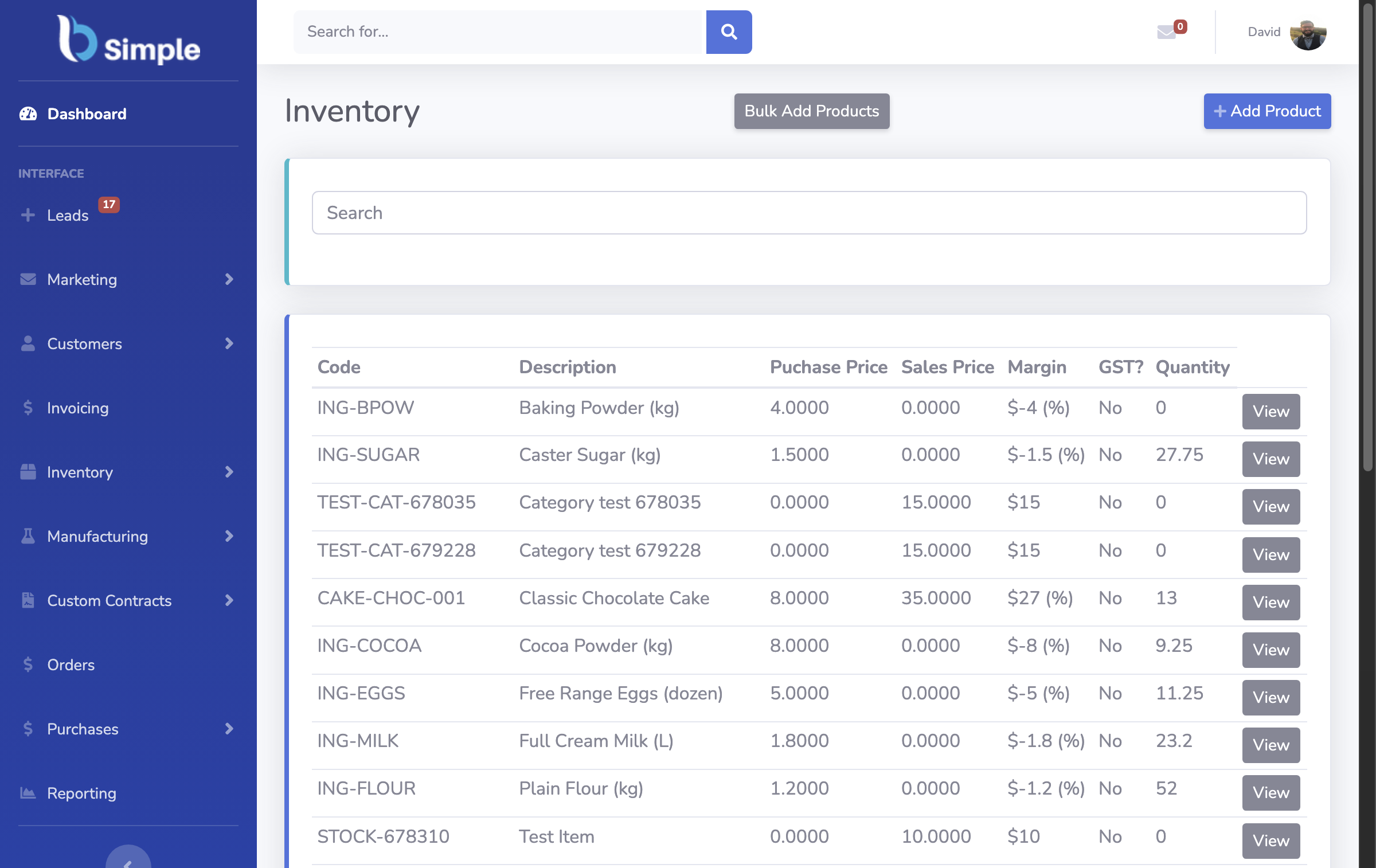
Parts inventory is identity-heavy: thousands of SKUs, many physically similar, distinguished by part numbers and fitment. Four needs follow. Barcodes everywhere — the shelf and the part both coded, because visual identification fails at part number scale. Movement ranking — fast movers live at the counter, slow movers tie up cash on shelves, and the split should come from the record, not memory. Supplier purchasing discipline — reorder levels against lead times, because a stockout on a common part sends the customer to the competitor across the road. Counter + wholesale in the one record — walk-ins at shelf pricing and trade accounts at their own pricing cannot oversell each other.
Specialist parts systems add the automotive layer: vehicle fitment lookup and catalogue integration. That layer matters for genuine parts retail and is worth paying a specialist for — BSimple does not provide fitment catalogues and will not pretend otherwise.
The free options, honestly
The spreadsheet works while one person knows the catalogue: part number, description, shelf, quantity. It fails at scale — identity questions get answered by walking the aisle, counts fall behind, and the fitment answer lives in someone's head. "Free download" parts software is typically a trial or a record-capped tier of a paid product; inspect the cap and the export before committing your catalogue to it. Free tiers of general inventory tools cover small catalogues but rarely the counter-and-wholesale mix.
What no free option includes is the joined record: scanning that writes to live stock, purchasing that answers demand signals, trade customers ordering through their own portal, and accounting handed to Xero or MYOB. The free stock management guide prices that gap, and the PC download question unpacks the "free download" pattern specifically.
Where BSimple fits
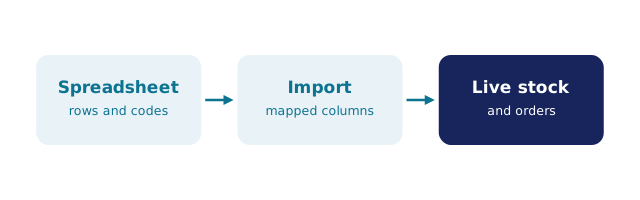
We build BSimple, so weigh that — and the boundary first: it is not an automotive-specialist system and has no fitment catalogue. What it does well for parts businesses is the core: live multi-location stock with multi-level units (cartons versus eaches), scanning from any phone browser or a desk wedge, reorder and par levels driving purchase orders, negative-stock guardrails, a customer ordering portal giving trade accounts their own pricing through a unique link, and invoicing handed to Xero or MYOB. From $180/month (AUD), with the free trial to load a slice of the real catalogue.
If fitment lookup is the make-or-break requirement, start with an automotive specialist — honestly. For the adjacent free-download comparisons, the spare-parts guide covers the supplier-heavy variant, and barcode scanning in inventory shows what a scan should write to. If the bleeding is stock truth, purchasing discipline and the counter-versus-trade mix, the inventory management overview shows how one record holds all three.
Frequently Asked Questions
Does BSimple include vehicle fitment lookup?
No — fitment and catalogue integration are specialist automotive features BSimple does not provide. It manages the stock record: part numbers as products, quantities, locations, purchasing and counter or portal sales. Businesses whose customers ask "does it fit my car?" by catalogue should pair a specialist system with that job.
Is the free trial enough to test a parts catalogue?
Load a meaningful slice, not the whole catalogue: one fast-moving category, one slow, one problem shelf. Run receiving, a count and a few counter sales plus a portal order. That exercises every part of the record the business depends on — a full catalogue migration before proving the fit is backwards.
How does BSimple handle part supersessions?
Superseded part numbers can be recorded as products and tagged or noted so staff find the successor, but there is no dedicated supersession engine mapping old to new automatically. If that automation is critical, that is a specialist conversation — the vendors guide frames how to test it.
Can trade customers order parts themselves?
Yes — the customer ordering portal gives each account their own product list and pricing through a unique secret link, no passwords. Orders land in the same record as counter sales, so neither channel can sell units the other already promised. That is standard BSimple, included from $180/month (AUD).

BSimple