
Guide / construction software
What software is used in construction management
Construction runs on four software categories — project management, estimating, field coordination, and accounting with job costing. BSimple serves the materials-and-trade side of that stack, and this page says plainly where it does and does not belong.
The key facts
- Category 1 — project management: schedules, drawings, RFIs, subcontractor coordination — the domain of construction-specific platforms.
- Category 2 — estimating and takeoff: quoting from plans; category 3 — field coordination: daily logs, safety, workforce.
- Category 4 — accounting with job costing: the books, tied to projects — plus the materials record nobody mentions until it breaks.
- BSimple's fit: the materials and trade-work record — inventory, purchasing, invoicing, projects for installed assets — not schedules or RFIs.
- Where it fits: this page is one branch of the inventory management guide.
- 01The key facts
- 02The four categories, and what each one runs
- 03Where BSimple fits the construction stack
The four categories, and what each one runs
Project management platforms are the construction category proper: programme scheduling, document control, RFIs, variations, subcontractor coordination — built for the contractual rhythm of construction projects, and for builders whose core problem is coordination across many parties. Estimating and takeoff software turns plans into quantities and quotes. Field coordination tools run the site day: daily logs, safety, toolbox talks, workforce and plant. Accounting with job costing ties the money to the project — and job costing is where construction accounting differs from ordinary books, because every invoice wants to know which job it belongs to.
For a building company, the first three categories are construction-specific and the choice is well-served by dedicated products. The fourth — and the materials record behind it — is where the search usually wanders into general software, and where honest boundaries matter.
Where BSimple fits the construction stack
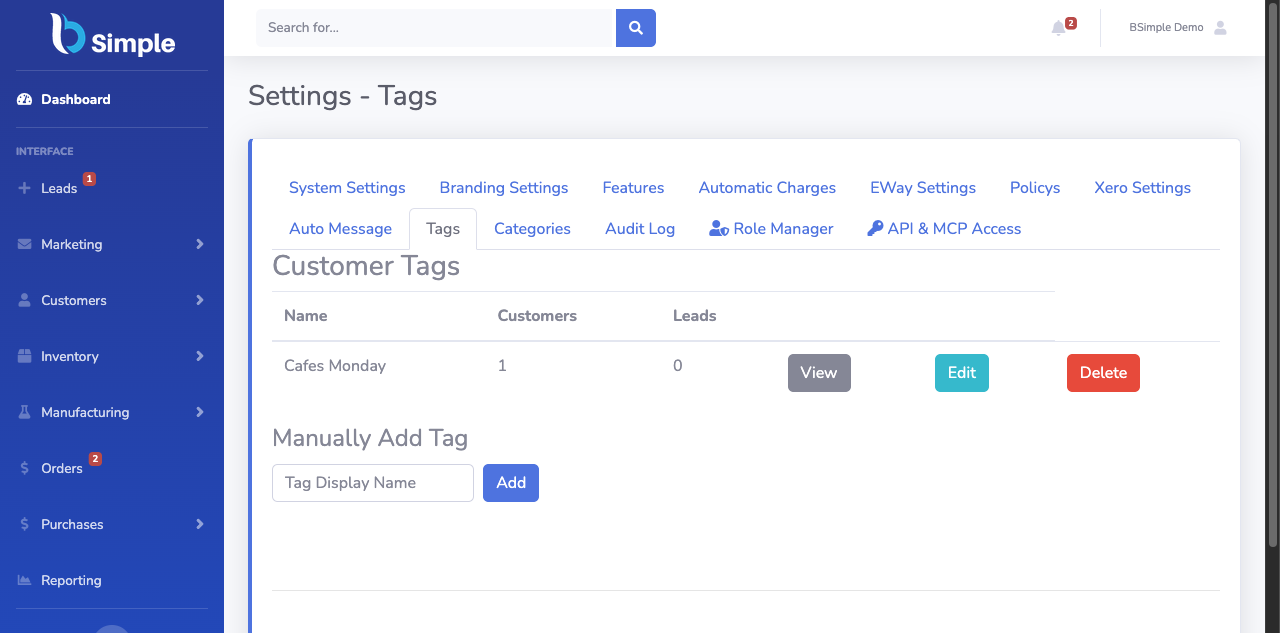
We build BSimple, so weigh that. It is not project management software: no schedules, no RFIs, no variations or claims. What it runs is the materials-and-trade record that construction businesses need underneath the project layer: live inventory across the yard, the warehouse and vehicles-as-locations; purchase orders raised from demand against reorder levels; supplier invoices reconciled with GST handling; customer invoicing with the accounting handoff to Xero or MYOB; and projects that group inventory and on-site assets under a customer — reserve materials against a job without consuming them, consume on invoice approval, and carry warranty and service history for the installed asset afterwards.
For builders and trades, that projects machinery is the part most often missing from their stack — materials and installations tracked per job, per customer. Construction management for small business and small business job management cover the trade side in depth, work order management the servicing half, and the trial runs one real job through reserve-consume-invoice.
Frequently Asked Questions
What software do construction companies use?
Four categories: project management platforms (schedules, RFIs, document control), estimating and takeoff, field coordination tools, and accounting with job costing. Materials and trade-work records sit underneath all four.
Is BSimple construction management software?
Not in the project-scheduling sense — no programmes, RFIs or claims. BSimple runs the materials and trade record: inventory, purchasing, invoicing, and projects that track installed assets and parts per job and customer.
Can BSimple do job costing?
It tracks materials and work per project against each customer, and invoices flow to accounting where costing is finalised. Construction-grade job costing with variations and progress claims lives in construction accounting tools — we would rather state that than overclaim.
Does BSimple track tools and equipment left on site?
Yes — that is the projects machinery: on-site assets registered under the customer with warranty, maintenance and service history, alongside the parts consumed per job.
What does it cost?
Starter $180, Professional $250 and Organisation $399 per month (AUD), projects included in the core plans. The trial runs a real job through the loop before any decision.
BSimple