
Guide / the tools in use
What software is used for inventory management?
Walk any product business and you will find the same stack in different proportions: a spreadsheet, some scanning, a system of record, maybe an ERP. Here is who uses what, and why.
The short answer
- Everyone starts in a spreadsheet — the default inventory software of the world.
- Growing businesses add scanning — phone apps or wedges — which improves input but not the record.
- Product businesses graduate to a system of record — stock, orders, purchasing and invoicing as one live record.
- Large organisations run ERPs — with the administrators that implies.
- 01The short answer
- 02The stack, as it is actually used
- 03Why the system of record wins
The stack, as it is actually used
The spreadsheet appears in every business at every size — sometimes as the system, sometimes as the shadow beside the real one. It holds lists well and promises badly. Scanning tools are the next layer: phone camera apps or desk wedges feeding whatever record exists. They make input fast and accurate — and expose rather than fix a weak record, because a fast scan into a stale sheet is still a stale sheet. Systems of record — business management software like BSimple — are where growing product businesses land: quantities, orders, purchasing and invoicing as one live record, with the accounting handoff designed in. ERPs are the end of the scale, run by organisations that can staff them.
The proportion is what defines a business: a market stall runs on the spreadsheet; a wholesaler with a van fleet lives in the system of record; a manufacturer adds recipes and batches to the same record. Which software businesses use, by stage sorts the same stack by company stage.
Why the system of record wins
The spreadsheet and the scanner are input tools; the system of record is a memory — quantities that update as goods move, allocation that stops double-promises, history that explains any number later, levels that turn demand into purchase orders. When businesses describe their software stack honestly, the pain lives in the seams: what the spreadsheet knows that the scanner app does not, what the invoicing tool re-keys. A single record removes the seams instead of managing them.
That is the honest answer to "what software is used": the businesses that run well use one record, and the tools around it feed it. BSimple is such a record for small-to-medium wholesale, manufacturing, distribution and trade businesses — from $180/month (AUD) with a free trial. The types of inventory software break the category down, and the inventory management overview shows the record itself.
Frequently Asked Questions
What do most small businesses use for inventory?
Spreadsheets first, honestly — then either channel-attached tools (POS, store platforms) if they are single-channel, or a system of record once stock moves through suppliers, orders and multiple hands. The stack usually reveals the business: the seams between tools are where its time goes.
Is a barcode app enough on its own?
No — scanning is input, not a record. A scanner app that does not write to live quantities, allocation and history improves typing speed and nothing else. The app question is downstream of the record question: decide what the scans should change, then choose the input.
What does BSimple replace in that stack?
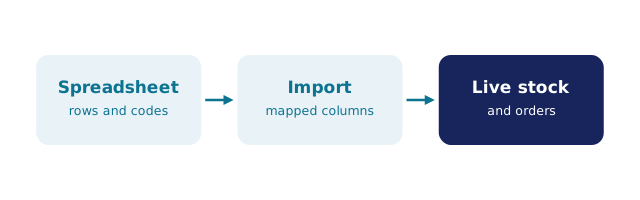
The spreadsheet-as-record and the seams around it: stock, orders, purchasing, invoicing and the customer portal become one record, with the accounting handoff to Xero or MYOB built in. It deliberately does not replace the accounting system, POS or HR tools — different jobs.
How do we know we have outgrown our current stack?
When the seams cost more than the licence would: re-keying between tools, quantities that disagree, orders promised on stale numbers. That arithmetic, done honestly, is the trigger — the vendor evaluation guide turns it into a trial process.
BSimple