
Guide / software types
The five types of inventory management software
Most software fits one of five types, defined by what it manages beyond the stock itself. Here is what each type does, who it suits, and how to tell which one your business needs.
The types at a glance
- Basic stock trackers — quantities and counts; nothing else moves.
- Order management systems — stock plus the workflow of selling it: orders, picking, invoicing, customer portals.
- Purchasing and procurement systems — stock plus the workflow of buying it: demand, purchase orders, supplier reconciliation.
- Production systems — stock plus making things: recipes, bills of materials, batches and traceability.
- ERP suites — all of the above plus HR, payroll and MRP scheduling, at enterprise cost and complexity.
- The wider system: inventory management end to end maps the whole record this page sits in.
Type 1: basic stock trackers
The floor of the category: live quantities, locations, and counts. Nothing enforces a workflow because there is no workflow — no orders, no purchasing, no invoices. This type suits operations where stock is tracked but the selling and buying happen elsewhere: a storeroom, an equipment pool, a workshop shelf.
Its ceiling is low and reached quickly. The moment someone asks "can we reserve this for the Jones order?" or "did we already reorder this?", the tracker has no answer, and the workarounds start living in email and spreadsheets.
- 01The types at a glance
- 02Type 1: basic stock trackers
- 03Type 2: order management systems
- 04Type 3: purchasing and procurement systems
- 05Type 4: production systems
- 06Type 5: ERP suites — and how to tell what you need
Type 2: order management systems
The next type adds the selling workflow: orders taken against live stock, picking and packing, invoices, and increasingly a portal where customers order themselves. Stock and orders share a record, so overselling becomes structural rather than a vigilance problem — an order allocates what is really there.
This is the type for wholesalers, distributors and any business whose day is order-driven. What order management software covers is its own topic; the short test is whether pick, pack and invoice run off the same record the stock levels come from.
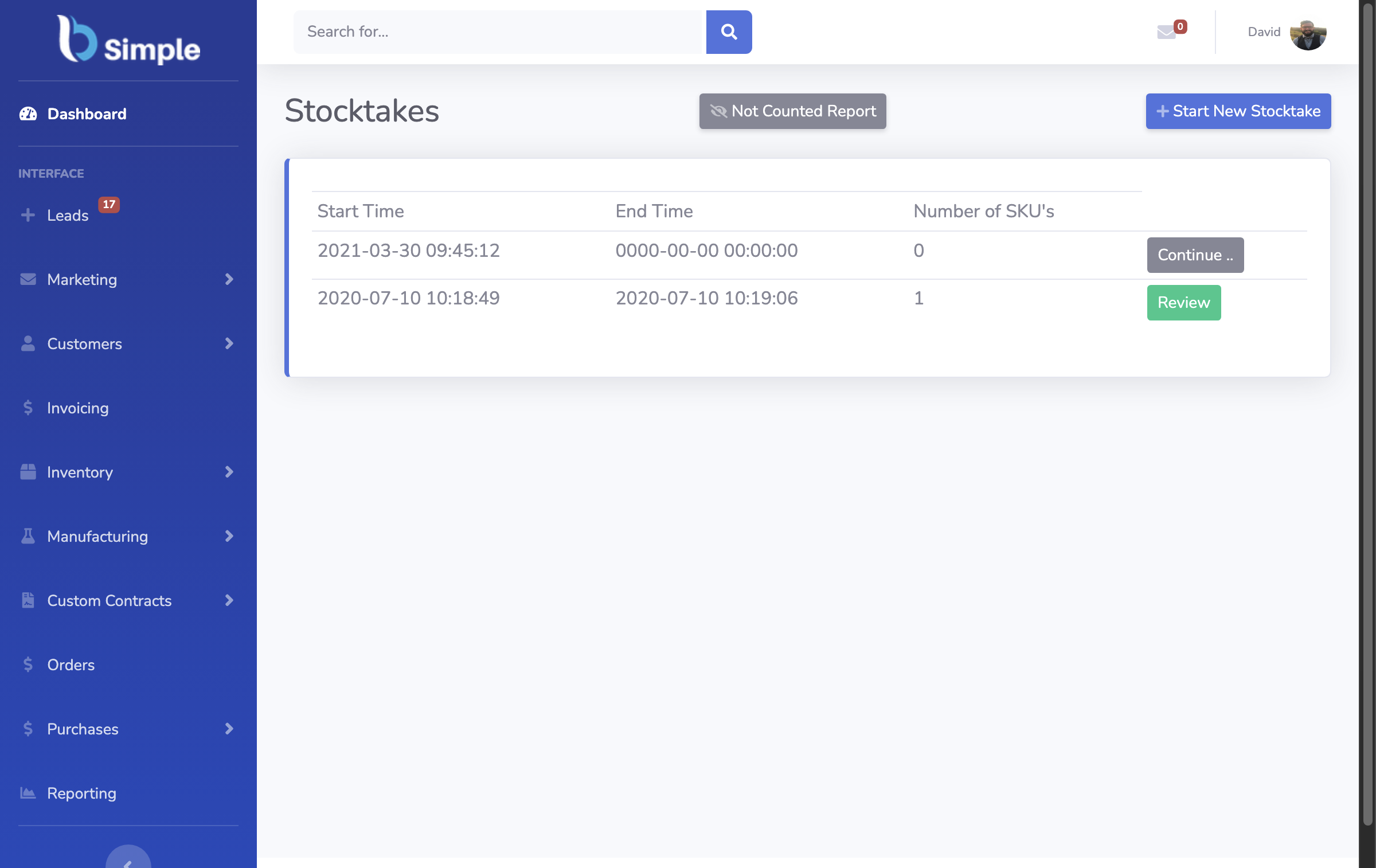
Type 3: purchasing and procurement systems
The mirror image of type 2: the buying side. Demand signals drive purchase orders, goods receipts update stock, and supplier invoices reconcile against what was ordered — including tax handling, which in Australia means GST-inc and ex-GST views.
Businesses rarely buy this type alone; purchasing without the stock and order record it feeds is half a system. The inventory-and-procurement pairing covers what the combined version should do, and it is the version BSimple implements: purchase orders raised from demand, goods received updating quantities, supplier variances flagged.
Type 4: production systems
For businesses that make what they sell: multi-level bills of materials, recipe versioning, production runs with shortage checks, batches with use-by dates, and traceability that can follow a lot from supplier to customer. Done properly, production consumes component stock and creates finished-goods stock on the same record the orders run against.
Food, beverage and cosmetics manufacturers usually end up here, and often for compliance reasons as much as efficiency — mass-balance reporting and traceability search are the features auditors ask about. BSimple includes recipes, production runs and batch tracking in every plan, and batch tracking software covers that capability in detail.
Type 5: ERP suites — and how to tell what you need
The ERP type bundles inventory, orders, purchasing, production, plus HR, payroll and MRP scheduling, with the configuration and administration to match. It is the right answer for organisations that need those extras and have staff to run them — and the wrong answer for businesses that mainly need their stock, orders and purchasing to stop disagreeing.
The way to find your type is to name your failure, not your aspiration. Overselling points to type 2. Reordering by memory points to type 3. Batch and expiry questions point to type 4. "All of it, plus payroll" points to type 5. BSimple is types 1–4 on one record, deliberately not type 5 — inventory software versus ERP draws that line in detail. Start with the free trial to see which side of the line your business sits on.

Frequently Asked Questions
What type of software is BSimple?
Types 1–4 combined on one record: live multi-location stock, an order workflow with a customer ordering portal, purchasing with GST-aware supplier reconciliation, and recipes and batch production — with invoicing that hands off to Xero or MYOB. It is deliberately not type 5: no MRP scheduling, no HR or payroll, no ERP administration overhead.
Can one product cover more than one type?
Yes, and it usually should — the types share the same underlying record, so splitting them across tools recreates the sync problems software exists to remove. The question worth asking a vendor is whether the extra capabilities are native or modules synced at arm's length, because only the first keeps one version of the truth.
Which type does a small wholesale business need?
Usually type 2 with the purchasing half of type 3: orders against live stock, picking and invoicing, and purchase orders raised when stock dips below reorder levels. Production features are only needed if you make what you sell. That combination is BSimple's core, from $180/month (AUD).
Is a basic stock tracker ever the right choice?
Genuinely, yes — for a storeroom, an equipment pool, or any stock that is tracked but not traded. If nothing orders against the stock and nothing sells it, a tracker is honest value. The mistake is choosing one for a trading business and discovering the missing workflow within a month.
BSimple