
Guide / warehouse list
A warehouse software list, grouped by what the room needs
Lists rank products; rooms need types. Here is the warehouse software market grouped by what it actually manages — with the test that tells you which group to shop in.
The list, in one view
- Location-and-count tools: live stock per location, receiving, stocktakes — the floor of the category.
- Pick-and-pack systems: orders, allocation, picking, packing slips, invoicing — the SME core.
- Dedicated WMS: slotting, wave planning, labour management — for big rooms with congestion.
- Connected records: the business management system that makes the warehouse one part of one truth.
- 01The list, in one view
- 02The groups, and who each serves
- 03The shortlist test per group
The groups, and who each serves
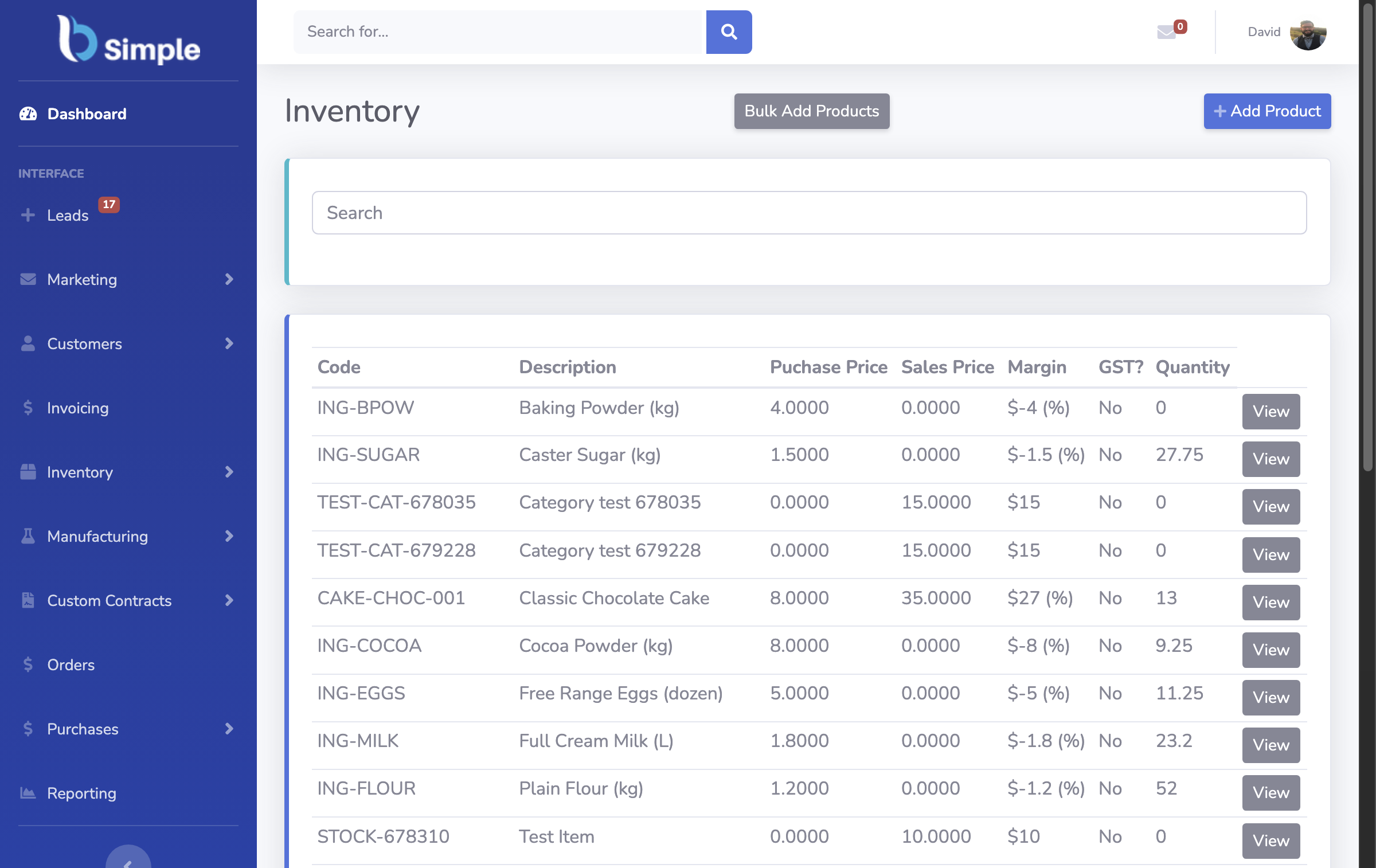
Location-and-count tools solve the oldest problem: what is where, and is it true. Good enough for storerooms and equipment pools where nothing sells against the stock. Pick-and-pack systems are the SME warehouse core: orders allocate from live quantities, picking runs against the order, packing slips and invoices carry the same numbers. Most small-to-medium product businesses need exactly this group — and buying beyond it mostly buys configuration burden. Dedicated WMS adds optimisation: slotting, wave planning, labour tracking, automation control. It earns its cost when the room congests — multiple pickers, thousands of lines a day, machinery to drive. Connected records are the business management systems where the warehouse is one part of the record: purchases in, orders out, accounting handed off — the group BSimple sits in.
The honest way to use any list: identify your group first, then compare products inside it. A wholesale business reading a WMS list is shopping two categories above its problem — the warehouse types guide walks that boundary.
The shortlist test per group
For location-and-count tools: can two people count at once, and does the record update in real time? For pick-and-pack systems: does the pick see live allocations — can the same unit be promised twice? Run a partial shipment through it. For WMS: does the congestion you actually have justify the configuration it needs — be honest about volumes. For connected records: does the warehouse share one record with purchasing and invoicing, and does the accounting handoff push on approval and mirror payment status back?
BSimple sits in the connected-records group — pick-and-pack, locations, counts and purchasing on one record with the Xero/MYOB handoff — from $180/month (AUD) with a free trial to run your own week against it. The Australian warehouse guide adds the local layer, the vendors guide names what to ask each seller, and the inventory management overview shows the record the groups compete to hold.
Frequently Asked Questions
What is the most popular warehouse management software?
Popularity follows the group: spreadsheets by raw count, channel-attached tools by retail, business management systems by wholesale and distribution fit. The list that matters groups by what your room needs first — popularity inside the wrong group is irrelevant.
How many products should we shortlist?
Three, all from the same group. Group-hopping in a shortlist guarantees incomparable demos; three from one group with the same test run on each produces a decision you can still defend a year later.
When do we outgrow the SME groups?
At congestion: multiple pickers whose paths need sequencing, storage that needs slotting, automation that needs driving. Until then, the connected record — locations, picking, counts, purchasing — does the daily job, and the WMS conversation can wait.
Where does BSimple sit on this list?
In the connected-records group: the warehouse loop on one record with orders, purchasing and invoicing, plus the accounting handoff — from $180/month (AUD). It is deliberately not a dedicated WMS; the types guide shows where that line sits.

BSimple