
Guide / warehouse software
Which software is used for warehouse management?
Most small-to-medium warehouses run inventory software with locations, picking and counts — not a dedicated WMS. Here is where the line sits, and how BSimple covers its side of it.
The short answer
- SME warehouses mostly run inventory software, not WMS — locations, live quantities, pick/pack and stocktakes cover the daily job.
- Dedicated WMS adds the big-room extras — slotting, wave planning, labour management — and earns its cost at scale.
- The warehouse cannot run alone: goods in, orders out and purchasing must share the stock record.
- BSimple covers the SME side: multi-location stock, pick and pack, purchase orders, stocktakes from any phone browser.
- 01The short answer
- 02What a small-to-medium warehouse actually does all day
- 03Where a dedicated WMS earns its place
- 04Where BSimple fits
What a small-to-medium warehouse actually does all day
Strip away the software question and the warehouse job is a loop: goods arrive against a purchase order and get put away; customer orders come in and get picked, packed and invoiced; quantities move between shelves or sites; and periodically everything is counted. Software "for the warehouse" is whatever keeps that loop accurate — and for the small-to-medium operations BSimple is built for, that is an inventory system with real stock control, not a standalone warehouse product.
The loop's enemies are the same everywhere: a receipt recorded hours after it happened, a pick against quantities that were already promised, a count that discovers what the record should have known. The fix is shared, live records — which is a property of how the software connects to orders and purchasing, not of the warehouse module in isolation. The inventory management overview shows that connection.
Where a dedicated WMS earns its place
A warehouse management system is a deeper product for a bigger room. It decides where stock lives (slotting), sequences picking across many orders at once (wave and batch planning), tracks pick paths and labour, and often drives automation. Those features pay for themselves when the operation has the volume to exploit them — multiple pickers working simultaneously, thousands of order lines a day, or machinery the software must talk to.
Below that volume, a WMS tends to add configuration burden without changing the outcome. The honest test: if your picking currently works with one or two people and a phone, and your receipts fit a purchase-order check, an inventory system with locations and pick/pack does the job — and the WMS conversation can wait until the operation outgrows it.
Where BSimple fits
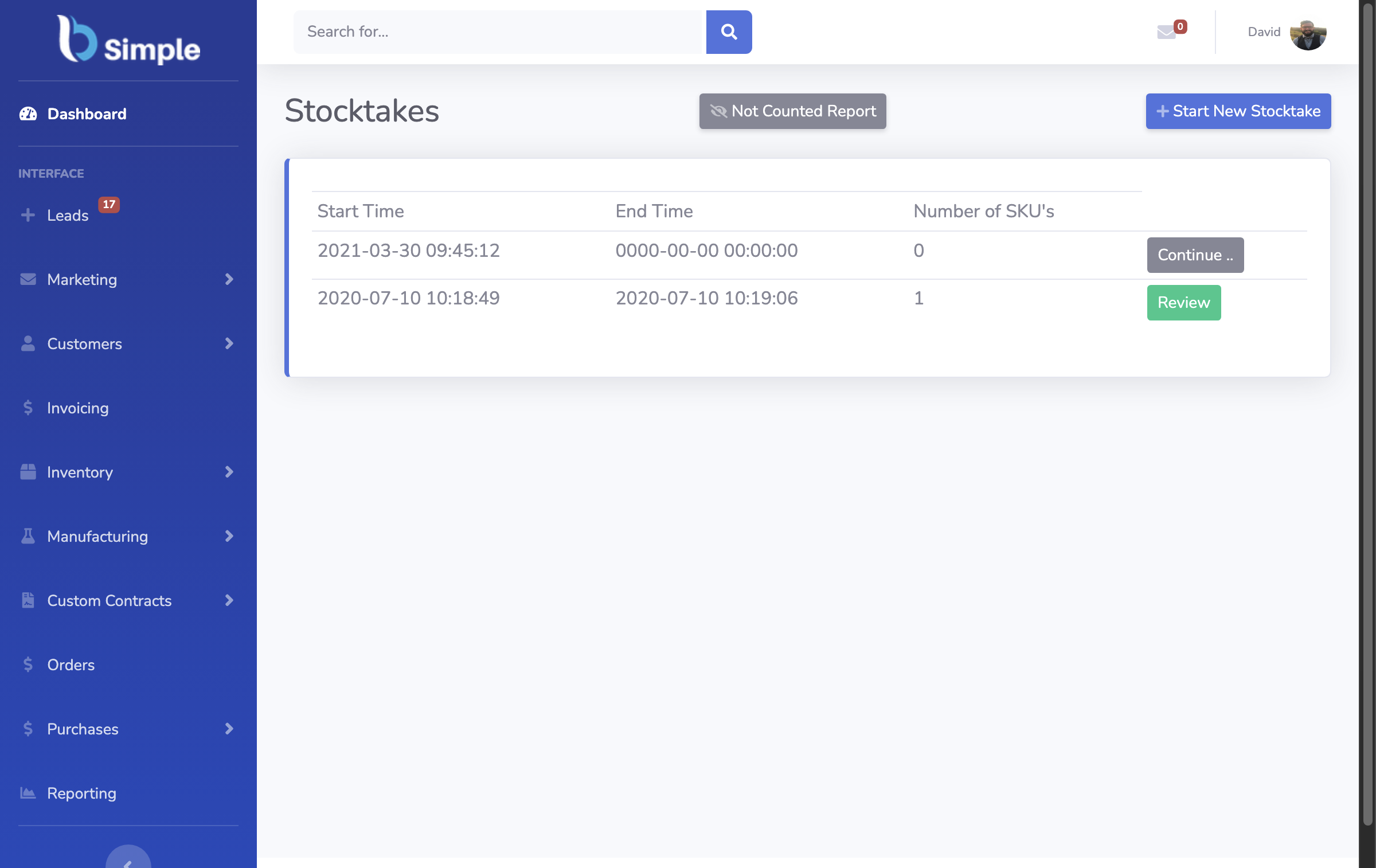
We build BSimple, so weigh that. It runs the SME warehouse loop end to end: goods received against purchase orders update live quantities; orders allocate, pick and pack off the same record, with packing slips; stock moves between locations with a trail; stocktakes and cycle counts run from any phone browser, with scanning through the camera. Because purchasing, orders and stock share the record, the warehouse never works from a copy. Plans start at $180/month (AUD), with a free trial to run one week of your real workflow against it.
The boundary, plainly: BSimple is not a dedicated WMS — no slotting optimisation, no wave planning, no automation control. If your operation has reached that scale, the WMS is the right next purchase. For the broader comparison of who sells what, the warehouse software vendors guide and which software businesses use for inventory map the field honestly.
Frequently Asked Questions
Is inventory software enough to run a warehouse?
For a small-to-medium operation, usually yes: locations, live quantities, picking, receiving and counts are the daily job. A dedicated WMS becomes worthwhile when volume justifies slotting, wave planning or automation — the features that optimise a big room, not just record it.
Does BSimple track multiple warehouse locations?
Yes. Stock quantities are live across locations, transfers between sites leave a trail, and every movement is attributed. That covers the common SME pattern — a main warehouse, a storeroom, goods on vans — without a separate warehouse product.
Can the warehouse staff use BSimple without training?
The floor workflows are deliberately simple: open the order or purchase order, scan or count, confirm — from a phone browser, nothing to install. What the warehouse team should never have to do is reconcile the stock record against another system, because in BSimple there is only one record.
When should we move from inventory software to a WMS?
When the room outgrows the record: multiple pickers whose paths need sequencing, storage that needs optimising, or automation that needs driving. The signal is not headcount but congestion — if picking still works cleanly and the record is accurate, inventory software is still doing its job.
BSimple