
Guide / स्टॉक प्रबंधन
Stock inventory management system, in Hindi and English
स्टॉक प्रबंधन प्रणाली — a stock inventory management system — is the same machine in any language: one true record of what came in, what went out, and what must be ordered next. The cycle explained in Hindi terms, with an honest note on language.
The key facts
- The Hindi vocabulary maps cleanly: स्टॉक (stock), इन्वेंटरी (inventory), आवक (inward/receipt), जावक (outward/dispatch), पुनः आदेश (reorder) — the system underneath is language-independent.
- The daily cycle: आवक raises quantities, जावक lowers them against real orders, गिनती (counting) keeps both honest, पुनः आदेश starts the next purchase before the shelf empties.
- The honest boundary: BSimple's interface and support are English — we do not claim a Hindi localisation, and any page promising one should be read with care.
- Accounting stays local: BSimple hands invoices to Xero and MYOB (US integrations rolling out); India-specific tax filing stays with your local accounting system.
- 01The key facts
- 02The daily cycle — आवक, जावक, गिनती, पुनः आदेश
- 03What separates a system from a spreadsheet register
- 04The language and accounting questions, answered plainly
The daily cycle — आवक, जावक, गिनती, पुनः आदेश
आवक (inward). Goods arrive against a purchase order; quantities rise per location and per lot. On paper this is a register entry; in a system it is a receipt that the rest of the record sees immediately — which is what stops "the register says 40, the shelf says 30".
जावक (outward). Stock leaves against a real order, not a favour: the dispatch (चालान) is produced from the same record the order was taken on, and the quantity drops the moment the goods move. When outward happens without a record, the system's truth and the shelf's truth part ways within days.
गिनती (counting). Cycle counts and year-end counts with variances flagged for review — not a festival of clipboards whose results nobody trusts. Every adjustment lands on the record with a reason.
पुनः आदेश (reorder). Par levels per product generate the next purchase order before the shelf empties, with incoming stock visible so you do not double-order what is already on the road.
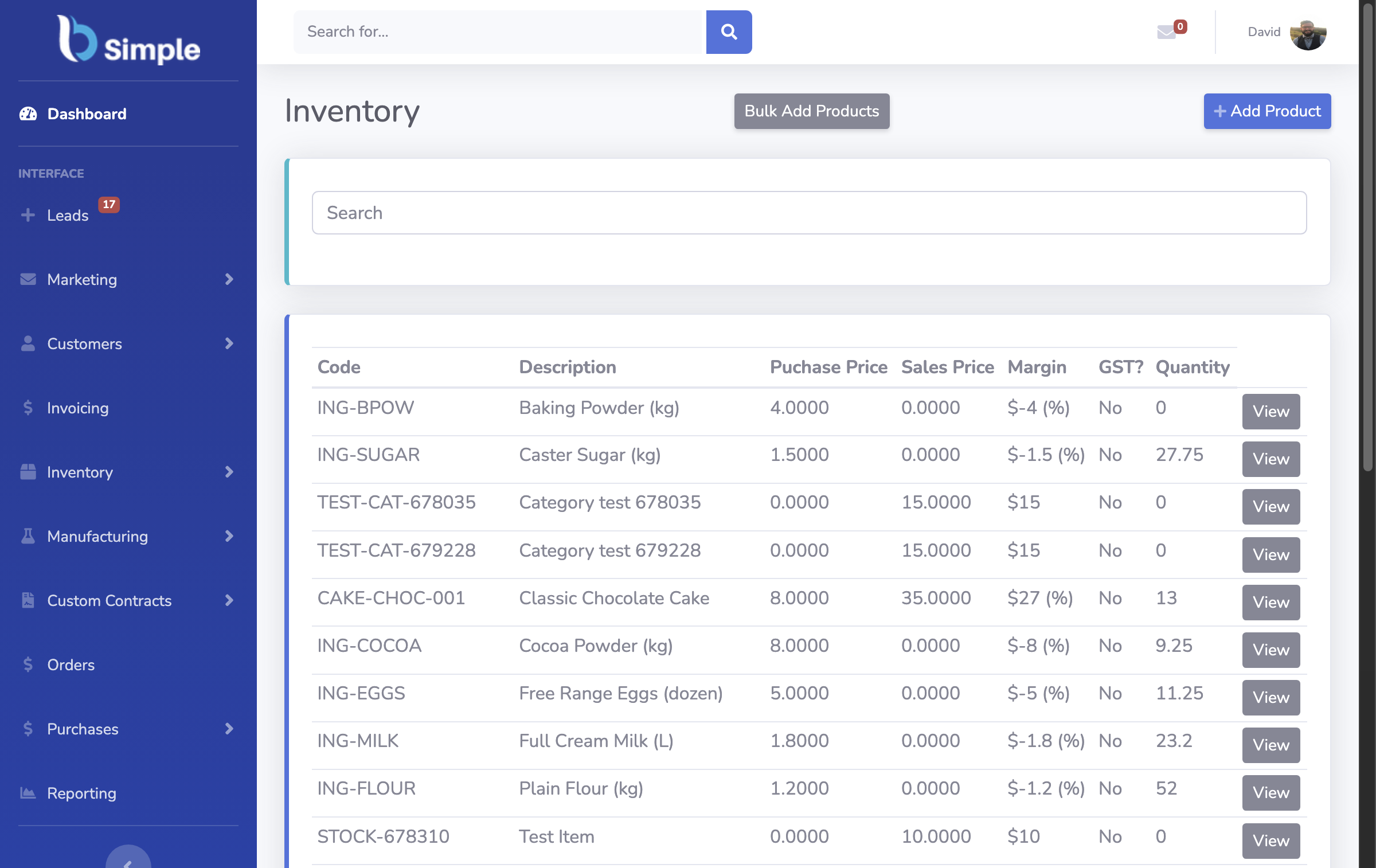
What separates a system from a spreadsheet register
The spreadsheet fails the same way in every language: it records what someone remembered to type, after the fact, in one place. A stock system records movements as they happen, per location, with the order and the receipt and the dispatch all pointing at the same product — so the answer to "कितना स्टॉक है?" (how much stock is there?) is one number, not three versions of it. Add a second location — a godown and a shop, or a van — and the spreadsheet version of that question becomes a phone call.
The warehouse examples in Hindi page walks two setups (the wholesale godown and the factory store) through this same vocabulary; the inventory guide is the full picture in English.
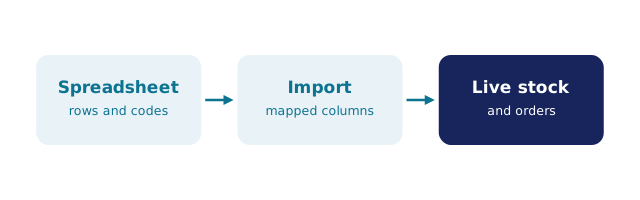
The language and accounting questions, answered plainly
We build BSimple, so weigh that. Its interface, documentation and support are in English — we do not claim Hindi localisation, and we would rather lose a trial now than a customer in month three. Teams that work bilingually commonly run the system in English alongside Hindi-speaking floor processes, but that is a test to run with your own staff during the free trial, not to assume from a feature list.
On accounting: BSimple holds the operational stock record and hands reviewed invoices to the accounting system — established with Xero and MYOB, with US accounting integrations rolling out. India-specific GST filing and statutory books stay with your local accounting system or accountant; BSimple does not replace them, and a vendor who claims otherwise for any country deserves suspicion. For the category view, the best stock management software for small business comparison applies in any market.
Frequently Asked Questions
स्टॉक प्रबंधन प्रणाली क्या है?
यह एक ऐसी प्रणाली है जो हर वस्तु का सटीक रिकॉर्ड रखती है — कितना आया, कितना गया, कहाँ रखा है, और कब और ऑर्डर करना है। In English: one live record of receipt, issue, counting and reorder, shared by everyone who touches the stock.
Does BSimple have a Hindi interface?
No — English only, stated plainly. The concepts above are language-independent, and the trial is the honest way to see whether your team works well in an English-interface system before any money changes hands.
Can it handle godown and shop as separate locations?
Yes — multiple locations each hold real quantities, and moves between them are recorded transfers. The shop can see godown stock before promising a customer, which is the whole point of one shared record.
Will it work for GST filings in India?
BSimple does not do tax filing anywhere — accounting compliance stays in the accounting system. The operational record (stock, orders, purchase reconciliation) is the layer BSimple runs; the statutory books are not, for any country.
How do we evaluate with a mixed-language team?
Run the trial with the actual floor staff who will use it daily, on real products, and watch where language friction appears. If the floor cannot record a receipt without help, the system is wrong for your team — whatever the feature list says.

BSimple