
Guide / self-hosting
Self-hosted business management software — the honest trade
Self-hosting buys control and data sovereignty with your own server time and skills. What the model really trades, who it suits, and why BSimple is cloud-only, stated plainly.
The key facts
- Self-hosting means running the software on your infrastructure: control, sovereignty, no per-seat vendor — plus updates, backups, security and support as your job.
- The honest comparison is total cost over two years: licence or subscription versus server, skills and the tail.
- BSimple is cloud-only — no self-hosted edition, stated plainly rather than softened.
- The genuine self-hosting wins: data sovereignty requirements, deep customisation, and teams that already run infrastructure well.
- 01The key facts
- 02What self-hosting really trades
- 03Who self-hosting genuinely suits
- 04BSimple's position, stated plainly
What self-hosting really trades
You gain: the data on your hardware under your policies; no vendor deciding uptime, upgrades or shutdown; customisation down to the code (with open source) or configuration (with licensed on-premise); and per-seat fees replaced by infrastructure costs. For organisations with sovereignty requirements, regulatory constraints, or strong internal IT teams, these are real advantages — not nostalgia.
You pay: a server and its failure modes (power, disk, backups that get tested — or do not); updates that become projects; security that is now your incident; and the quiet accumulation of one-truth risk — the unpatched system that "still works" is the one whose quantities nobody fully trusts. The on-premise trade-offs apply the same arithmetic to licensed software; self-hosting open source adds the open-source ledger — free licence, paid sysadmin.
Who self-hosting genuinely suits
Teams that already run infrastructure: if servers, backups and monitoring are existing competence, self-hosting adds a workload, not a capability gap. Organisations with sovereignty mandates: where policy or regulation requires data on your hardware, the trade is made for you. Businesses with genuine customisation needs: deep changes to workflow or data model that no SaaS product will make.
The unsuit signals are equally clear: no named person who owns the server; "the cloud" feared on instinct rather than evidence; and a business whose real problem is stock truth, not architecture. For most small and mid-size operations, the record — live, shared, auditable — matters more than where it runs, and vendor-run infrastructure is the lower-risk path. The trust conversation is the better test than architecture preference.
BSimple's position, stated plainly
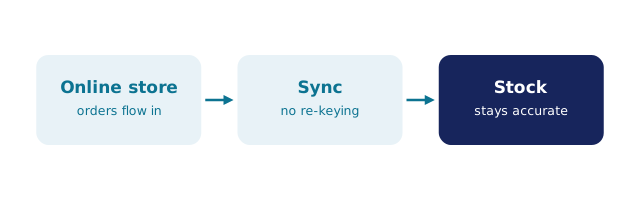
We build BSimple, so weigh that: it is cloud software with no self-hosted edition — and we would rather lose the requirement here than promise a product that does not exist. What the cloud model buys a wholesale, manufacturing, distribution or trade business: one live record across every site and device, barcode scanning and portals without installation, updates and backups as the vendor's job, invoices crossing to Xero or MYOB (US integrations rolling out), and a public REST API keeping your record readable — no one-way doors, even in someone else's cloud. Plans run $180/$250/$399 per month AUD, with the trial as the full product. The offline variant of this requirement has its own honest page.
Frequently Asked Questions
Does BSimple offer a self-hosted version?
No — cloud only, browser-based, stated plainly. We do not sell a self-hosted edition and will not pretend otherwise to close a sale.
Is self-hosted software cheaper than cloud?
The licence is often free or lower; the total usually is not — servers, skills, updates and incident response add up. Price two years of both honestly, including the tail, before believing either headline.
What data sovereignty requirements force self-hosting?
Genuine ones exist — contracts or regulations requiring data on specified hardware. Note that many are satisfied by vendor attestations and hosting-region guarantees; verify what your requirement actually says before designing around it.
Can we export everything from BSimple if we leave?
Yes — imports and exports are standard, and the public REST API (read projections with scoped keys) keeps your record readable continuously. The exit door is part of the product, not a negotiation.
How do we decide between self-hosting and cloud for our business?
Score three things honestly: a real sovereignty or connectivity requirement; named people who will own the infrastructure; and the true two-year cost of both paths. The trial shows what the cloud side delivers on your products.

BSimple