
Guide / open source
Open source manufacturing inventory management software
Genuinely open-source manufacturing inventory projects exist, and some are good — but manufacturing is where the free route breaks hardest: bills of materials, batch traceability and shortage checks are rare in community code. What to check, what to expect, and where BSimple stands.
The key facts
- What exists: open-source inventory and ERP-class projects with manufacturing modules — real code, real licences, real communities of varying size.
- The manufacturing gap: multi-level bills of materials, shortage-checked production runs, batch/use-by tracking and mass-balance reporting are the features community projects most often lack or half-finish.
- The inherited tail: hosting, patching, backups, upgrades and every missing feature become yours — a manufacturing record is the wrong place to learn that lesson cheaply.
- BSimple is not open source: commercial cloud software with recipes, batches, traceability and mass balance in the core plans; this page assesses the open-source route honestly rather than dismissing it.
- 01The key facts
- 02What the open-source route actually offers
- 03The four checks before trusting a project with production
- 04BSimple's position, stated plainly
What the open-source route actually offers
The serious projects fall into two groups: dedicated inventory applications with movement-based stock records, and ERP-class suites whose manufacturing modules add bills of materials and work orders. Both are legitimate software with real communities, and both cost nothing to license. For a developer learning how manufacturing inventory works, or a workshop with one technical person and simple needs, they can be exactly the right tool.
The pattern to expect at the manufacturing edge is unevenness. Plain stock control — products, quantities, locations — is well covered. The moment the requirements turn into "this recipe consumed those batches and must be traceable backwards", coverage thins: multi-level BOMs exist in some suites, shortage checks before a run commits in fewer, and mass-balance reporting for certification audits is rare enough that businesses usually bolt it on with spreadsheets. That bolt-on is where the free route starts charging.
The four checks before trusting a project with production
The BOM test. Build a two-level recipe — a sub-assembly inside a finished good — and run a production run that should fail on a missing input. Half-implemented work-order code fails this in front of you.
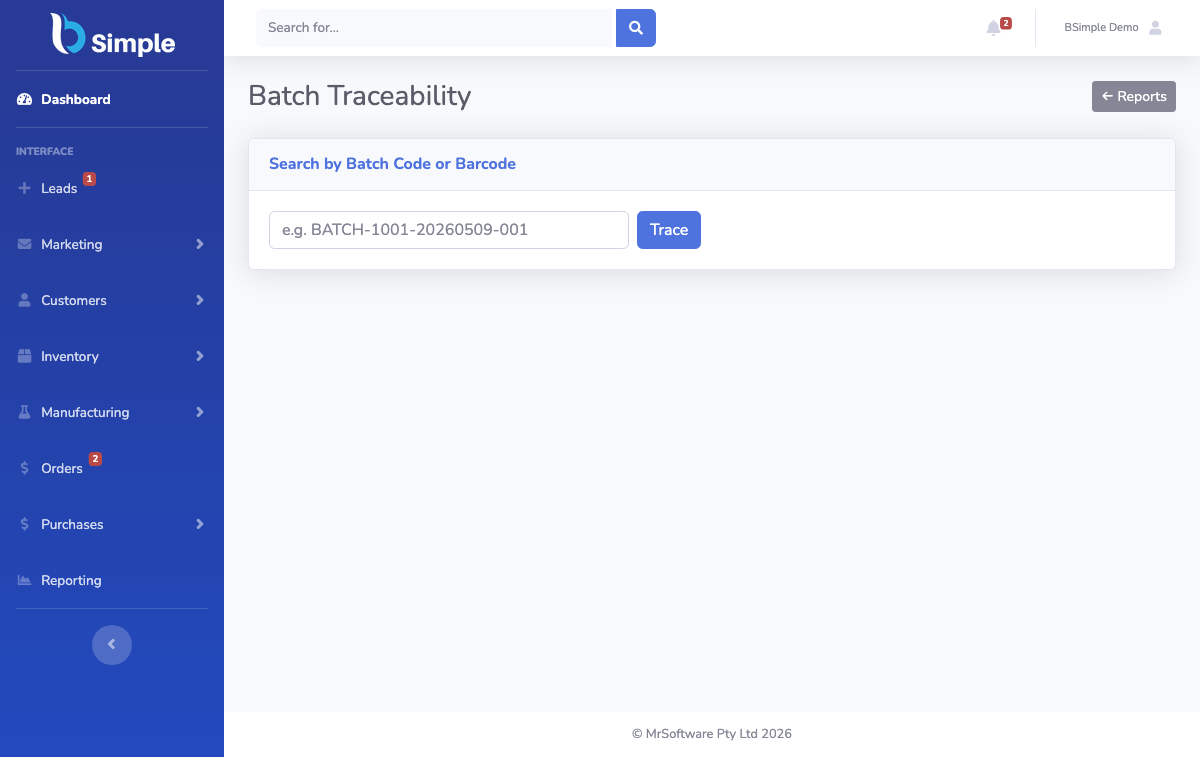
The batch test. Create a batch with a use-by date, ship part of it, then trace backwards from the shipment to the input lots. If the demo hesitates, the recall answer does not exist.
The maintenance test. Commit activity, issue responsiveness, and who specifically owns the deployment: patches, backups, upgrades. Open source is free to license and owned in practice — the field guide covers the repo-level checks.
The handoff test. Follow one sale into your accounting software and count the manual steps. The established integrations in open-source projects skew to generic exports rather than maintained accounting connections.
BSimple's position, stated plainly
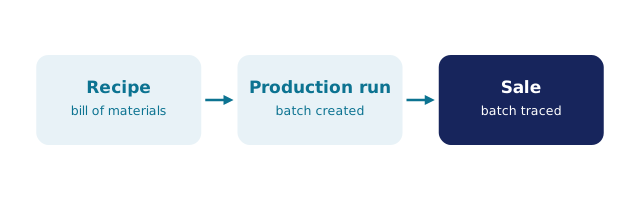
We build BSimple, so weigh that: it is not open source — it is commercial cloud software for wholesale, manufacturing, distribution and trade businesses. The manufacturing layer is in the core plans, from $180/month AUD with no separate module: versioned multi-level recipes, production runs with shortage checks, batches with use-by dates, two-directional traceability search, and mass-balance reporting that existing customers use in organic certification audits (ACO, NASAA, OFC). Around that: purchasing raised from demand, price-variance flags, multi-location stock, ordering portals, and invoicing handed to Xero or MYOB (US integrations rolling out).
The honest comparison: the open-source route trades money for ownership of the tail, and manufacturing makes that tail heavy — the features it most needs are the ones most often missing. The manufacturing capability page shows what a purpose-built layer covers, the build-vs-buy arithmetic prices both routes, and the manufacturing buyer's guide compares the field — the trial runs a real production run before any money changes hands.
Frequently Asked Questions
Is there any good open-source manufacturing inventory software?
Yes — the ERP-class suites with manufacturing modules are genuinely capable, and a workshop with technical ownership can run on them. Run the four checks before committing data; the failures cluster around multi-level BOMs, batch traceability and shortage checks, not basic stock control.
What will open source usually be missing for manufacturing?
Depth features: shortage-checked production runs, use-by date tracking on batches, mass-balance reporting for certification, and maintained accounting integrations. Plain quantity tracking is well covered; the conversion events — inputs becoming traceable outputs — are where the gaps live.
What does running an open-source system really cost?
The licence is free; the tail is not: hosting, security patches, backups, upgrades and the hours of whoever owns it. Price two years of that honestly against a subscription before deciding — the build-vs-buy arithmetic does the sums.
Is BSimple open source?
No. BSimple is commercial cloud software — manufacturing features in the core plans from $180/month AUD, sold directly with a full-product trial. Developers get a public REST API and an MCP endpoint rather than source code.
Can I try the manufacturing workflow before buying anything?
Yes — BSimple's trial is the full product: build a versioned recipe, run a production with a deliberate shortage, create a batch and trace it backwards. The same test script works on any open-source demo, which makes the comparison real.
BSimple